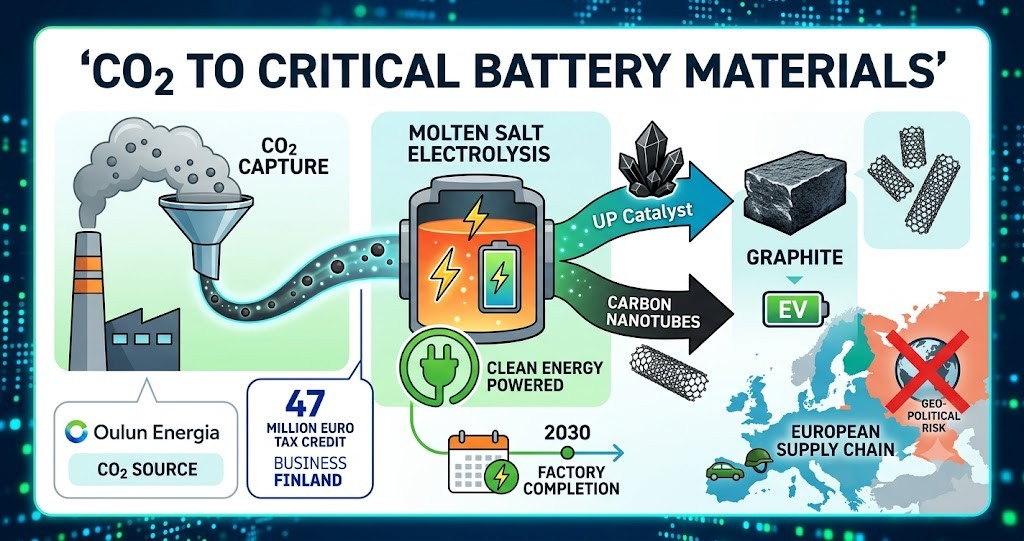
エストニアのディープテック企業であるUP Catalyst社は、フィンランドのエネルギー大手Oulun Energia(オウルン・エネルギア)と提携し、回収した二酸化炭素(CO2)を電気自動車(EV)などのバッテリーに不可欠な「グラファイト(黒鉛)」と「カーボンナノチューブ」に変換する新工場の建設に向けた意向表明書に署名しました。
プロジェクトの詳細とスケジュール
- 技術的アプローチ: 「CO2溶融塩電解」という独自のプロセスを用いて、工場から排出・回収されたCO2から高付加価値の炭素材料を抽出します。
- 生産能力: 年間約2万トンの持続可能なグラファイトおよびカーボンナノチューブの生産を計画しています。
- スケジュール: 2030年末までに建設を完了し、2031年初頭の操業開始を目指します。
- 公的支援: フィンランドの政府機関(ビジネス・フィンランド)は、この事業拡大を支援するため、すでに4700万ユーロの税額控除を付与しています。
関連情報(背景と影響)
1. なぜ「フィンランド」が選ばれたのか
フィンランドは今、欧州におけるバッテリー産業の聖地(バリューチェーンの中心地)として急速に台頭しています。
- クリーンエネルギーの優位性: 豊富な水力や風力、原子力による安価で安定した「脱炭素電力」が利用可能です。二酸化炭素を価値ある材料に変える電解プロセスには大量の電気が必要なため、クリーンで競争力のある電力網が不可欠です。
- 強固な産業エコシステム: フィンランド政府はクリーンテックへの移行を国策として強く後押ししており、今回のような大規模な税額控除(4700万ユーロ)を含めた支援体制が整っています。
2. グラファイト(黒鉛)の重要性と「地政学的リスク」
グラファイトは、EV用リチウムイオン電池の「負極材(アノード)」として絶対に必要な材料です。
- 中国への高い依存度: 現在、世界のグラファイト供給(特に精製・加工プロセス)の約7割から9割を中国が支配しています。中国政府は2023年末からグラファイトの輸出管理を厳格化しており、欧米の自動車・電池メーカーにとって「中国依存からの脱却(デリスキング)」が最優先課題となっています。
- 欧州の自給率向上: 今回のUP Catalystの工場が稼働すれば、欧州域内で完結する持続可能なサプライチェーンが強化され、防衛産業やEV産業の安全保障が大きく向上します。
3. 「環境に優しい黒鉛」という圧倒的メリット
従来のグラファイト生産には2つの方法しかありませんでした。
- 天然グラファイト: 主に中国やアフリカでの鉱山採掘(環境破壊や労働環境の問題が伴う)。
- 人造グラファイト: 石油コークスやコールタールなどの化石燃料を約3000度の高温で焼成するため、膨大なCO2を排出する。 これに対し、UP Catalystの技術は「排出されたCO2を回収して、それを材料に変える」ため、製造プロセス全体で炭素を削減する「カーボンネガティブ」な革新技術として、環境負荷を劇的に減らすことができます。
出典:https://www.bestmag.co.uk/up-catalyst-to-turn-co%e2%82%82-to-graphite-in-finland/
Estonia’s UP Catalyst Launches Large-Scale Project in Finland to Produce Battery Materials from CO2
Estonian deep-tech company UP Catalyst has partnered with Finnish energy giant Oulun Energia and signed a letter of intent to build a new plant. The facility will convert captured carbon dioxide (CO2) into graphite and carbon nanotubes, which are essential materials for batteries used in electric vehicles (EVs) and other applications.
Project Details and Schedule
- Technical Approach: Utilizing a proprietary process called “CO2 molten salt electrolysis,” the company extracts high-value carbon materials from CO2 emitted and captured from the plant.
- Production Capacity: The project plans to produce approximately 20,000 tons of sustainable graphite and carbon nanotubes per year.
- Schedule: Construction is aimed to be completed by the end of 2030, with operations targeted to begin in early 2031.
- Public Support: Business Finland, a government agency, has already granted 47 million euros in tax credits to support this business expansion.
Related Information (Background and Impact)
1. Why Finland Was Chosen
Finland is rapidly emerging as a hub for the European battery industry and a central player in the regional value chain.
- Advantage in Clean Energy: The country offers cheap and stable “decarbonized electricity” backed by abundant hydropower, wind, and nuclear energy. Because the electrolysis process that turns carbon dioxide into valuable materials requires massive amounts of electricity, a clean and competitive power grid is absolutely vital.
- Strong Industrial Ecosystem: The Finnish government strongly backs the transition to cleantech as a national strategy, providing a solid support framework that includes large-scale tax credits like the 47 million euros granted to this project.
2. The Importance of Graphite and “Geopolitical Risks”
Graphite is an absolute necessity as the “anode material” in lithium-ion batteries for EVs.
- High Dependency on China: Currently, China controls roughly 70% to 90% of the global graphite supply, particularly in the refining and processing stages. With the Chinese government tightening export controls on graphite since late 2023, reducing dependence on China (de-risking) has become a top priority for Western automakers and battery manufacturers.
- Boosting European Self-Sufficiency: Once this UP Catalyst plant goes operational, it will strengthen a sustainable supply chain contained entirely within Europe, significantly enhancing security for both the defense and EV industries.
3. The Overwhelming Benefit of “Eco-Friendly Graphite”
Historically, there have been only two ways to produce graphite:
- Natural Graphite: Extracted mainly through mining in China and Africa, which often involves environmental destruction and harsh working conditions.
- Synthetic Graphite: Produced by baking fossil fuels like petroleum coke or coal tar at extreme temperatures of around 3,000 degrees Celsius, which releases massive amounts of CO2. In contrast, UP Catalyst’s technology captures emitted CO2 and transforms it into raw material. This makes it a “carbon-negative” breakthrough that reduces carbon throughout the entire manufacturing process, dramatically lowering environmental impact.

コメント