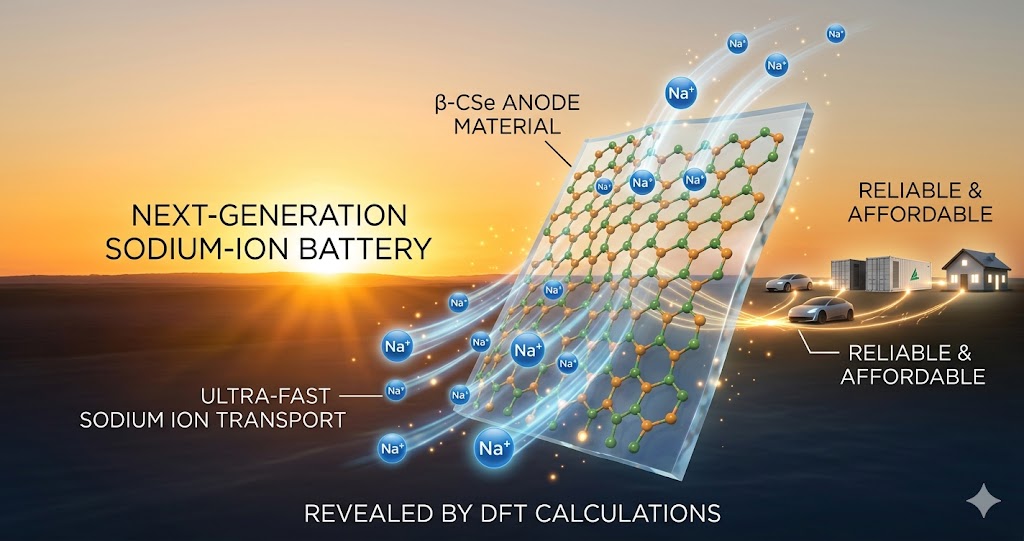
現在、電気自動車(EV)や大型蓄電システムの主役であるリチウムイオン電池(LIB)は、リチウム資源の希少性や価格高騰という大きな壁に直面しています。そこで、資源が豊富で安価なナトリウムを用いたナトリウムイオン電池(SIB)への期待が世界中で高まっています。
しかし、ナトリウムイオンはリチウムよりもサイズが大きいため、従来の電極材料では「動きにくい」「入りにくい」という課題がありました。今回、2026年に発表された最新の研究では、2次元(2D)セレン化炭素(β-CSe)という新材料が、この課題を劇的に解決する可能性を秘めていることが第一原理計算(DFT)による結果より明らかになりました。
1. β-CSeの構造的特徴:なぜ「座屈」が重要か
β-CSeは、炭素(C)とセレン(Se)がハニカム状に並んだ1層のシート状物質です。
- 座屈(Buckled)構造: 完全に平らなグラフェンとは異なり、原子の並びが上下に波打っています。
- 強固な化学結合: C原子とSe原子が非常に強く結びついており、室温(300 K)だけでなく、電池が熱を持つ400 Kという高温下でも構造が壊れない優れた安定性を持っています。
- 電子状態の変化: 本来は半導体ですが、ナトリウム(Na)を取り込むと金属のような性質に変化し、電気を非常によく通すようになります。
2. 驚異のパフォーマンス:数字で見る実力
研究チームが第一原理計算(DFT)を用いて導き出したデータは、既存の材料を圧倒するものでした。
| 項目 | β-CSeの性能 | 比較・解説 |
| Na拡散障壁 | 0.019 – 0.021 eV | 従来のMXeneや黒リンより10倍以上低い。超高速充電が可能。 |
| 理論容量 | 589.22 mAh/g | グラファイト(372 mAh/g)を大きく上回る蓄電能力。 |
| ポアソン比 | 0.05 (Armchair方向) | 極めて低い値。充放電時の体積変化を最小限に抑え、電極の劣化を防ぐ。 |
| 結合エネルギー | -2.954 eV (C側) | ナトリウムが表面に強く均一に付着し、発火原因となるデンドライトを防ぐ。 |
3. 3つの革新的なメリット
① 超高速充電の実現
ナトリウムイオンが移動する際のエネルギーの壁(拡散障壁)が、2D材料の中でも「世界最小クラス」です。これは、スマホやEVの充電時間を劇的に短縮できる可能性を示しています。
② 電池の長寿命化と安全性
「ポアソン比」が極めて低いため、ナトリウムの出し入れによる材料の膨張・収縮がほとんど起こりません。また、ナトリウムが表面で「ダマ」にならず均一に広がるため、内部ショートの原因となるデンドライト(樹枝状結晶)の発生を抑えられます。
③ 外部電場による性能調整
外部から電界(Electric Field)をかけることで、ナトリウムの結合力をさらに強めたり(最大35%向上)、電子の流れを制御したりすることが可能です。これにより、使用シーンに合わせたインテリジェントな電池制御への道が開けます。
4. 結論:実用化に向けた次なるステップ
この研究は、β-CSeが次世代ナトリウムイオン電池の負極材料として「理想的」な特性を備えていることを理論的に証明しました。
今後は、この計算結果をベースに、実際にβ-CSeを合成し、実機レベルでの充放電試験を行う実験フェーズへと進むことが期待されます。リチウム依存からの脱却を目指すエネルギー業界にとって、この新材料はまさに「希望の光」となるかもしれません。
出典:https://www.sciencedirect.com/science/article/pii/S0169433226007154#fig2
2026 Latest Research: 2D Material beta-CSe Theoretically Proven to Have Ideal Anode Properties for Sodium-Ion Batteries
Currently, Lithium-Ion Batteries (LIBs), the mainstay for Electric Vehicles (EVs) and large-scale energy storage systems, face significant hurdles due to the scarcity and rising costs of lithium resources. Consequently, global expectations are rising for Sodium-Ion Batteries (SIBs), which utilize abundant and inexpensive sodium.
However, because sodium ions are larger than lithium ions, they face challenges such as low mobility and difficulty entering conventional electrode materials. A new study released in 2026, using Density Functional Theory (DFT) calculations, has revealed that a novel material called 2D Carbon Selenide (beta-CSe) holds the potential to dramatically solve these issues.
1. Structural Characteristics of beta-CSe: The Importance of “Buckling”
beta-CSe is a single-layer sheet material with carbon (C) and selenium (Se) atoms arranged in a honeycomb lattice.
- Buckled Structure: Unlike perfectly flat graphene, the atomic arrangement waves up and down.
- Robust Chemical Bonds: Strong bonding between C and Se atoms ensures excellent stability, maintaining its structure not only at room temperature (300 K) but also at high temperatures (400 K) typical of operating batteries.
- Electronic State Transition: While originally a semiconductor, it transitions to a metallic state upon incorporating sodium (Na), becoming highly conductive.
2. Extraordinary Performance: The Data
Data derived from DFT calculations outshines existing materials:
| Item | beta-CSe Performance / Comparison |
| Na Diffusion Barrier | 0.019 – 0.021 eV: Over 10 times lower than conventional MXenes or black phosphorus. Enables ultra-fast charging. |
| Theoretical Capacity | 589.22 mAh/g: Significantly higher than graphite (372 mAh/g). |
| Poisson’s Ratio | 0.05 (Armchair direction): Extremely low. Minimizes volume change during cycles to prevent electrode degradation. |
| Binding Energy | -2.954 eV (C-side): Sodium adheres strongly and uniformly, preventing dendrite formation that causes fires. |
3. Three Revolutionary Benefits
I. Achievement of Ultra-Fast Charging
The energy barrier for sodium ion movement is among the lowest in the world for 2D materials. This suggests the possibility of drastically reducing charging times for smartphones and EVs.
II. Long Life and Enhanced Safety
Due to the extremely low Poisson’s ratio, there is almost no expansion or contraction during sodium insertion and extraction. Furthermore, since sodium spreads uniformly without clumping, it suppresses the growth of dendrites (tree-like crystals) that cause internal short circuits.
III. Performance Tuning via External Electric Fields
Applying an external electric field can further strengthen sodium binding (up to a 35% improvement) and control electron flow. This paves the way for intelligent battery management tailored to specific usage scenarios.
4. Conclusion: Next Steps Toward Practical Use
This research theoretically proves that beta-CSe possesses “ideal” characteristics as an anode material for next-generation Sodium-Ion Batteries. The next expected phase is the experimental synthesis of beta-CSe and real-world charge-discharge testing based on these computational results. For an energy industry seeking to move away from lithium dependency, this new material could truly be a “beacon of hope.”

コメント