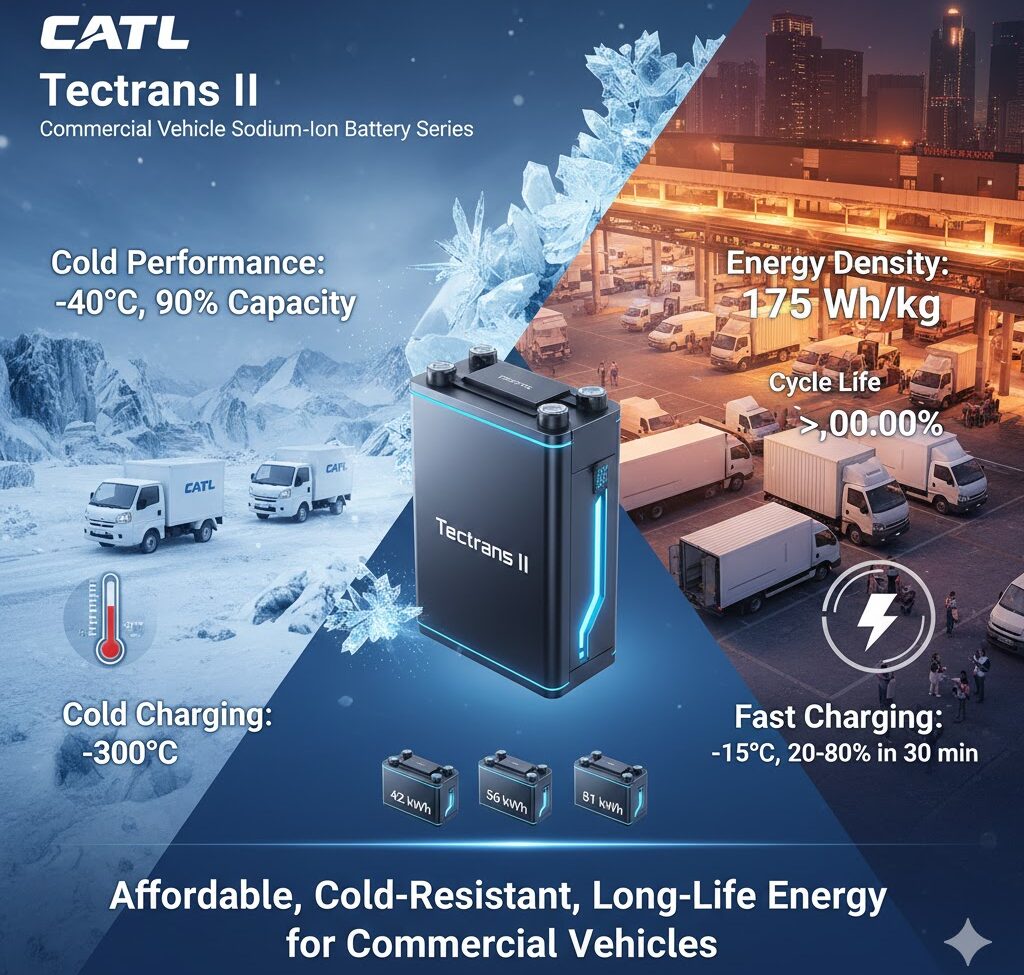
CATLは、主に小型バンやマイクロトラックを対象とした商用車向けバッテリーブランド「Tectrans II(中国名:天行 II)」シリーズを発表しました。その最大の特徴は、リチウムの代わりに安価で豊富なナトリウムを使用し、「低温環境への圧倒的な強さ」を実現した点にあります。
1. 驚異的な耐寒性能と仕様
従来の電池が苦手とする極寒地でも、物流を止めない性能を備えています。
- 耐寒性能: マイナス40度Cの環境下でも、使用可能容量の 90% を維持します。
- 低温充電: マイナス30度Cという過酷な条件下でも、外部電源からの直接充電が可能です。
- 基本スペック: パック容量は 45 kWh。エネルギー密度は 175 Wh/kg に達し、一般的なLFP(リン酸鉄リチウム)電池に匹敵する水準まで向上しています。
- 長寿命: サイクル寿命は 10,000回 を超え、商用車に求められる高い耐久性をクリアしています。
2. 「Tectrans II」シリーズの多彩なラインナップ
ナトリウムイオン電池以外にも、用途に合わせたリチウムイオンモデルが展開されています。
- 超急速充電版: マイナス15度Cでも、30分以内に 20%から80% まで充電可能。
- 長距離版: 最大容量 253 kWh を備え、航続距離 800 km を実現。
- 交換式(スワップ)ブロック: 42 kWh、56 kWh、81 kWhの3サイズを用意し、迅速なバッテリー交換に対応。
【関連情報】背景と市場の展望
「リチウム・ナトリウム」の二本柱戦略
CATLは2026年を「ナトリウム電池の大規模採用の年」と位置づけています。リチウム価格の変動リスクを抑えつつ、安価なナトリウム電池を普及させることで、リチウムイオン電池との「デュアルスター(二本柱)」体制を構築し、市場の全方位をカバーする戦略です。
なぜ「ナトリウム」が注目されるのか?
- 資源の豊富さ: ナトリウムは塩などの形で地球上に無限に存在するため、リチウムのような地政学的な供給リスクが極めて低いです。
- コスト優位性: 材料コストはリチウムの数分の一(将来的には30から50%減)に抑えられると予測されています。
- 安全性: 熱安定性が高く、発火リスクがリチウムイオン電池よりも低いという特性があります。
商用車から乗用車への拡大
今回の発表に続き、CATLは 2026年第2四半期 から乗用車へのナトリウムイオン電池搭載も開始する予定です。最初の搭載車両は広州汽車グループ(GAC Group)の「Aion」モデルになると報じられており、安価な小型EVの普及を加速させることが期待されています。
まとめ表:CATL ナトリウムイオン電池(Tectrans II 低温版)
| 項目 | 内容 |
| 対象車両 | 小型バン、マイクロトラック(軽商用車) |
| パック容量 | 45 kWh |
| エネルギー密度 | 175 Wh/kg |
| 耐寒性能 | マイナス40度Cで容量 90% 維持 / マイナス30度Cで充電可能 |
| サイクル寿命 | 10,000回 以上 |
| 認証規格 | 中国国家標準 GB 38031-2025(業界初合格) |
視点: 「冬になると航続距離が落ちる」というEV最大の弱点を、ナトリウムという身近な素材で解決したことは、寒冷地における商用車の電化を一気に進めるゲームチェンジャーとなるでしょう。
出典:https://cnevpost.com/2026/01/22/catl-launches-sodium-battery-for-light-commercial-vehicles/
Here is the English translation of your summary. I have used plain text for units and ensured there are no superscripts or subscripts (e.g., -40 degrees C instead of -40°C).
CATL Launches First Sodium-Ion Battery for Light Commercial Vehicles
CATL has unveiled the “Tectrans II” (Chinese name: Tianxing II) series, a battery brand for commercial vehicles primarily targeting small vans and micro-trucks. The most significant feature of this series is the use of inexpensive and abundant sodium instead of lithium, achieving “overwhelming resilience in low-temperature environments.”
1. Extraordinary Cold Resistance and Specifications
This battery is designed to maintain logistics operations even in extreme cold, conditions where conventional batteries often fail.
- Cold Resistance: Maintains 90% of its usable capacity even in environments as cold as -40 degrees C.
- Low-Temperature Charging: Can be plugged in and charged directly from an external power source even at -30 degrees C.
- Basic Specs: The pack capacity is 45 kWh. The energy density has reached 175 Wh/kg, a level comparable to standard LFP (Lithium Iron Phosphate) batteries.
- Long Lifespan: With a cycle life exceeding 10,000 cycles, it meets the high durability requirements for commercial vehicles.
2. Diverse Lineup of the Tectrans II Series
In addition to the sodium-ion battery, the series includes various lithium-ion models tailored for different needs.
- Ultra-Fast Charging Model: Capable of charging from 20% to 80% within 30 minutes, even at -15 degrees C.
- Long-Range Model: Features a maximum capacity of 253 kWh, enabling a driving range of 800 km.
- Battery Swap Blocks: Available in three sizes (42 kWh, 56 kWh, and 81 kWh) to support rapid battery swapping.
[Related Information] Background and Market Outlook
The “Lithium-Sodium” Dual-Star Strategy
CATL has designated 2026 as the “Year of Large-Scale Adoption of Sodium-Ion Batteries.” By promoting affordable sodium batteries while mitigating the risks of lithium price volatility, CATL aims to establish a “Dual-Star” system that covers all market segments.
Why Is Sodium Gaining Attention?
- Resource Abundance: Since sodium is infinitely available in forms like salt, the geopolitical supply risk is extremely low compared to lithium.
- Cost Advantage: Material costs are predicted to be a fraction of lithium’s (potentially 30% to 50% lower in the future).
- Safety: High thermal stability means the risk of fire is lower than that of lithium-ion batteries.
Expansion from Commercial to Passenger Vehicles
Following this announcement, CATL plans to start installing sodium-ion batteries in passenger vehicles in the second quarter of 2026. The first vehicle reported to feature this is a model from the GAC Group’s “Aion” brand, which is expected to accelerate the adoption of affordable, small EVs.
Summary Table: CATL Sodium-Ion Battery (Tectrans II Cold-Resistant Version)
| Item | Details |
| Target Vehicles | Small vans, Micro-trucks (Light Commercial Vehicles) |
| Pack Capacity | 45 kWh |
| Energy Density | 175 Wh/kg |
| Cold Resistance | Maintains 90% capacity at -40 degrees C / Chargeable at -30 degrees C |
| Cycle Life | Over 10,000 cycles |
| Certification | Passed Chinese National Standard GB 38031-2025 (Industry First) |
Perspective: Solving the greatest weakness of EVs—the drop in range during winter—using a common material like sodium will be a game-changer for the electrification of commercial vehicles in cold regions.


コメント