世界最大の電池メーカーである中国のCATL(寧徳時代)が発表した2026年上半期(1-6月期)の中間決算報告は、世界のエネルギー移行と電動化の「いま」を如実に物語っています。
これまで同社の成長を牽引してきた電気自動車(EV)向けバッテリー事業が市場の成熟や政策変更の影響で減速する一方、エネルギー貯蔵システム(ESS / BESS)事業が新たな成長エンジンとして急速に台頭しています。米中対立による関税やFEOC(懸念される外国法人)規制といった地政学リスクに直面しながらも、海外展開や次世代技術(ナトリウムイオン電池など)の開発を加速させるCATLの最新動向と決算のポイントを解説します。
2026年上半期決算の主要ハイライト
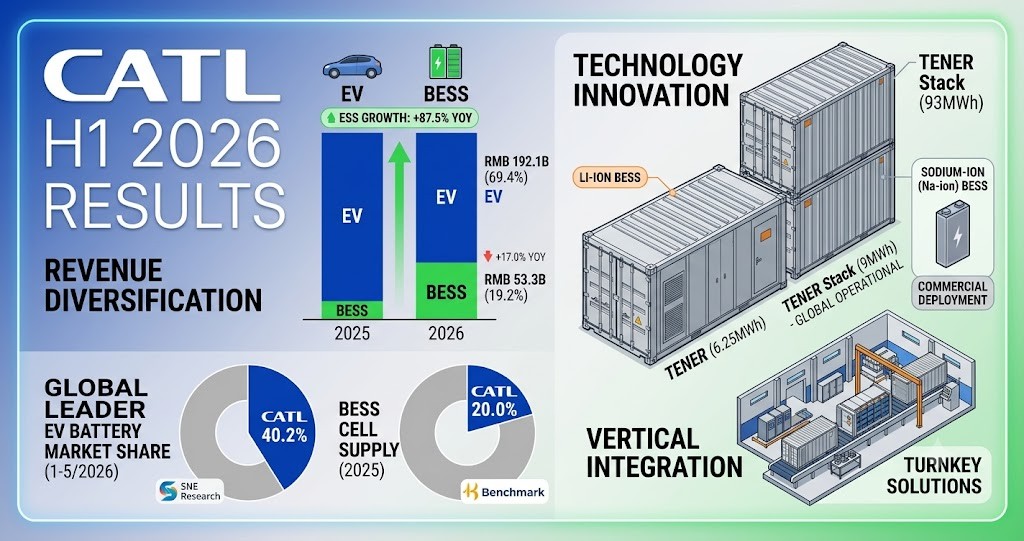
CATLの2026年上半期の総売上高は2,769億人民元(約408億9,000万米ドル)に達し、純利益は前年同期比41.98%増の432億8,400万人民元と大幅な増益を達成しました。
事業別売上構成と収益性
- EV用バッテリー事業
- 売上高:1,921億人民元(全体の69.38%)
- 粗利益率:20.63%(前年同期の22.41%から低下)
- ESS(エネルギー貯蔵)事業
- 売上構成比:19.23%(前年同期の15.88%・売上284億人民元から大幅拡大)
- 粗利益率:23.96%(前年同期の25.52%から低下したものの、EV用を上回る高水準を維持)
【ポイント】 ESS事業は利益率が高く、中国国内のEV購入優遇策縮小(全額税控除の廃止など)による減速を補う重要な成長柱となっています。
地域別売上と研究開発費
- 地域別:国内売上が全体の68.54%を占める一方、海外売上は31.48%に留まりますが、海外売上の粗利益率は29.97%と国内(21.16%)に比べて非常に高い収益性を誇ります。
- 研究開発費:前年同期の100億人民元から12.7%増となる113億8,000万人民元へ増額し、技術開発を一段と強化しています。
市場シェアと競合環境
各種調査機関のデータによると、CATLは主要2分野で圧倒的なシェアを保持しています。
- EVバッテリー世界シェア:40.2%(SNE Research調べ、2026年1-5月)
- BESS用セル供給量:世界第1位・シェア20%(Benchmark Mineral Intelligence調べ、2025年実績)。2位タイはHithiumとEVE Energy(各12%)。
- BESSインテグレーター(統合システム)市場:シェア6%で4位タイ(1位はBYDの13%)。
技術革新と製品戦略
CATLは単なる電池セルの供給にとどまらず、組み立て済みの「ターンキーソリューション」の提供へとシフトし、垂直統合を進めています。
- TENERシリーズの展開
- 6.25MWhの「TENER」リチウムイオンBESS
- 9MWhの「TENER Stack」(超大容量システム、2025年半ばに稼働開始予定)
- ナトリウムイオン(Na-ion)電池版TENER
- ナトリウムイオン電池の本格商業化
- システムインテグレーターのHyperStrong社と60GWhの枠組み供給契約を締結。
- 世界初の「実証済みステーションレベルのナトリウムイオン電池蓄電ソリューション」として商業展開を加速。
地政学リスクと海外市場の展望
米国のトランプ政権によるFEOC規制強化に伴い、中国製電池を採用するBESSプロジェクトは投資税額控除(ITC)の対象外となるリスクに直面しています。このため、CATLをはじめとする中国電池メーカーは、米国依存を下げ、ヨーロッパや中東などの代替市場へ注力する動きを強めています。
また、香港証券取引所(HKEX)へのH株上場(2025年5月)などを通じ、世界の投資家からの資金調達と認知度向上を図っています。
関連情報・補足解説
1. ナトリウムイオン電池(Na-ion)が注目される理由
主原料であるリチウムは価格変動が激しく地政学的リスクも高いため、豊富で安価な塩(ナトリウム)を利用するナトリウムイオン電池は「脱リチウム」の切り札として急速に開発が進んでいます。エネルギー密度ではリチウムイオンに譲るものの、低温特性や安全性、コスト面で定置用蓄電池(ESS)に適しています。
2. EV市場からESS(電力網向け蓄電池)への需要シフト
再生可能エネルギー(太陽光・風力)の急速な普及に伴い、発電量の変動を吸収する「電力網用大型蓄電池」の需要が世界中で爆発的に伸びています。EVの成長ペースが鈍化する中で、蓄電池事業は電池メーカーの業績を支える新たな主役に躍り出ています。
3. テスラ(Tesla)などグローバル競合との攻防
CATLはBESSセル供給で世界トップですが、システム全体を統合する「インテグレーター」としてはBYDやテスラ(Megapackを展開)が先行しています。CATLが「TENER Stack」などの完成品ソリューションを投入するのは、単なるセルメーカーからシステムプロバイダーへ脱皮し、利益率を維持・拡大する狙いがあります。
CATL H1 2026 Financial Results Summary: Growth Engine Shifts from EVs to Stationary Battery Storage
The H1 2026 (January–June) interim financial report released by CATL, China’s and the world’s largest battery manufacturer, vividly illustrates the current state of global energy transition and electrification.
While the electric vehicle (EV) battery business that previously drove the company’s growth is slowing down due to market saturation and policy changes, the energy storage system (ESS / BESS) business is rapidly emerging as a new growth driver. This report highlights key financial results and latest trends of CATL as it accelerates overseas expansion and the development of next-generation technologies (such as sodium-ion batteries), despite facing geopolitical risks like tariffs from US-China tensions and Foreign Entity of Concern (FEOC) regulations.
Key Highlights of H1 2026 Financial Results
CATL’s total revenue for the first half of 2026 reached 276.9 billion RMB (approx. 40.89 billion USD), achieving a significant profit increase with a net profit of 43.284 billion RMB, up 41.98% year-on-year.
Revenue Breakdown and Profitability by Division
- EV Battery Division
- Revenue: 192.1 billion RMB (69.38% of total revenue)
- Gross Profit Margin: 20.63% (down from 22.41% in the same period last year)
- ESS (Energy Storage) Division
- Revenue Share: 19.23% (a substantial increase from 15.88% and 28.4 billion RMB in revenue in the same period last year)
- Gross Profit Margin: 23.96% (maintained a high level higher than the EV division, though down from 25.52% last year)
[Key Takeaway] The ESS business offers high profit margins and serves as a vital growth pillar, offsetting the slowdown caused by reduced domestic EV purchasing incentives in China, such as the repeal of full tax exemptions.
Regional Revenue and R&D Expenditure
- By Region: Domestic sales accounted for 68.54% of total revenue, while overseas sales remained at 31.48%. However, overseas sales boasted high profitability with a gross profit margin of 29.97%, compared to 21.16% domestically.
- R&D Expenses: Increased by 12.7% year-on-year from 10.0 billion RMB to 11.38 billion RMB, further strengthening technological development.
Market Share and Competitive Landscape
Data from market research firms shows that CATL maintains a dominant market share across two major sectors:
- Global EV Battery Market Share: 40.2% (SNE Research, Jan–May 2026)
- BESS Cell Supply Volume: Ranked No. 1 globally with a 20% market share (Benchmark Mineral Intelligence, 2025 results). Hithium and EVE Energy tied for 2nd place at 12% each.
- BESS Integrator Market: Tied for 4th place with a 6% share (BYD led the market with 13%).
Technological Innovation and Product Strategy
CATL is advancing vertical integration by shifting beyond raw battery cell supply to offering fully assembled “turnkey solutions.”
- Expansion of the TENER Series
- 6.25MWh “TENER” Lithium-ion BESS
- 9MWh “TENER Stack” (Ultra-large capacity system, scheduled for operation in mid-2025)
- Sodium-ion (Na-ion) battery version of TENER
- Full-Scale Commercialization of Sodium-Ion Batteries
- Signed a 60GWh framework supply agreement with system integrator HyperStrong.
- Accelerating commercial deployment as the world’s first proven station-level sodium-ion battery storage solution.
Geopolitical Risks and Overseas Market Outlook
Under stricter FEOC rules from the US Trump administration, BESS projects using Chinese-made batteries face the risk of losing eligibility for Investment Tax Credit (ITC) incentives. Consequently, Chinese battery makers including CATL are reducing reliance on the US market and increasing focus on alternative regions such as Europe and the Middle East.
Additionally, through H-share listing on the Hong Kong Stock Exchange (HKEX) in May 2025, CATL aims to enhance global investor awareness and expand international fundraising.
Related Insights & Supplementary Analysis
1. Why Sodium-Ion (Na-ion) Batteries are Gaining Attention
Because main raw materials like lithium experience heavy price volatility and geopolitical risks, sodium-ion batteries—utilizing abundant and cheap sodium (salt)—are being developed rapidly as a solution to replace lithium dependency. Although lower in energy density compared to lithium-ion, they excel in low-temperature performance, safety, and cost, making them well-suited for stationary energy storage systems (ESS).
2. Demand Shift from EV Market to ESS (Grid-Scale Batteries)
With the rapid expansion of renewable energy (solar and wind), global demand for large-scale grid storage batteries to absorb power generation fluctuations is exploding. As the growth rate of EVs tempers, the energy storage business is stepping up as a key player supporting battery manufacturers’ earnings.
3. Competition with Global Rivals like Tesla
While CATL leads the world in BESS cell supply, companies like BYD and Tesla (with its Megapack) hold an early lead as “integrators” that combine entire systems. CATL’s rollout of complete solutions like the TENER Stack aims to transition the company from a mere cell manufacturer to a comprehensive system provider, allowing it to sustain and boost profit margins.

コメント