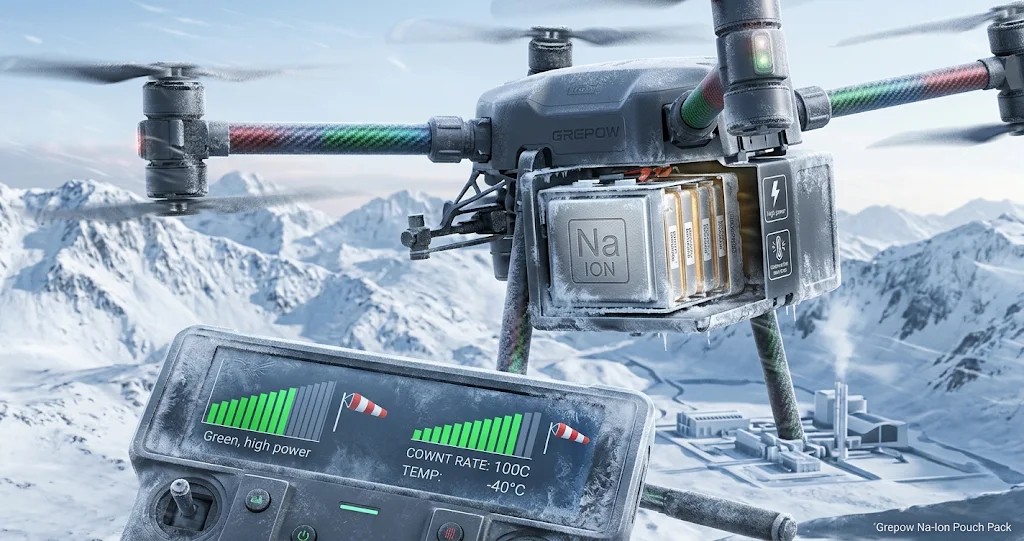
リチウムイオン電池の代替として注目を集めるナトリウムイオン電池ですが、その主戦場はこれまで大型の電気自動車(EV)や定置用エネルギー貯蔵システム(ESS)向けの「角型セル」が中心でした。しかし、厳冬期の極低温環境や、瞬発的な大電流を必要とする産業機器の現場では、既存のリン酸鉄リチウム(LFP)電池の性能低下が長年の課題となっています。そうした中、ドローン向け高レート電池などで知られる中国の電池メーカー・Grepow(グレポウ)社が、高出力かつ寒冷地仕様に特化した「パウチ型ナトリウムイオン電池」の新シリーズを発表し、ニッチな産業用市場の開拓に乗り出しました。
1. Grepow社の新製品:高出力・寒冷地仕様のナトリウムイオンパウチ型電池
深センに拠点を置くGrepow社は、2026年11月12日、既存のニッケル水素電池およびリチウムポリマー電池に続く第3の主要技術として、容量2Ahから7Ahまでの5種類のナトリウムイオンパウチ型電池シリーズを発売しました。
- 基本仕様: 全5モデルとも公称電圧は3.0Vです。2Ahから6.5Ahまでの小型4モデルは充電カットオフ電圧が3.4V、フラッグシップの7Ahモデルは4.0Vに設定されています。
- 圧倒的な高レートパルス放電: 特定の実験室条件下において、最大45Cで30秒間の連続放電、さらに最大100Cで2秒間の瞬間的なパルス放電に対応します。
- 優れたサイクル寿命: 25℃環境下での社内テスト(1C充電・30C放電)において、2,000サイクル後も初期容量の94%を維持(同条件のLFPセルは83%)し、容量80%までの寿命は4,000サイクル以上と予測されています。
2. 極低温環境下でのパフォーマンスとLFP電池との比較
ナトリウムイオン電池の最大の強みの一つが、低温環境におけるイオン伝導性の高さです。Grepow社の社内テストでは、厳冬期を想定した過酷な環境下での優位性が示されています。
- 氷点下でのパルス放電: マイナス20℃で4時間放置した後に28Cで3秒間のパルス放電を繰り返し実行し、さらにマイナス30℃の環境下でも20Cでの同様の放電プロトコルをクリアしました。また、マイナス20℃で0.2Cの連続放電も維持可能です。
- LFP電池を上回る低温出力: マイナス20℃での社内比較テストにおいて、同社のナトリウムイオン電池はLFP電池よりも強力な高レートパルス放電性能を発揮しました。
リチウムイオン電池(特にLFP)は低温下で電解液の粘度が上がり内部抵抗が急増するため、ヒーターによる加温システムなしでは出力が大幅に制限されます。ナトリウムイオン電池はこの弱点を補うことができるため、寒冷地でのシステム簡素化とコスト削減に直結します。
3. 大型角型セルと一線を画す「ニッチ市場・カスタマイズ戦略」
現在、中国国内ではEVや大型ESS向けにコスト競争の激しい大型角型ナトリウムイオン電池の量産が進んでいます。これに対し、Grepow社はあえて「小型のパウチ型フォーマット」を選択し、独自のポジションを築こうとしています。
- 主なターゲット用途: 寒冷地での車両始動(クランキング)やジャンプスターター、建設機械の補助電源、寒冷地の通信基地局バックアップ電源、モバイルロボット(AGV/AMR)、小型定置型蓄電など。
- 既存ブランドの知見とカスタム対応: 同社は「Tattu」や「Gens Ace」ブランドでドローン向け高レートリチウムポリマー電池を手掛けており、少量多品種・高出力市場への強い販路を持っています。非標準の電圧や形状要件に応えるため、セル選定からパック構造、バッテリー管理システム(BMS)までの一貫したカスタマイズサービスを提供します。
今後は、社内テストで示されたサイクル寿命の予測値が実際の過酷な産業現場でどこまで再現できるか、そして既存のLFP電池や鉛蓄電池からの置き換え需要をどれだけ取り込めるかが商業的成功の鍵を握ります。
出典:https://www.ess-news.com/2026/11/13/sodium-ion-pouch-cells-target-cold-climate-industrial-niche/
Achieving High-Power Pulse Discharge Even at Minus 30 Degrees: Grepow Launches “Pouch-Type Sodium-Ion Batteries” for Cold Climates and Industrial Equipment
Sodium-ion batteries have been attracting attention as an alternative to lithium-ion batteries, with their main battleground thus far centered on “prismatic cells” for large electric vehicles (EVs) and stationary energy storage systems (ESS). However, in the extreme sub-zero environments of harsh winters and in industrial equipment requiring instantaneous high currents, the performance degradation of existing lithium iron phosphate (LFP) batteries has long been a challenge. Amid these circumstances, Chinese battery manufacturer Grepow—known for its high-rate batteries for drones and other applications—has announced a new series of “pouch-type sodium-ion batteries” specialized for high output and cold-climate specifications, venturing into the development of niche industrial markets.
1. Grepow’s New Product: High-Output, Cold-Climate Pouch-Type Sodium-Ion Batteries On November 12, 2026, Shenzhen-based Grepow launched a series of five pouch-type sodium-ion battery models with capacities ranging from 2Ah to 7Ah as its third core technology, following its existing nickel-metal hydride (NiMH) and lithium-polymer batteries.
- Basic Specifications: All five models have a nominal voltage of 3.0V. The four smaller models (2Ah to 6.5Ah) have a charge cut-off voltage of 3.4V, while the flagship 7Ah model is set at 4.0V.
- Overwhelming High-Rate Pulse Discharge: Under specific laboratory conditions, the series supports continuous discharge at up to 45C for 30 seconds, as well as instantaneous pulse discharge at up to 100C for 2 seconds.
- Superior Cycle Life: In internal testing at 25C (1C charge, 30C discharge), the cells retained 94% of their initial capacity after 2,000 cycles (compared to 83% for LFP cells under the same conditions), with a projected lifespan of over 4,000 cycles before dropping to 80% capacity.
2. Performance in Extreme Cold Environments and Comparison with LFP Batteries One of the greatest strengths of sodium-ion batteries is their high ionic conductivity in low-temperature environments. Grepow’s internal tests demonstrated superiority under harsh conditions simulating severe winter weather.
- Sub-Zero Pulse Discharge: After resting at minus 20C for 4 hours, a cell repeatedly executed 3-second pulse discharges at 28C, and further cleared the same discharge protocol at 20C even in a minus 30C environment. It can also maintain a continuous discharge of 0.2C at minus 20C.
- Low-Temperature Output Surpassing LFP Batteries: In internal comparative tests at minus 20C, the company’s sodium-ion batteries demonstrated stronger high-rate pulse discharge performance than LFP batteries.
Because lithium-ion batteries (especially LFP) suffer from increased electrolyte viscosity and a sharp rise in internal resistance at low temperatures, their output is severely restricted without a heating system. Sodium-ion batteries can compensate for this weakness, directly leading to system simplification and cost reduction in cold regions.
3. A “Niche Market and Customization Strategy” Distinct from Large Prismatic Cells Currently in China, mass production of large prismatic sodium-ion batteries—marked by fierce price competition—is advancing for EVs and large ESS. In contrast, Grepow has deliberately chosen a “small pouch-type format” to carve out a unique position.
- Primary Target Applications: Cold-weather vehicle starting (cranking) and jump starters, auxiliary power supplies for construction machinery, backup power for telecommunications base stations in cold regions, mobile robots (AGVs/AMRs), and small stationary energy storage.
- Leveraging Existing Brand Expertise and Custom Support: Having supplied high-rate lithium-polymer batteries for drones under the “Tattu” and “Gens Ace” brands, the company possesses strong sales channels into high-mix, low-volume, high-output markets. To meet non-standard voltage and form-factor requirements, it offers comprehensive customization services ranging from cell selection to pack architecture and battery management systems (BMS).
Moving forward, the keys to commercial success will lie in how accurately the cycle life projections shown in internal tests can be replicated in actual harsh industrial environments, and how much replacement demand the company can capture from existing LFP and lead-acid batteries.

コメント