超急速充電(10C)における物理的な壁とされてきた「発熱によるエネルギー損失」に対し、オーストラリアのGraphene Manufacturing Group(GMG)が極めて有望な実証データを発表しました。次世代の蓄電技術として注目を集める「グラフェンアルミニウムイオン電池(G CELLS)」の最新成果と、その背景・関連情報についてまとめます。
GMG グラフェンアルミニウムイオン電池(G CELLS)最新発表の要点
1. 超急速充電と優れたエネルギー効率
- 充放電レート: 10C(約6分間でのフル充放電に相当)という超急速充放電に対応。
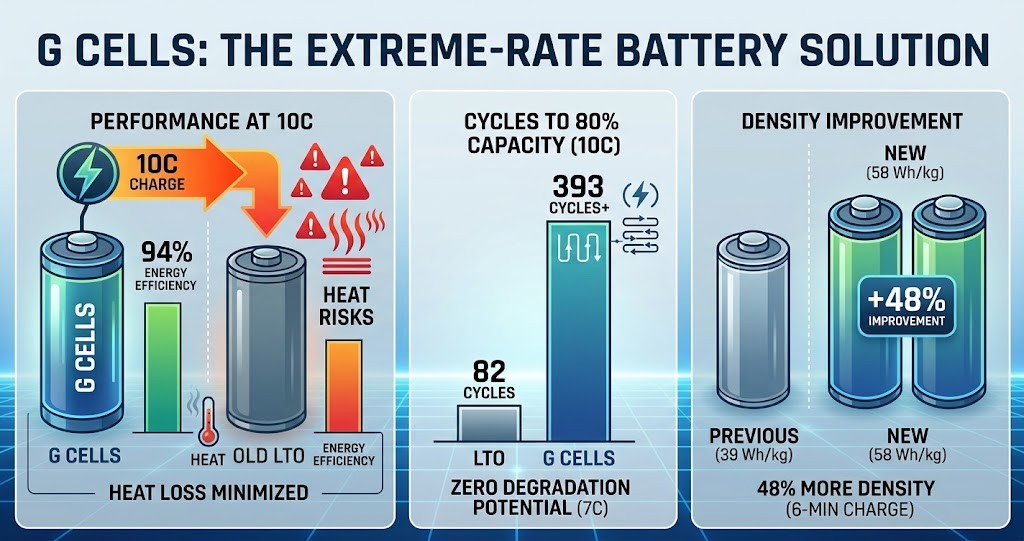
- エネルギー効率: 10C動作時に 94% の高いエネルギー効率を実証。
- 熱損失の低減: 既存の超急速充電向け電池であるLTO(チタン酸リチウム)型は10Cでのエネルギー効率が64%にとどまり、残りの36%が熱として排出されるため強力な液冷装置を要するが、G CELLSは充放電時の発熱を大幅に低減可能。
2. サイクル耐久性
- 10C試験: 1.5Ahセルの10C充放電において、LTOは82サイクル以内で初期容量の80%(一般的な寿命閾値)まで低下したのに対し、G CELLSは393サイクル到達後もわずか10%の容量減少に抑えられた。
- 7C試験: 7C充放電レートでは、1000サイクル経過後も性能劣化がほとんど見られないゼロ劣化挙動を達成。
3. エネルギー密度の向上
- 6分充電(10C)条件におけるエネルギー密度は 58Wh/kg に達し、従来公表データ(39Wh/kg)比で 48%向上。
- 米国インディアナ州のBIC(Battery Innovation Center)において開発および実証テストが継続中。
関連情報・背景解説
アルミニウムイオン電池とグラフェン正極の技術的特長
- キャリアとしてのアルミニウム: アルミニウムイオンは1イオンあたり3個の電子を移動できる多価イオンであり、原理的に高い電荷キャリア密度と高い理論容量のポテンシャルを持つ。
- グラフェンの役割: 正極に導電性と比表面積に優れたグラフェンを採用することで、大規模な電子およびイオン伝導ネットワークを形成。これが内部抵抗の極小化をもたらし、10Cという超急速充電下でも発熱によるエネルギー損失を防ぎ、94%のエネルギー効率を実現している。
- 脱リチウム・地政学リスク低減: 主原料としてリチウムやコバルト、ニッケルを使用しないため、供給網のリスク低減や低コスト化、環境負荷低減(クリーンサプライチェーン)が期待できる。
主要共同開発パートナーと実用化に向けた動き
- Rio Tinto(リオ・ティント)との協業: グローバル鉱業大手Rio Tintoと共同開発協定を締結しており、開発資金の投下に加え、鉱山機械や重工業向け車輌、エネルギーストレージシステム(ESS)などでの採用を視野に入れた実証が行われている。
- 想定される用途: 58Wh/kgというエネルギー密度は一般的な車載用リチウムイオン電池(150-250Wh/kg程度)と比べると発展途上にあるものの、極めて高い充放電レートと耐発熱性、長寿命特性を活かし、重機・鉱山車輌、急速充放電対応の固定型蓄電池(ESS)、データセンター用バックアップ電源(BBU)、超急速充電が必要な局所モビリティ領域での早期実用化が見込まれている。
出典:https://motor-fan.jp/article/1648195/
Durability and Low Heat Generation Outperforming LTO — Latest Cycle Performance of Graphene Aluminum-Ion Batteries
Australia-based Graphene Manufacturing Group (GMG) has announced highly promising performance validation data addressing “energy loss due to heat generation,” which has long been considered a physical barrier in ultra-fast charging (10C). Below is a summary of the latest results, technical background, and relevant information regarding “Graphene Aluminum-Ion Batteries (G CELLS),” an emerging next-generation energy storage technology.
Key Highlights of GMG’s Graphene Aluminum-Ion Battery (G CELLS) Announcement
- Ultra-Fast Charging and Outstanding Energy Efficiency
- Charge/Discharge Rate: Supports ultra-fast charging and discharging at 10C, equivalent to a full charge/discharge cycle in approximately 6 minutes.
- Energy Efficiency: Demonstrated a high energy efficiency of 94% under 10C operation.
- Reduced Heat Loss: Conventional ultra-fast charging batteries such as LTO (lithium titanate) achieve an energy efficiency of only 64% at 10C, dissipating the remaining 36% as heat and requiring robust liquid cooling systems. In contrast, G CELLS significantly reduce heat generation during charging and discharging.
- Cycle Life Durability
- 10C Cycling Test: In 10C charge/discharge testing of a 1.5Ah cell, LTO degraded to 80% of its initial capacity (commonly considered the end-of-life threshold) within 82 cycles. G CELLS exhibited only a 10% capacity reduction even after reaching 393 cycles.
- 7C Cycling Test: At a 7C charge/discharge rate, G CELLS achieved near-zero degradation behavior with virtually no performance drop after 1,000 cycles.
- Improvements in Energy Density
- Under 6-minute charging (10C) conditions, energy density reached 58Wh/kg, representing a 48% increase compared to previously published data (39Wh/kg).
- Development and validation testing remain ongoing at the Battery Innovation Center (BIC) in Indiana, USA.
Related Information and Technical Background
Technical Characteristics of Aluminum-Ion Chemistry and Graphene Cathodes
- Aluminum as a Charge Carrier: Aluminum ions are multivalent carriers capable of transferring three electrons per ion, inherently offering high charge carrier density and significant theoretical capacity potential.
- Role of Graphene: Utilizing graphene with high electrical conductivity and large surface area for the cathode establishes an extensive electron and ion conduction network. This minimizes internal resistance, prevents thermal energy loss during ultra-fast 10C charging, and yields 94% energy efficiency.
- Lithium-Free & Geopolitical Risk Reduction: By eliminating key materials such as lithium, cobalt, and nickel, the chemistry offers supply chain risk mitigation, lower material costs, and reduced environmental impact through a cleaner supply chain.
Key Development Partners and Commercialization Outlook
- Collaboration with Rio Tinto: GMG has entered into a joint development agreement with global mining leader Rio Tinto. In addition to financial backing, testing is underway with an eye toward implementation in mining machinery, heavy industrial vehicles, and energy storage systems (ESS).
- Target Applications: While an energy density of 58Wh/kg is still developing compared to conventional automotive lithium-ion batteries (around 150-250Wh/kg), its exceptional C-rate capability, thermal tolerance, and long cycle life position it well for early adoption in heavy machinery, mining vehicles, fast-charging stationary energy storage systems (ESS), data center backup power units (BBU), and specialized localized mobility sectors requiring ultra-fast charging.
コメント