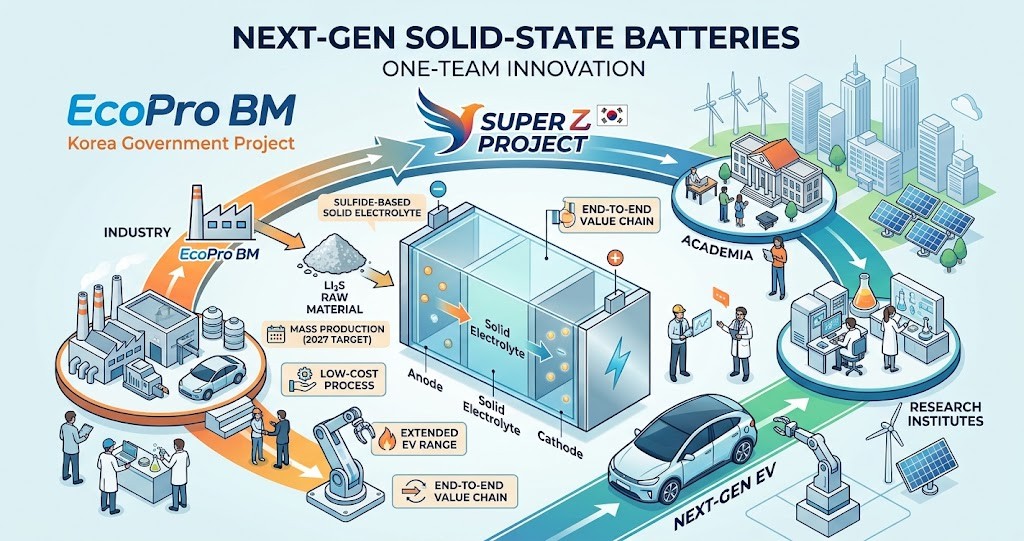
次世代電池として世界中から大きな注目を集める「全固体電池」は、電気自動車(EV)の航続距離伸長や発火リスクの低減、さらにはロボティクスなど先端産業の動力源として急速な技術開発が進められています。こうした中、韓国の正極材大手であるEcoPro BMが政府主導の国家プロジェクトに選定され、原料からセル製造までを一括して担う産学研の共同開発体制を発足させました。本稿では、同記事の要点に加え、全固体電池の仕組みや「スーパー乙プロジェクト」の背景など関連情報を交えて整理・解説します。
1. プロジェクトの背景と目的
- 韓国政府の「スーパー乙プロジェクト」への選定
- 韓国産業通商省が主導する、世界最高水準の技術力を有する素材・部品・装置企業を育成・支援するR&D事業です。EcoPro BMを含む5社が選定されました。
- 商用化の早期実現
- 2027年の硫化物系全固体電池の商用化を目標とし、大量生産プロセスの最適化および製造単価の低減を目指します。
2. 「全固体産学研ワンチーム」の体制と役割
- 全体の構想
- 原料から素材、電池セルへの適用・検証に至るまで、全周期(エンドツーエンド)の統合バリューチェーンを構築します。
- 主な参加機関
- 産業界、韓国電子技術研究院(KETI)、韓国科学技術研究院(KIST)、浦項工科大学校(POSTECH)、漢陽大学校など。
- EcoPro BMの役割
- 高純度硫化リチウム(Li2S)の供給を受け、結晶性制御、不純物除去、粒度均一性の確保などの精密な工程変数を制御し、高品質な硫化物系固体電解質を製造・供給します。
- 電池セルメーカーの役割
- 供給された固体電解質をセルに適用し、実証・検証作業を行います。
3. EcoPro BMの現状と生産規模
- 現在の生産設備
- 年間40トン(40 tons/year)規模のパイロットプラントを既に運営中であり、独自の工程技術を確保しています。
- 今後の戦略
- 国内のセルメーカーと開発ロードマップを共有し、パイロット段階の成功をもとに量産プロセスの構築を進めます。
関連情報・解説(補足)
- 全固体電池の技術的特徴
- 従来のコンベンショナルなリチウムイオン電池が可燃性の「液体電解質」を使用するのに対し、全固体電池は「固体電解質」を使用します。これにより、発火・爆発のリスクが極めて低くなり、熱耐性が向上します。
- エネルギー密度の向上が期待でき、電気自動車(EV)の航続距離の大幅な伸長や、高出力・高安全性が求められるヒューマノイドロボットなど次世代プラットフォームへの活用が見込まれています。
- 硫化物系固体電解質(Li2Sベース)の特徴
- 固体電解質には酸化物系、高分子(ポリマー)系、硫化物系などの種類がありますが、硫化物系は高いイオン電導度(リチウムイオンの移動しやすさ)を持つため、最も車載用途に適していると評価されています。一方で、空気中の水分と反応しやすい性質があるため、高純度な原料(Li2S)の制御や精密な量産・加工技術が不可欠となります。
出典:https://finance.biggo.jp/news/6c951032-3baa-4101-80f0-554dfac374b1
Sulfide-Based Technology Holding the Key to Next-Generation Batteries: EcoPro BM and Major South Korean Research Institutions’ One-Team Strategy
All-solid-state batteries, which are drawing major global attention as next-generation batteries, are undergoing rapid technological development to extend the driving range of electric vehicles (EVs), lower fire risks, and power advanced industries such as robotics. Against this backdrop, EcoPro BM, a major South Korean cathode material manufacturer, was selected for a government-led national project and launched an industry-academia-research joint development system covering the entire pipeline from raw materials to cell manufacturing. This article summarizes and explains key points of the news release alongside relevant background information, including the mechanism of all-solid-state batteries and the context behind the Super-Eul Project.
1. Background and Objectives of the Project
- Selection for the South Korean Government’s “Super-Eul Project”
- An R&D support program led by the Ministry of Trade, Industry and Energy of South Korea to foster and support materials, parts, and equipment companies that possess world-class and world-first level technology. EcoPro BM was selected as one of five participating companies.
- Early Commercialization
- Target commercialization of sulfide-based all-solid-state batteries by 2027, aiming to optimize mass production processes and reduce manufacturing costs.
2. Structure and Roles of the “All-Solid-State Industry-Academia-Research One-Team”
- Overall Concept
- Build an integrated, end-to-end full-lifecycle value chain spanning from raw materials to materials, as well as application to and verification in battery cells.
- Main Participating Institutions
- Industry partners, Korea Electronics Technology Institute (KETI), Korea Institute of Science and Technology (KIST), Pohang University of Science and Technology (POSTECH), Hanyang University, and others.
- Role of EcoPro BM
- Receive high-purity lithium sulfide (Li2S) from raw material suppliers, control precise process variables such as crystallinity control, impurity removal, and particle size uniformity, and manufacture and supply high-quality sulfide-based solid electrolytes.
- Role of Battery Cell Manufacturers
- Apply the supplied solid electrolytes to battery cells and perform verification and testing processes.
3. Current Status and Production Capacity of EcoPro BM
- Current Production Facilities
- Already operating a pilot plant with a capacity of 40 tons/year, securing proprietary process technologies.
- Future Strategy
- Share development roadmaps with domestic cell manufacturers and build mass production processes based on success at the pilot stage.
Supplementary Information & Technical Overview
- Technical Characteristics of All-Solid-State Batteries
- Unlike conventional lithium-ion batteries that use flammable liquid electrolytes, all-solid-state batteries use solid electrolytes. This significantly lowers fire and explosion risks while improving thermal stability.
- Higher energy density is expected, which is anticipated to substantially extend EV driving ranges and power next-generation platforms such as humanoid robots requiring high output and safety.
- Characteristics of Sulfide-Based Solid Electrolytes (Li2S-Based)
- Solid electrolytes fall into categories such as oxide-based, polymer-based, and sulfide-based. Sulfide-based electrolytes have high ionic conductivity (ease of lithium-ion movement) and are considered most suitable for automotive applications. However, because they readily react with moisture in the air, precise high-purity raw material control (Li2S) and advanced mass-production processing technologies are essential.
コメント