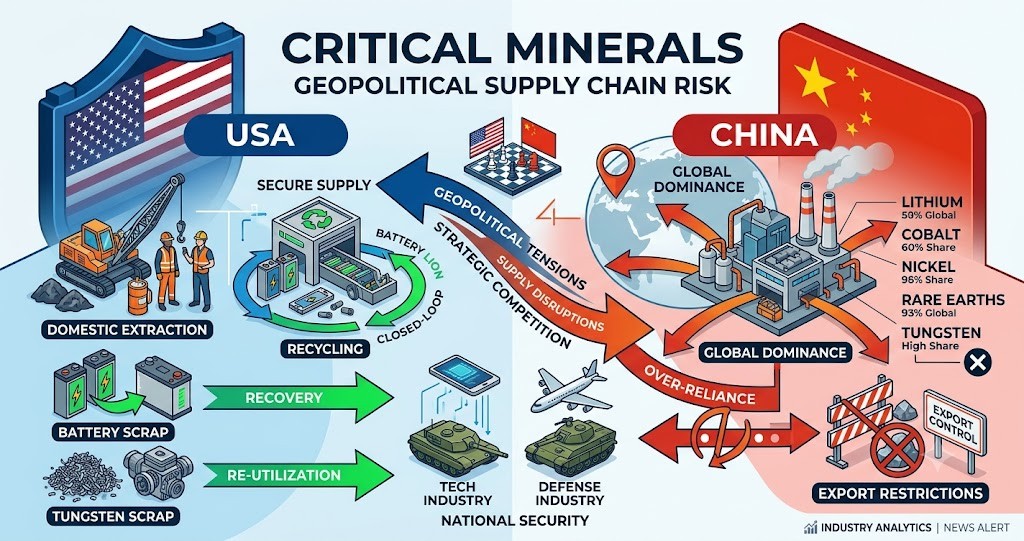
現在、ハイテク産業や国防装備に欠かせない「重要鉱物(クリティカル・ミネラル)」のサプライチェーンは、世界的にも大きな地政学的リスクに直面しています。特に採掘・精製分野で圧倒的なシェアを持つ中国に対し、米国は自国内での資源確保とリサイクル体制(クローズド・ループ)の構築を急速に進めています。今回の廃材輸出禁止措置は、単なる貿易規制にとどまらず、国家安全保障と産業自給率の向上を狙った包括的な戦略の一環です。
ニュースの要点
- 規制の内容: 米商務省は今月後半から1年間にわたり、米国内で発生するリチウムイオン電池スクラップおよびタングステン廃材の海外流出を規制し、原則として国内市場での流通・販売を義務付けます(一定の再輸入条件を満たす場合は例外規定あり)。
- 規制の狙い: 防衛産業および最先端技術分野において、中国への資源依存を低減し、国内での回収・再生資源を囲い込むこと。
- 対象素材の重要性:
- タングステン: 高強度・高耐熱性を持ち、戦車装甲や各種兵器、エンジン部品に不可欠。中国が世界最大の生産国であり、すでに輸出規制を実施中。
- 電池スクラップ(ブラックマス): リチウム、コバルト、ニッケル、マンガン、黒鉛などを効率よく回収可能な貴重な再生資源。
- 国防総省の動き: 国防総省は防衛関連企業に対し、磁石向け供給網から中国産レアアースを来年までに完全に排除するよう要請しています。
関連情報・背景解説
1. 「ブラックマス」と電池リサイクル市場の台頭
電気自動車(EV)や蓄電池の普及に伴い、使用済み電池や製造工程から出る廃材を粉砕・選別して得られる黒い粉末「ブラックマス(Black Mass)」の価値が世界的に急上昇しています。 ブラックマスから化学処理を経て回収されるリチウムやニッケルは、未加工の鉱石から採掘・精製するよりも環境負荷が低く、製錬コスト面でも優位性があります。米国ではレッドウッド・マテリアルズ(Redwood Materials)やライ・サイクル(Li-Cycle)などのリサイクル企業が大型投資を進めており、国内での処理能力向上に合わせて原料の海外流出を防ぐ狙いがあります。
2. タングステンの極めて高い中国依存度
タングステンは金属の中で最も高い融点(約 3422 deg C)を持ち、超硬工具や防衛装備に代替不能な素材です。全世界の採掘量の8割以上を中国が占めており、米国国内での採掘量は極めて限られています。米国にとって、国内で発生するスクラップ(廃材)は最も確実で迅速に確保できるタングステン資源供給源となります。
3. 法制度と自国重視の経済安全保障
米国はインフレ抑制法(IRA)などを通じ、北米内で採掘・加工・リサイクルされた重要鉱物を使用した製品に対して税制優遇や補助金を支給する政策を進めてきました。今回の輸出規制は、インセンティブ(補助金)だけでなく、物理的な規制(輸出制限)を組み合わせることで、国内での資源循環システムを急速に完成させようとする動きの一環です。
出典:https://s.kabutan.jp/news/n202608051655/
US to Ban Exports of Battery Scrap and Tungsten Waste: Accelerating Shift Away from Reliance on China and Securing Domestic Resources
Currently, the supply chain for critical minerals, which are indispensable for high-tech industries and defense equipment, faces major global geopolitical risks. In response to China, which holds an overwhelming market share in mining and refining, the US is rapidly advancing efforts to secure resources domestically and establish a closed-loop recycling system. This ban on scrap exports is more than a mere trade restriction; it is part of a comprehensive strategy aimed at boosting national security and industrial self-sufficiency.
Key News Points Regulation Details: Over a one-year period starting late this month, the US Department of Commerce will restrict the outflow of lithium-ion battery scrap and tungsten waste generated within the US, making sale and distribution in the domestic market mandatory in principle (with exceptions for cases meeting specific re-import conditions). Goal of Regulations: To reduce resource dependence on China in the defense industry and cutting-edge tech sectors, while securing recycled and recovered resources domestically. Importance of Targeted Materials:
- Tungsten: Possesses high strength and heat resistance, making it vital for tank armor, weaponry, and engine components. China is the world’s largest producer and has already implemented export controls.
- Battery Scrap (Black Mass): A valuable recycled resource that allows for the efficient recovery of lithium, cobalt, nickel, manganese, and graphite. Pentagon Actions: The Department of Defense has directed defense contractors to completely eliminate Chinese rare earths from magnet supply chains by next year.
Related Information and Background
- The Rise of “Black Mass” and the Battery Recycling Market With the widespread adoption of electric vehicles (EVs) and energy storage systems, the value of “black mass”—the black powder obtained by crushing and sorting used batteries and manufacturing scrap—is surging globally. Lithium and nickel recovered from black mass via chemical processing have a lower environmental impact and cost advantages over mining and refining raw ore. Recycling firms in the US, such as Redwood Materials and Li-Cycle, are making large-scale investments. The export ban aims to prevent raw materials from leaving the country as domestic processing capacity expands.
- Extreme Dependence on China for Tungsten Tungsten has the highest melting point of any metal (approx. 3422 deg C) and is irreplaceable in cemented carbide tools and defense hardware. China accounts for over 80% of global mining output, whereas domestic mining in the US is extremely limited. For the US, scrap generated domestically represents the most reliable and immediate source of tungsten resources.
- Legal Frameworks and Protectionist Economic Security Through legislation like the Inflation Reduction Act (IRA), the US has incentivized the use of critical minerals mined, processed, or recycled in North America via tax credits and subsidies. Combining physical trade restrictions (export controls) with financial incentives (subsidies), this export ban reflects a broader movement to rapidly complete a domestic resource-cycling ecosystem.
コメント