電気自動車(EV)の購入を検討する際、多くのユーザーにとって最大の懸念事項となるのが「バッテリーの劣化と交換費用」です。エンジン車におけるエンジンのように高額な中核部品であるため、長期使用や中古車購入におけるリスクとして認識されてきました。
こうした懸念に対し、フォード・モーター(Ford)が2026年11月11日に発表した大規模な実走行調査データは、実際の利用環境においてEVバッテリーの耐久性が想定以上に高いことを実証する重要な知見を提供しています。
5年・32億kmの走行データが示す驚異的な健全度
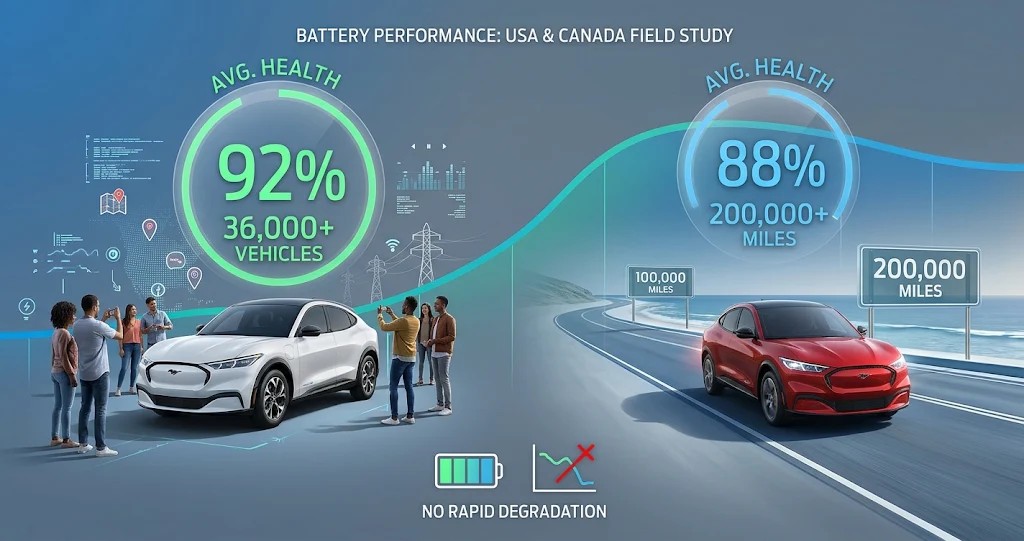
フォードが実施した調査は、米国50州およびカナダの顧客に納車された同社初の本格EVクロスオーバー「マスタング・マッハE(Mustang Mach-E)」の2021年モデル3万6,000台超を対象としたものです。推定累計20億マイル(約32億km)に及ぶ走行データを分析した結果、全体の平均バッテリー健全度は92%という高水準を維持していることが判明しました。
新品時の容量を100%とした場合、全調査対象の約95%が87〜97%の範囲に収まっており、個体差による極端な劣化の発生も抑えられていることが示されています。
走行距離別の詳細データにおいても、距離の増加に伴って緩やかに低下するものの、急激な性能低下(いわゆる劣化の崖)は見られませんでした。
走行距離とバッテリー健全度の関係:
- 全調査対象(3万6,000台超): 平均 92%
- 10万マイル(約16万km)超(約2,000台): 平均 約91%
- 20万マイル(約32万km)超(約30台): 平均 88%
マスタング・マッハEの2021年モデルにはニッケルコバルトマンガン(NCM)系リチウムイオン電池が搭載されています。日常的な充電において上限を80〜90%程度に設定し、化学的・電圧的な負荷を軽減する運用法が功を奏していると分析されています。
業界全体のトレンド:他社データとの整合性と材料技術の進化
バッテリーの緩やかな劣化傾向は、フォード以外のメーカーや独立系の調査機関によるデータとも整合しています。
オーストリアのEVバッテリー診断企業AVILOOが2026年に発表した世界20ブランド・計50万台超の分析データによると、走行距離15万km時点でのバッテリー健全度は以下の通りとなっています。
- ヒョンデ(Hyundai) IONIQ 5: 92.8%
- フォルクスワーゲン(Volkswagen) ID.4: 90.6%
- テスラ(Tesla) Model Y: 約90.3%
- 日産(Nissan) 初代リーフ: 86.3%
初期のEVである初代リーフなどと比較し、水冷式の温度管理システムや最適化されたバッテリーマネジメントシステム(BMS)を備えた現行世代のEVは、劣化耐性が大幅に向上していることが確認できます。
さらに、今後のEV市場ではバッテリー化学の移行が進みます。フォードは小型電動ピックアップトラック「ファゾム(Fathom)」の基盤となる新開発プラットフォーム「Universal Electric Vehicle(UEV)」において、リン酸鉄リチウム(LFP)系電池の採用を拡大する計画です。LFP系電池はNCM系に比べてエネルギー密度でやや劣るものの、熱安定性に優れ、100%の満充電を繰り返す使用環境に対する耐久性が非常に高いという特徴を持ちます。
中古EV市場および今後の残価設定への波及効果
今回のデータ公表は、自動車産業および中古車市場において以下のような実用上のインパクトをもたらすと予想されます。
- 中古EVの残価率向上 過度なバッテリー劣化への懸念から、従来の中古EVはエンジン車に比べて値落ちが大きい傾向にありました。約32万km走行しても88%の容量を維持するという客観的データは、リース返却車や中古EVの適正な査定価格の維持に寄与します。
- 保証設計およびフリート需要への追い風 タクシーや配送など、年間走行距離の長い商用フリート事業者にとって、10万マイル(約16万km)走行時でも90%以上の健全性を維持できる実証データは、EV導入の経済的合理性を補強する材料となります。
今後の課題と検証ポイント
バッテリーの化学的劣化そのものを完全にゼロにすることは不可能であり、長期使用における検証課題も残されています。
- V2X(双方向充電)環境での耐久性 UEVプラットフォームをはじめ、車載電池から家庭や電力網へ給電するV2H/V2G技術の普及に伴い、走行以外での充放電サイクルが増加します。双方向充電が電池寿命に与える影響については、今後の市場データ蓄積が必要です。
- 極端な気候環境での個体差 極寒地域や酷暑地域における急速充電の多用など、環境負荷が著しく高い条件での長期的な健全度推移のトラッキングが引き続き求められます。
フォードをはじめとする自動車メーカーによる大規模な実走行データの開示は、EVが研究開発・初期普及のフェーズを脱し、既存のエンジン車と同等以上の長期信頼性を備えた成熟した製品へと進化していることを物語っています。
出典:https://finance.biggo.jp/news/9d8d0145-1b3b-4a83-9fb0-44a742705a54
Allaying Used EV Concerns? Ford Reveals Large-Scale Battery Tracking Survey of 36,000 Vehicles
When considering the purchase of an electric vehicle (EV), the primary concern for many prospective buyers is battery degradation and replacement costs. As a high-cost core component akin to the engine in an internal combustion vehicle, battery longevity has long been perceived as a risk in long-term ownership and used car purchases.
Addressing these concerns, large-scale real-world driving data published by Ford Motor Company on November 11, 2026, provides vital insights demonstrating that EV battery durability in actual operating environments is significantly higher than previously assumed.
Impressive Battery Health Shown by 5-Year, 3.2-Billion-km Driving Data
Ford’s survey covered over 36,000 units of the 2021 model year Mustang Mach-E, the company’s first full-fledged EV crossover delivered to customers across all 50 US states and Canada. Analyzing driving data covering an estimated cumulative 2 billion miles (approx. 3.2 billion km) revealed that overall average battery state of health (SoH) maintained a high level of 92%.
Taking new capacity as 100%, approximately 95% of all surveyed vehicles fell within the 87% to 97% range, demonstrating that extreme degradation due to individual vehicle variance has been effectively mitigated.
Detailed breakdowns by mileage also show that while health declines gradually as distance increases, no rapid performance drop-off (the so-called degradation cliff) was observed.
Relationship Between Mileage and Battery Health:
- All Surveyed Vehicles (Over 36,000 units): Average 92%
- Over 100,000 miles / approx. 160,000 km (Approx. 2,000 units): Average approx. 91%
- Over 200,000 miles / approx. 320,000 km (Approx. 30 units): Average 88%
The 2021 model year Mustang Mach-E is equipped with nickel-manganese-cobalt (NMC) lithium-ion batteries. Routine charging practices that limit daily upper thresholds to around 80% to 90% are credited with reducing chemical and voltage stress on the cells.
Industry-Wide Trends: Consistency with Independent Data and Evolving Chemistry
This gradual degradation trend aligns with data from other automakers and independent testing bodies.
According to 2026 data published by Austrian EV battery diagnostics company AVILOO, which analyzed over 500,000 EVs across 20 global brands, average battery health at 150,000 km was recorded as follows:
- Hyundai IONIQ 5: 92.8%
- Volkswagen ID.4: 90.6%
- Tesla Model Y: Approx. 90.3%
- First-Generation Nissan Leaf: 86.3%
Compared to early EVs like the original Leaf, current-generation EVs equipped with liquid thermal management systems and optimized battery management systems (BMS) exhibit significantly improved resistance to degradation.
Furthermore, a shift in battery chemistry is underway across the broader EV market. Ford plans to expand the adoption of lithium iron phosphate (LFP) batteries in its newly developed Universal Electric Vehicle (UEV) platform, which will serve as the foundation for the Fathom compact electric pickup truck. While LFP batteries feature slightly lower energy density compared to NMC variants, they offer superior thermal stability and exceptional durability under repeated 100% full-charge cycles.
Implications for Used EV Markets and Residual Values
This data release is expected to deliver practical benefits across the automotive industry and secondhand markets:
- Higher Residual Values for Used EVsDue to exaggerated fears of battery degradation, secondhand EVs previously suffered steeper depreciation than internal combustion vehicles. Objective data showing an 88% capacity retention even after 320,000 km will help support accurate and stable valuation for off-lease vehicles and pre-owned EVs.
- Tailwinds for Warranty Design and Fleet DemandFor commercial fleet operators in taxi and delivery services with high annual mileage, empirical data proving over 90% health at 100,000 miles (approx. 160,000 km) provides strong backing for the economic rationale of EV adoption.
Remaining Challenges and Verification Points
Because chemical degradation cannot be reduced completely to zero, long-term operational questions remain:
- Durability Under V2X (Bidirectional Charging)With the expansion of V2H/V2G technologies that feed power back to homes or grids from vehicle batteries—such as on the UEV platform—non-driving charge-discharge cycles will increase. The long-term impact of bidirectional usage on battery lifespan requires further real-world data collection.
- Variances Under Extreme ClimatesContinued tracking is necessary to assess long-term health trends under high-stress conditions, such as frequent DC fast charging in extreme cold or hot environments.
This disclosure of large-scale real-world driving data by Ford and other automakers indicates that EVs are moving past the R&D and early-adoption phases, maturing into products that offer long-term reliability equal to or exceeding that of conventional internal combustion vehicles.


コメント