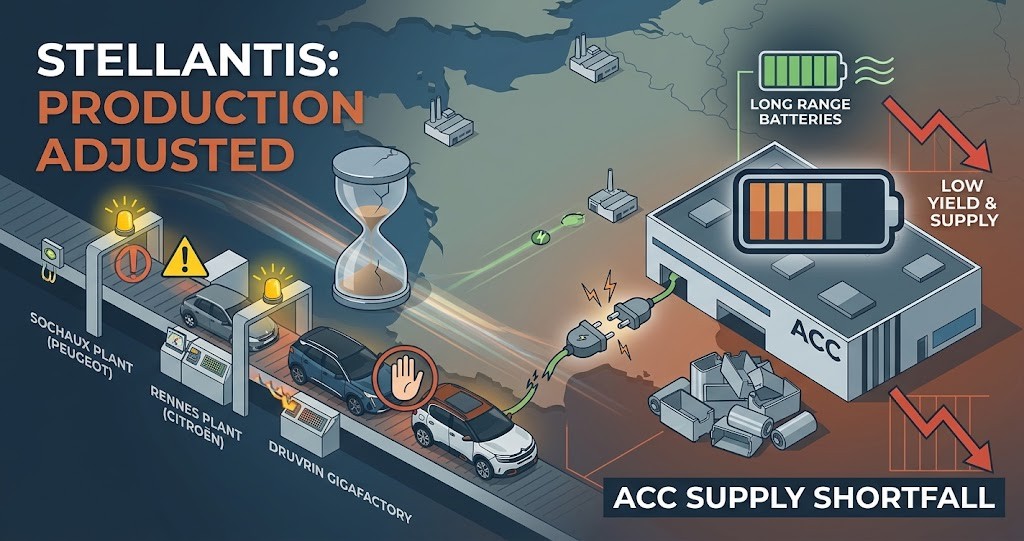
ステランティスが仏国内の主要3工場でEV用バッテリー供給不足を理由に一時減産・操業停止を発表したニュースについて、サプライチェーンの構造課題や合弁会社ACCの動向などの関連情報を補足してまとめます。
1. ニュースの全体像と対象拠点
- 概要: ステランティス(Stellantis)は、フランス国内の3つの主要工場において、2026年10月下旬から少なくとも1週間、車両の生産を一時停止することを発表しました。
- 主な対象工場と影響車種:
- ソショー(Sochaux)工場: 10月23日〜30日停止。「プジョー 3008(Peugeot 3008)」「プジョー 5008(Peugeot 5008)」の生産に影響。
- レンヌ(Rennes)工場: 10月22日〜30日停止。「シトロエン C5 エアクロス(Citroen C5 Aircross)」の生産に影響。
- 停止理由: 法人顧客を中心に長距離航続向けモデルの需要が強い一方、搭載する「長距離用バッテリー」の調達が追いついていないため。需要に見合わない不均一な在庫増加を防ぐための生産調整としています。
2. バッテリー供給元「ACC」の現状と課題
- 調達元: ステランティス、メルセデス・ベンツ(Mercedes-Benz)、トタルエナジーズ(TotalEnergies)傘下Saftの3社による合弁バッテリー会社「ACC(Automotive Cells Company)」。
- 生産立ち上げの遅れ: ACCのフランス・ドゥヴラン(Douvrin)ギガファクトリーは増産を進めているものの、要求される初期歩留まりや長距離用高容量セルの十分な供給量に到達しておらず、車両組み立て側のペースに供給が追いついていない状況です。
3. 欧州EV市場とバッテリー戦略の背景(関連情報の補足)
- 欧州バッテリー内製化の壁: 欧州自動車大手は中国・アジア勢依存からの脱却を目指し、ACCなどを通じて域内でのギガファクトリー建設を推進してきました。しかし、セル生産の歩留まり改善や量産技術の確立には時間を要しており、今回の供給不足として表面化しています。
- ACCの事業計画見直し: 欧州市場における一時的なEV需要減速を受け、ACCはイタリア(テルモリ)およびドイツ(カイザースラウテルン)での工場建設計画を延期・中断していました。一方で、直近では燃料価格高騰などの影響でEV需要が再び持ち直したため、需要急増に対する供給体制のズレ(ボトルネック)が生じています。
- 長距離用バッテリー(高ニッケル系等)への需要集中: 今回影響を受けたモデルは、航続距離500 km〜700 kmクラスを実現する大型バッテリーパック搭載車です。エントリーモデル向けのLFP(リン酸鉄リチウム)等に比べ、エネルギー密度の高い高ニッケル系NMCセルの調達・生産難易度が高いことも背景にあります。
総括
今回の減産は「EV全体の需要低迷」ではなく、「長距離モデルへの強い需要に対し、欧州域内での高容量バッテリー立ち上げが追いついていないサプライチェーンのアンバランス」を示しています。ステランティスをはじめとする欧州車メーカーにとって、車体の生産能力だけでなく、提携バッテリーファクトリーの量産安定化(ランプアップ)をいかに迅速に進められるかが、今後のEV販売拡大に向けた最重要課題となっています。
Stellantis Halts Production at Three French Plants! The Cause: “Long-Range Battery Shortages” and Supply-Demand Gap
Below is a summary of the news regarding Stellantis’s announcement of temporary production cuts and closures at three major plants in France due to EV battery supply shortages, supplemented with context on structural supply chain challenges and developments at its joint venture, ACC.
1. Executive Summary and Affected Facilities
- Overview: Stellantis announced a temporary suspension of vehicle production at three major plants in France for at least one week starting in late October 2026.
- Key Plants and Affected Models:
- Sochaux Plant: Shutdown from October 23 to October 30. Affects production of the Peugeot 3008 and Peugeot 5008.
- Rennes Plant: Shutdown from October 22 to October 30. Affects production of the Citroen C5 Aircross.
- Reason for Shutdown: Strong demand for long-range models—particularly among corporate fleet clients—has outpaced the supply of “long-range batteries.” The production adjustment aims to prevent uneven inventory build-up that does not align with market demand.
2. Current Status and Challenges of Battery Supplier “ACC”
- Supplier: Automotive Cells Company (ACC), a battery joint venture formed by Stellantis, Mercedes-Benz, and Saft (a subsidiary of TotalEnergies).
- Production Ramp-Up Delays: Although ACC’s gigafactory in Douvrin, France, is increasing production, it has not yet achieved required initial yield rates or sufficient supply volumes for high-capacity long-range cells, failing to match the pace of vehicle assembly lines.
3. European EV Market Background and Battery Strategy Context (Additional Insights)
- Hurdles in European Battery In-Housing: Major European automakers have been pushing regional gigafactory construction via initiatives like ACC to reduce dependence on Asian suppliers. However, improving cell yield rates and establishing mass-production technology take time, surfacing as current supply bottlenecks.
- ACC’s Revised Business Plans: Following a temporary slowdown in European EV demand, ACC previously postponed or suspended factory construction plans in Italy (Termoli) and Germany (Kaiserslautern). However, with EV demand rebounding recently due to surging fuel prices, a mismatch (bottleneck) between sudden demand growth and supply capability has emerged.
- Concentration of Demand on Long-Range Batteries (High-Nickel Chemistries): The affected vehicles feature large battery packs delivering range classes of 500 km to 700 km. Compared to LFP (Lithium Iron Phosphate) used in entry-level models, high-energy-density high-nickel NMC cells present higher procurement and manufacturing complexities.
Summary This production cut does not stem from “overall sluggish EV demand,” but rather highlights a “supply chain imbalance where European high-capacity battery ramp-ups cannot keep pace with strong demand for long-range models.” For European automakers including Stellantis, the key priority moving forward is not just vehicle assembly capacity, but how quickly they can stabilize and ramp up mass production at their partner battery factories.


コメント