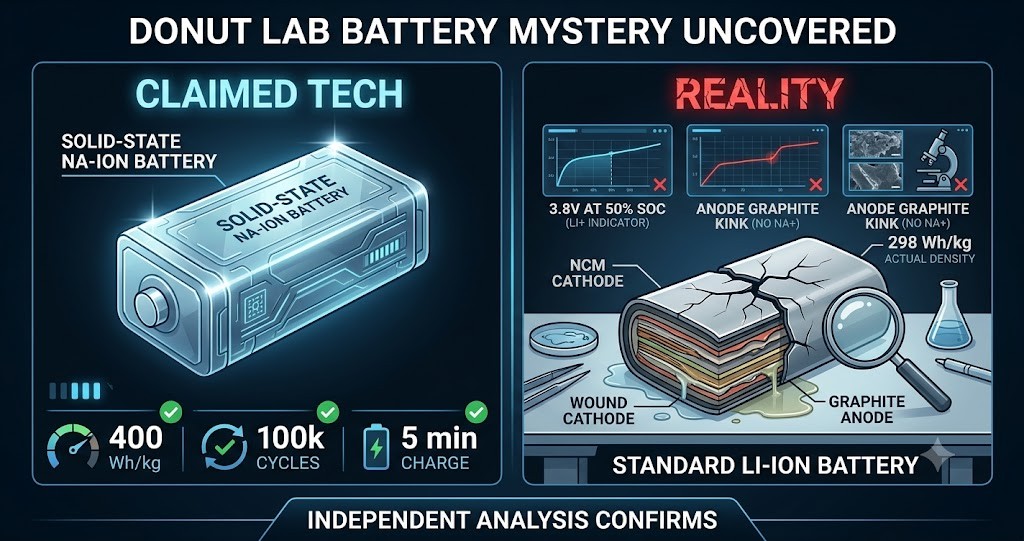
電動モビリティ向けの次世代バッテリーとして注目を集めていたフィンランドのスタートアップ「Donut Lab」の全固体電池について、著名な調査者や独立した電池専門家グループによるデータ分析が行われ、「中身は通常のリチウムイオン電池(NCM)である」とする衝撃的な調査結果が暴露されました。
主な疑惑とデータによる裏付け
調査を行ったRyan Inis Hughes氏(YouTubeチャンネル「Ziroth」)と20人超の専門家(フラウンホーファー研究機構など)は、Donut Labが公開した試験データを分析し、以下の決定的な証拠を提示しました。
| 検証項目 | Donut Lab側の主張 | 実際のデータ・分析結果 |
| 電池の種類 | リチウムフリーの「全固体ナトリウムイオン電池」 | 充電50%付近で3.7〜3.8Vを記録(高ニッケル系リチウムイオン電池の特徴と一致。ナトリウム系は通常3.5Vを超えない)。 |
| 負極(アノード)の挙動 | 特許に基づく新技術 | 充放電時の膨張データに、黒鉛(グラファイト)特有の「キンク(変化が緩む現象)」を確認(ナトリウムイオンは分子が大きすぎて黒鉛に入らないため、リチウムイオン確定の証拠となる)。 |
| エネルギー密度 | 400Wh/kg(世界トップクラス) | 試験記録(94Wh)をセルの質量(315g)で割ると約298Wh/kgとなり、技術提供元の旧型セル(297Wh/kg)の数値とほぼ一致。 |
| 寿命と充電速度 | 10万サイクルの寿命、5分での急速充電 | フィンランド国立技術研究センター(VTT)の試験では、核心である「400Wh/kg」と「10万サイクル」の検証は行われていなかった。 |
| 出荷・量産の進捗 | 2026年第1四半期に量産車を消費者へ出荷 | 実際には社内向けの試作車(プロトタイプ)であり、CEOもメディアに対し「400Wh/kgの電池は顧客に納入しておらず、出荷予定のものですらない」と認めている。 |
企業構造と資金規模
- 分業体制: 電動バイクメーカー「Verge Motorcycles」から分社化したDonut Lab(販売担当)、Nordic Nano(製造担当とされるが一度もセルを造っていないと指摘)、ドイツのCT Coatings(特許・技術提供元)の複数社が関与。
- 被害規模: 主に小口の投資家1300人超から約40億円を集め、企業の評価額は一時約2000億円に達していました。
関連情報(背景と影響)
1. なぜ「全固体ナトリウムイオン電池」は熱狂されたのか
リチウムイオン電池の限界を超える存在として、以下の「2つの夢の技術」を掛け合わせたため、投資家の期待が爆発しました。
- 全固体電池: 液体電解質を固体に変えることで、発火リスクをゼロにし、超急速充電と高密度を両立する。
- ナトリウムイオン: 高価で地政学的リスクのある「リチウム」の代わりに、地球上に無限にある「塩(ナトリウム)」を使うため、コストを劇的に下げられる。これらを「400Wh/kg・10万サイクル・5分充電」という、現在の技術水準を遥かに凌駕するスペックで同時に達成したと発表したため、世界中で「奇跡の電池」と騒がれました。
2. バッテリー業界における「スタートアップの過剰な宣伝(ハイプ)」問題
今回の事件は、近年の次世代電池開発における「ハイプ(過剰な期待・宣伝)」と投資詐欺ギリギリの不透明な実態を浮き彫りにしました。
過去にも、全固体電池や革新的なバッテリーをうたうスタートアップが、研究所レベルの限定的なデータを「量産可能」であるかのように誇大発表し、巨額の資金を集めた後に頓挫・あるいは虚偽が発覚するケース(例:米国のSPAC上場企業などで相次いだスキャンダル)が多発しています。今回のDonut Labへの疑惑に対し、中国の電池大手Svoltの楊紅新CEOが公に「詐欺」と呼んだ背景には、こうした業界全体の不信感があります。
3. 第三者機関(VTT)の悪用と「チェリー・ピッキング」
Donut Labは、信頼できる公的機関であるVTT(フィンランド国立技術研究センター)の試験結果を盾に自社を擁護してきました。
しかしこれは典型的な「データのチェリー・ピッキング(都合の良い部分だけの抽出)」です。VTTは「100kWでの充電ができた(リチウムパウチセルのプロトタイプとしては優秀な成果)」という限定的な事実を記録しただけであり、Donut Labはそのブランド力を利用して、肝心の「全固体ナトリウムで400Wh/kgを達成した」という嘘のストーリーを投資家に信じ込ませていたと指摘されています。
出典:https://fabscene.com/new/news/donut-lab-solid-state-battery-investigation/
Has the “Miracle Solid-State Battery” Been Exposed? Data Unveils Donut Lab’s Lies and Its Actual Lithium-Ion Interior
A shocking investigation has been exposed regarding the solid-state battery from Donut Lab, a Finnish startup that had been drawing immense attention for its “miracle battery” tailored for electric mobility. Data analysis conducted by a prominent investigator and an independent group of battery experts has revealed that the interior is actually a conventional lithium-ion battery (NCM).
Major Allegations and Data-Backed Evidence
Investigator Ryan Inis Hughes (from the YouTube channel “Ziroth”) along with more than 20 independent experts (including those from the Fraunhofer Institute) analyzed the test data published by Donut Lab and presented the following definitive evidence:
| Evaluation Item | Donut Lab’s Claims | Actual Data & Analysis Results |
| Battery Type | Lithium-free “All-Solid-State Sodium-Ion Battery” | Recorded 3.7 to 3.8 V at around 50% charge. This matches the characteristics of high-nickel lithium-ion batteries. Sodium-based systems typically do not exceed 3.5 V in this range. |
| Anode Behavior | New technology based on proprietary patents | Analysis of expansion data during charging and discharging revealed a “kink” (a plateau in expansion) unique to graphite. Since sodium ions are too large to intercalate into graphite layers, this serves as definitive proof of a lithium-ion interior. |
| Energy Density | 400 Wh/kg (World-class performance) | Dividing the recorded test energy (94 Wh) by the cell mass (315 g) yields approximately 298 Wh/kg. This nearly perfectly overlaps with the 297 Wh/kg found in third-party reports of the technology provider’s older cells, falling far short of the claimed 400 Wh/kg. |
| Lifespan & Charging Speed | 100,000-cycle lifespan, 5-minute fast charging | The Technical Research Centre of Finland (VTT) tests did not actually verify the core claims of “400 Wh/kg” and “100,000 cycles.” |
| Production & Delivery Progress | Delivering mass-produced vehicles to consumers in Q1 2026 | The vehicles were actually internal prototypes. The CEO also admitted to Finnish media that the 400 Wh/kg batteries have not been delivered to customers and are not even the cells scheduled for shipment. |
Corporate Structure and Financial Scale
- Divided Structure: Multiple companies are involved, including Donut Lab (handling sales and commercialization), which spun off from electric motorcycle manufacturer Verge Motorcycles; Nordic Nano (supposedly handling manufacturing but pointed out as having never produced a single cell); and Germany-based CT Coatings (the source of the patents and technology).
- Scale of Impact: The company gathered approximately 4 billion yen (at an exchange rate of 160 yen per dollar) from over 1,300 mostly small-scale investors, with its valuation briefly peaking at around 200 billion yen.
Related Information (Background and Impact)
1. Why the “All-Solid-State Sodium-Ion Battery” Sparked Such Wild Hype
The explosion of investor expectations was driven by the combination of two “dream technologies” touted as the ultimate answer to the limitations of lithium-ion batteries:
- Solid-State Batteries: Replacing liquid electrolytes with solid ones to eliminate fire risks while simultaneously enabling ultra-fast charging and high energy density.
- Sodium-Ion: Replacing expensive and geopolitically risky lithium with sodium (salt), which is infinitely abundant on Earth, to drastically slash costs.Because Donut Lab announced they had simultaneously achieved these benefits alongside a spec sheet that far exceeds current technological limits—400 Wh/kg, 100,000 cycles, and a 5-minute charge—it was hailed worldwide as a “miracle battery.”
2. The Problem of Overhyped Startup Claims in the Battery Industry
This incident shines a harsh spotlight on the “hype” surrounding recent next-gen battery development and the non-transparent realities bordering on investment fraud. In recent years, multiple startups claiming to have solid-state or revolutionary battery technologies have made exaggerated announcements, presenting limited, lab-level data as if it were ready for mass production. Many crashed or were exposed as fraudulent after raising massive funds (such as scandals involving US SPAC-listed companies). The fact that Yang Hongxin, CEO of Chinese battery giant Svolt, publicly labeled this battery a fraud reflects this deep-seated skepticism across the entire industry.
3. Misuse of Third-Party Testing (VTT) and “Cherry-Picking”
Donut Lab has consistently defended its claims by hiding behind the test results of VTT, a highly reputable public research institution. However, this is a classic case of data “cherry-picking.” VTT merely documented the limited fact that a prototype pack made of lithium pouch cells successfully achieved a 100 kW charge—a solid achievement for a prototype, but unrelated to the core claim. Donut Lab weaponized the prestige of the institution’s brand to trick investors into believing the false narrative that they had successfully achieved 400 Wh/kg with an all-solid-state sodium-ion battery.

コメント