全固体電池の開発をリードする米QuantumScape(クアンタムスケープ、NASDAQ: QS)が、2026年11月11日に次世代全固体電池プラットフォーム「Osprey」を発表しました。従来のQSE-5セルの製品化に向けた取り組みと並行し、長期的な技術的飛躍を見据えた新たなソリューションとして提示されています。
「1気圧で1,000サイクル」が意味する技術的ブレイクスルー
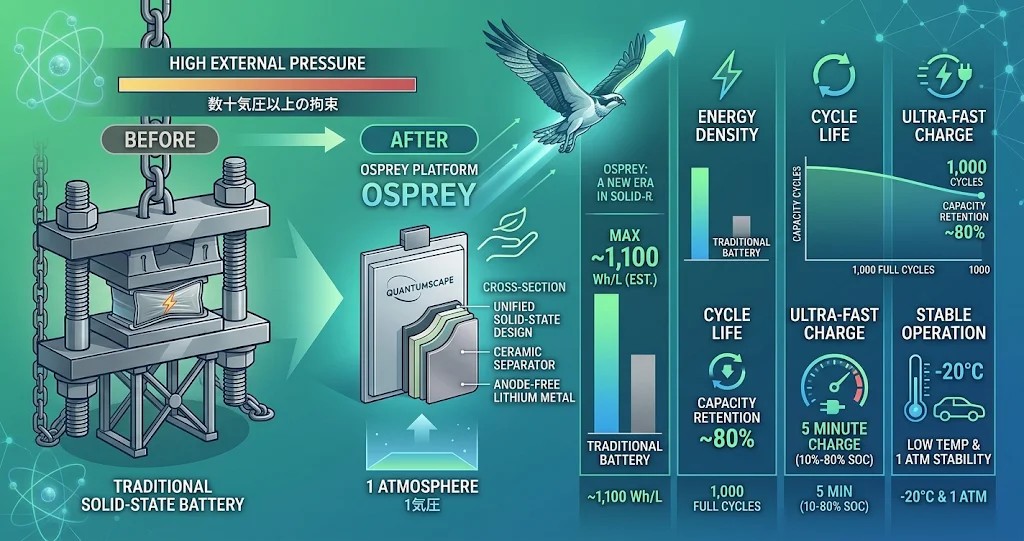
全固体電池、特に硫化物系の正極や電解質を使用する設計では、充放電に伴う材料の膨張・収縮によって粒子間に隙間ができ、性能が急速に劣化するという根本的な課題がありました。これを防ぐため、従来は数十気圧以上の高い「外圧(プレッシャー)」を常時かけ続ける大型の拘束装置が必要となり、車載化に向けた重量やコストの壁となっていました。
Ospreyプラットフォームは、同社独自のセラミックセパレーターとアノードフリー(負極集電体に直接リチウム金属を析出させる構造)リチウム金属設計に、独自の固体正極を統合しています。これにより、大気圧と同等の「1気圧」という極めて低い圧力環境下で1,000回の充放電サイクル(容量維持率 約80%)を達成しました。同社によると、硫化物系正極において1気圧下でここまでのサイクル耐久性を示した公開データは業界初となります。
主な公開スペック・テスト結果:
- エネルギー密度: 最大 約1,100 Wh/L(予測値)
- 充放電サイクル: 1気圧下で1,000フルサイクル(容量維持率 約80%)
- 急速充電性能: SOC 10%から80%まで 5分以内
- 動作環境: -20 deg C 以下の低温環境、および 1気圧での安定動作
- 柔軟性: 自社開発正極に加え、自動車メーカー顧客が開発した正極材料にも対応可能
既存のリチウムイオン電池のエネルギー密度が一般的に600〜700 Wh/L程度、急速充電に15〜30分程度を要することを考えると、1,100 Wh/Lというエネルギー密度と5分未満の超急速充電能力は圧倒的なアドバンテージです。
業界トレンドとQuantumScapeの2軸戦略
車載向け全固体電池を巡っては、日本のトヨタ自動車やパナソニック、韓国のサムスンSDI、中国のCATLなど世界的メーカーが2020年代後半から2030年頃の実用化を目指して激しい開発競争を繰り広げています。
現在、QuantumScapeは2つの大きな技術軸を推進しています。
- QSE-5(近中期の商業化軸) VW(フォルクスワーゲン)グループの電池製造会社PowerCoなどとの提携を通じ、Bサンプルセルの出荷と量産化技術の確立を目指している主力製品。
- Osprey(中長期の革新プラットフォーム軸) 今回発表された次世代プラットフォーム。自社での完成品製造だけでなく、硫化物系全固体電池の開発に取り組む競合や自動車メーカーに対して技術ライセンス供与や共同開発を行う事業モデルを見込んでいます。
業界全体が硫化物系材料の取り扱い難度(有毒な硫化水素ガスの発生リスクや高圧制御の必要性)に苦戦する中、1気圧で動作するOspreyの技術は、他社の開発ラインにも組み込める汎用性の高いソリューションとして大きな注目を集めています。
量産化に向けた今後の展望と課題
Siva Sivaram CEOが「長年にわたる先端研究開発の成果」と語る通り、Ospreyの発表は全固体電池の構造的課題を解決する重要な節目となります。しかし、研究室やパイロットテストでの優れたデータがそのまま直ちに商業化につながるわけではありません。
今後の焦点は以下の点に移ります。
- 製造プロセスのスケールアップ: 大面積・多層セルを均一かつ欠陥なく高速で量産する歩留まりの確保
- 車載規格での検証: 実際のEVバッテリーブロックに組んだ際の安全性・耐久性データ収集
- ライセンスパートナーの獲得: 自動車メーカーや既存電池メーカーとの具体的な共同開発契約の締結
現在、QuantumScapeの株価は開発進捗や決算発表に伴って変動が続いていますが、QSE-5の商業供給とOspreyによる長期ライセンスビジネスという2本柱が確立されれば、EV市場の航続距離と充電時間を劇的に変えるキープレイヤーとしての地位を一層確固たるものにするでしょう。
出典:https://jp.investing.com/news/company-news/article-93CH-1752852
QuantumScape Announces Next-Generation Platform “Osprey” — Achieving 1,000 Cycles at 1 atm in Sulfide-Based Solid-State Batteries
US-based QuantumScape (NASDAQ: QS), a leader in solid-state battery development, announced its next-generation solid-state battery platform “Osprey” on November 11, 2026. Presented alongside its ongoing efforts toward the commercialization of its conventional QSE-5 cells, this new solution targets a long-term technological leap forward.
The Technical Breakthrough of “1,000 Cycles at 1 atm”
Solid-state batteries—particularly designs employing sulfide-based cathodes or electrolytes—face a fundamental challenge: expansion and contraction of materials during charge and discharge create gaps between particles, causing rapid performance degradation. To prevent this, conventional designs required bulky clamping mechanisms that continuously applied several tens of atmospheres of high external pressure, creating weight and cost hurdles for automotive integration.
The Osprey platform integrates the company’s proprietary ceramic separator and anode-free (a structure that deposits lithium metal directly onto the anode current collector) lithium-metal design with a solid-state cathode. Through this architecture, QuantumScape achieved 1,000 charge-discharge cycles (with approximately 80% capacity retention) under an extremely low pressure environment of 1 atm, equivalent to atmospheric pressure. According to the company, this represents the first published data in the industry demonstrating such cycle durability at 1 atm for sulfide-based cathodes.
Key Published Specs and Test Results:
- Energy Density: Up to approximately 1,100 Wh/L (projected)
- Charge-Discharge Cycles: 1,000 full cycles at 1 atm (approx. 80% capacity retention)
- Fast-Charging Performance: SOC 10% to 80% in under 5 minutes
- Operating Environment: Stable operation in low-temperature environments below -20 deg C, as well as at 1 atm
- Flexibility: Compatible with in-house developed cathodes as well as cathode materials developed by automaker customers
Considering that standard lithium-ion batteries generally feature energy densities around 600 to 700 Wh/L and require 15 to 30 minutes for fast charging, an energy density of 1,100 Wh/L combined with sub-5-minute fast-charging capabilities offers a decisive advantage.
Industry Trends and QuantumScape’s Two-Pronged Strategy
In automotive solid-state batteries, global manufacturers including Japan’s Toyota Motor and Panasonic, South Korea’s Samsung SDI, and China’s CATL are engaged in intense development competition, targeting commercial application between the late 2020s and around 2030.
QuantumScape is currently advancing two major technical tracks:
- QSE-5 (Near- to Medium-Term Commercialization Track) The flagship product aiming for B-sample cell shipments and establishing mass-production technology through partnerships with entities such as PowerCo, the battery manufacturing subsidiary of the Volkswagen Group.
- Osprey (Medium- to Long-Term Innovative Platform Track) The next-generation platform announced in this update. Beyond in-house finished cell production, QuantumScape envisions a business model centered on technology licensing and joint development for automotive manufacturers and competitors working on sulfide-based solid-state batteries.
While the broader industry struggles with the handling complexity of sulfide-based materials—such as the risk of toxic hydrogen sulfide gas generation and the necessity of high-pressure control—Osprey’s ability to operate at 1 atm attracts significant attention as a highly versatile solution that can be integrated into external development pipelines.
Future Outlook and Challenges Toward Mass Production
As CEO Dr. Siva Sivaram noted that Osprey is “the result of years of advanced R&D,” the announcement marks a significant milestone in resolving structural issues inherent to solid-state batteries. However, impressive laboratory and pilot test data do not instantly translate into immediate commercialization.
Future attention will focus on the following areas:
- Manufacturing Process Scale-Up: Securing high yields for uniform, defect-free, high-speed mass production of large-area, multi-layer cells.
- Automotive-Spec Validation: Gathering safety and durability data when integrated into actual EV battery packs.
- Securing Licensing Partners: Concluding concrete joint development agreements with automakers and existing battery manufacturers.
While QuantumScape’s stock price continues to fluctuate alongside development milestones and earnings reports, a dual-track strategy built upon QSE-5 commercial supply and Osprey long-term licensing could further solidify its position as a key player capable of transforming EV driving ranges and charging speeds.
コメント