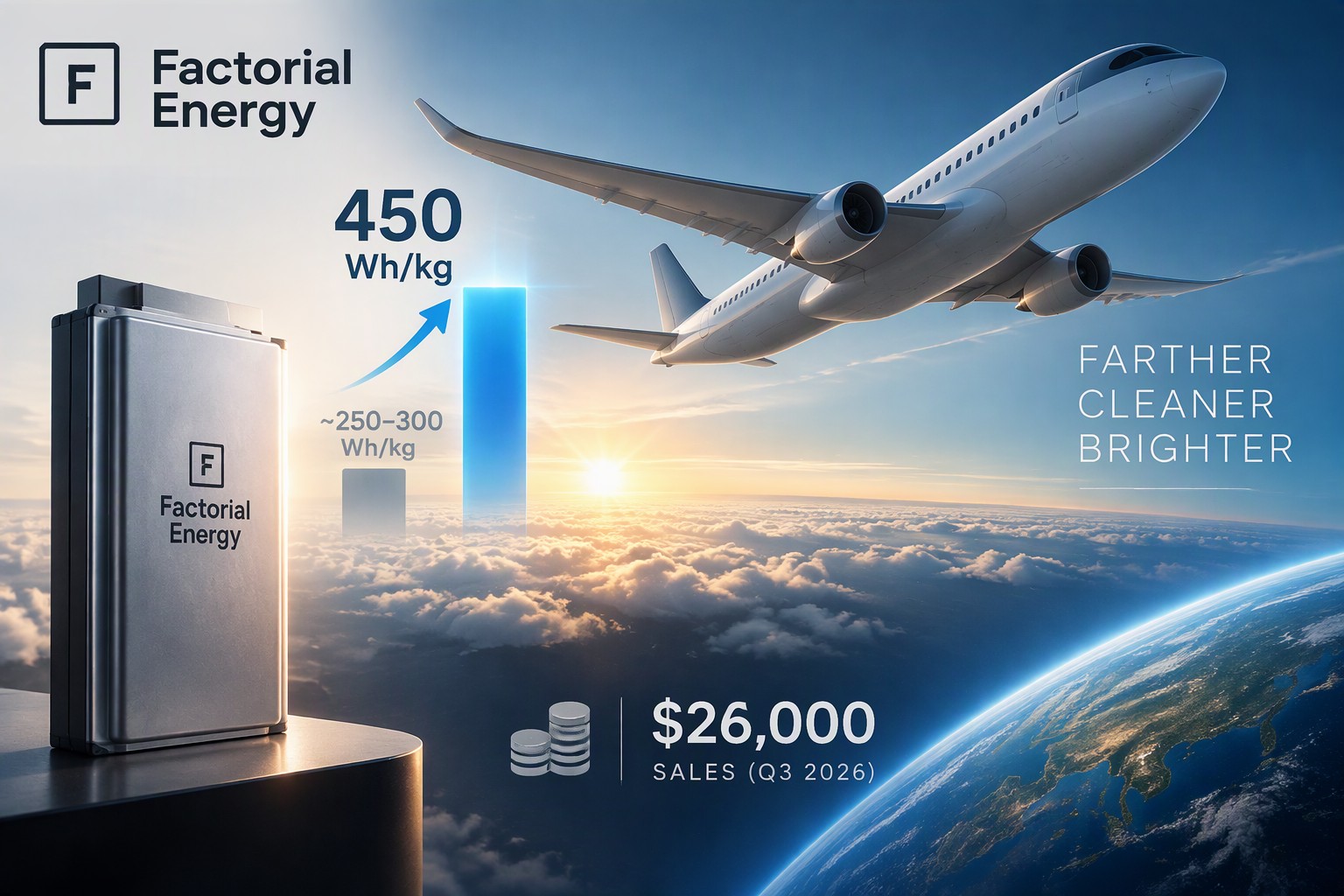
次世代電池技術の最前線に立つ米ベンチャー企業Factorial Energy(ファクトリアル・エナジー)が、商業化に向けた大きな一歩を踏み出しました。同社は2026年11月10日、2026年第3四半期(7〜9月期)決算において、航空宇宙向け電池セルで初となる2万6,000ドルの売上を計上したと発表しました。当初の予定であった2027年からの収益化を前倒しで達成した格好です。
さらに同社は、航空宇宙向けセルにおいてエネルギー密度450 Wh/kgを達成したと公表しました。一般的な次世代電池開発においてエネルギー密度450 Wh/kgという数値は、既存のリチウムイオン電池(およそ250〜300 Wh/kg程度)を大きく上回る画期的な水準であり、次世代モビリティや航空宇宙産業の航続距離を飛躍的に伸ばす鍵として注目を集めています。
しかし、この華々しいニュースの裏側には、技術的な解釈の違いや量の拡大に向けた厳しい現実が存在します。
「達成済み」と「設計目標」:技術方式で異なる450 Wh/kgの位置付け
Factorialが取り組む電池技術は大きく2つの系統に分かれており、それぞれ進捗と評価軸が異なります。
- ポリマー系固体電池(FEST) リチウム金属負極を採用した航空宇宙向けセル。今回450 Wh/kgを達成したとされるのはこの技術です。2026年7月にはTitan Dynamicsのドローン(重量20ポンド以下)に搭載され、8時間半を超える飛行記録を樹立しました(※ただし記録飛行時のセルは450 Wh/kg未満の旧仕様)。今回はこの系統で初の有償供給が行われ、売上へと結実しました。
- 硫化物系全固体電池(Solstice) 液体電解質を一切使用しない、主に自動車向けとして開発中の次世代セル。現在最大40 Ahのセルを製造しパートナー企業へ出荷・検証中ですが、Solsticeにおける「450 Wh/kg」は現時点ではあくまで設計目標であり、実証済みの性能ではありません。
業界のトレンドと競合環境:なぜ「航空宇宙」からの参入なのか?
車載向け全固体電池の実用化は、過酷な安全基準、低コスト化、そして大規模な生産体制の構築が必要となるため、多くの電池メーカー(日本のパナソニック、トヨタ自動車、韓国のLGエナジーソリューション、サムスンSDI、CATLなど)が2020年代後半から2030年頃を目指してしのぎを削っています。
このような中、Factorialのようなスタートアップが車載に先駆けて「航空宇宙・ドローン用途」で先行収益化を図るアプローチは、業界の合理的な戦略と言えます。航空宇宙や高価格帯の電動航空機(eVTOLなど)市場は、自動車市場に比べて価格感受性が低く、コストよりも「軽さとエネルギー密度の高さ」が最優先されるためです。
量産化に向けたパートナーシップと課題
Factorialは生産コストを抑えるため、既存のリチウムイオン電池生産設備を最大80%再利用できる設計を採用しており、パイロットラインでの歩留まり(良品率)は85%を超えていると報告しています。また、量産体制の構築に向けて以下のようなグローバル企業との提携を進めています。
- SK On(韓国):既存製造ネットワークを活用した生産可能性の共同評価(2026年7月MOU)
- 三井金属:Solstice向け硫化物固体電解質の共同開発(2026年9月契約)
- POSCO Future M:正極・負極材料の開発
同社はFESTのライン増強を2027年末、Solsticeのライン増強を2028年末までに完了させる計画ですが、これらはあくまで設備整備の目標です。自社製造による供給を基本とする航空宇宙向けに対し、自動車向けは委託製造や技術ライセンス供与を主軸とする計画であり、一般向け自動車メーカーとの量産用購入契約(Off-take agreement)の締結が今後の最大の壁となります。
財務面が示す現実:高い製造原価と会計上の黒字
今回の2万6,000ドルの売上計上は「有償での製品出荷」が成立したことを証明する重要な節目ですが、財務内容を精査すると依然として厳しい収益構造が浮かび上がります。
- 本業の赤字:第3四半期の営業損益は1,643万5,000ドルの赤字でした。GAAPベースの最終損益は884万ドルの純利益となっていますが、これは新株予約権(ワラント負債)の再評価に伴う2,401万2,000ドルの非現金利益によるものであり、本業で稼いだ利益ではありません。
- 製造コストの超過:初期の少量生産段階であるため固定費負担と材料費が高く、セル1個当たりの製造原価が販売価格を上回る状態が続いています(第3四半期の売上原価183万1,000ドルのうち、177万9,000ドルは在庫評価減によるもの)。
今後の展望
Factorialが本格的な商業収益を見込むのは2027年以降であり、それまでは試供品や少量出荷による不安定な売上状況が続くと予想されます。
同社が「研究開発型のベンチャー」から「持続可能な電池メーカー」へと脱皮できるかどうかは、以下の3点にかかっています。
- 航空宇宙分野における顧客の拡大と継続受注の確保
- 生産スケール拡大による製造原価の低減と歩留まりの維持
- 2020年代末の一般向け電気自動車(EV)搭載に向けた、自動車メーカーとの量産契約の締結
技術的証明である「450 Wh/kg」を、商業的な「採算性と品質の安定」へと転換できるかどうかが、今後のFactorialの成長を大きく左右することになります。
出典:https://xenospectrum.com/factorial-first-revenue-battery-milestones/
Reaching 450 Wh/kg and First Revenue Generation: How Far Has Factorial’s Next-Generation Battery Development Progressed?
US startup Factorial Energy, standing at the forefront of next-generation battery technology, has taken a major step toward commercialization. On November 10, 2026, the company announced in its third quarter (July–September) 2026 financial results that it recorded its first-ever revenue of 26,000 USD from aerospace battery cells. This marks an early achievement of commercial revenue ahead of its original 2027 timeline.
Furthermore, the company disclosed that it achieved an energy density of 450 Wh/kg in its aerospace cells. In next-generation battery development, a figure of 450 Wh/kg represents a breakthrough level that significantly exceeds existing lithium-ion batteries (around 250 to 300 Wh/kg). It is drawing strong attention as a key technology to dramatically extend the range of next-generation mobility and the aerospace industry.
However, behind this news lie nuances in technical interpretation and harsh realities regarding scaling up production.
“Achieved” vs. “Design Target”: Differing Roles of 450 Wh/kg by Technology Path
Factorial’s battery development falls into two main technology lines, each with distinct progress and evaluation metrics:
- Polymer-based Solid-State Battery (FEST) An aerospace cell utilizing a lithium-metal anode. This is the technology reported to have achieved 450 Wh/kg. In July 2026, it was integrated into a Titan Dynamics drone (weighing under 20 lbs), establishing a flight record of over 8.5 hours (*Note: the cells used during the record flight were an earlier specification below 450 Wh/kg). This technology line delivered the company’s first commercial shipment, resulting in revenue.
- Sulfide-based All-Solid-State Battery (Solstice) A next-generation cell currently under development primarily for automotive use, containing no liquid electrolyte. While Factorial is producing cells up to 40 Ah and shipping them to partners for testing, the 450 Wh/kg specification for Solstice remains a design target at this stage, not a proven performance metric.
Industry Trends and Competitive Landscape: Why Enter via Aerospace?
Commercializing all-solid-state batteries for automotive use requires meeting strict safety standards, lowering costs, and building massive production systems. Major battery manufacturers (including Japan’s Panasonic and Toyota Motor, and South Korea’s LG Energy Solution, Samsung SDI, and CATL) are competing aggressively with target timelines around the late 2020s to 2030.
Under these conditions, a startup strategy like Factorial’s—seeking early monetization in aerospace and drone applications ahead of automotive—is a rational industry approach. The aerospace and high-end electric aircraft (such as eVTOL) markets are less price-sensitive than the automotive market, prioritizing high energy density and low weight over immediate unit cost.
Partnerships for Mass Production and Remaining Challenges
To curb manufacturing costs, Factorial adopts a design allowing up to 80% re-use of existing lithium-ion battery production equipment, reporting yields above 85% on its pilot line. It is also establishing global partnerships to build out mass production capabilities:
- SK On (South Korea): Joint evaluation of manufacturing feasibility leveraging existing networks (MOU signed July 2026).
- Mitsui Mining & Smelting: Joint development of sulfide solid electrolytes for Solstice (Agreement signed September 2026).
- POSCO Future M: Development of cathode and anode materials.
The company plans to complete expansion of the FEST line by the end of 2027 and the Solstice line by the end of 2028, though these represent equipment setup targets. While aerospace supply relies primarily on in-house manufacturing, the automotive strategy centers on contract manufacturing and technology licensing. Securing off-take agreements with mainstream automakers remains the largest future milestone.
Financial Realities: High Production Costs Behind Accounting Profit
Recording 26,000 USD in revenue is an important milestone proving that commercial product delivery has taken place, but close inspection of the financials reveals an ongoing challenging cost structure:
- Operating Loss: The company reported an operating loss of 16,435,000 USD for the third quarter. While GAAP net income reached 8,840,000 USD, this was driven by a non-cash gain of 24,012,000 USD from the remeasurement of warrant liabilities, rather than operational earnings.
- Excess Production Costs: Due to early low-volume production, fixed overhead allocations and material costs remain high, keeping manufacturing costs per cell above intended selling prices (out of 1,831,000 USD in cost of goods sold for Q3, 1,779,000 USD was due to inventory write-downs).
Future Outlook
Factorial expects meaningful commercial revenue to begin in 2027 and beyond, with revenue until then likely to remain modest and variable due to sample and low-volume shipments.
Whether the company can transition from an R&D startup to a sustainable battery manufacturer will depend on three key factors:
- Expanding its aerospace customer base and securing recurring orders.
- Reducing unit manufacturing costs while maintaining high yields through production scaling.
- Finalizing mass production supply agreements with automakers for integration into mass-market electric vehicles (EVs) by the late 2020s.
Converting the technical milestone of 450 Wh/kg into commercial profitability and consistent manufacturing quality will determine Factorial’s ultimate trajectory.

コメント