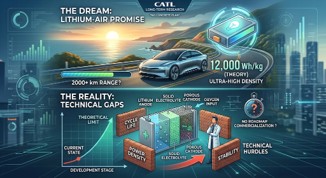
中国の車載電池最大手CATL(寧徳時代)がリチウム空気電池を長期的な研究対象として言及したことを受け、ネットメディア等で「航続距離2,000kmのEV実現か」と話題になりました。しかし、理論上の限界値と実際の車載化との間には極めて巨大な技術的ギャップが存在し、CATL側も商業化に向けた具体的なスケジュールや車載計画を発表しているわけではありません。
- 1. 注目を集めた背景とCATLの公式ロードマップ
- 2. リチウム空気電池の作動原理と「数字」のからくり
- 3. 車載化に向けた「3つの技術的障壁」
- 4. 各国研究機関の試みとアプローチ(歴史・先行研究)
- 結論・業界の見方
1. 注目を集めた背景とCATLの公式ロードマップ
報道のきっかけ
- 発言の源流:2026年の「装備強国フォーラム(Equipment Powerhouse Forum)」にて、CATLのチーフサイエンティストである呉凱(Wu Kai)氏が長期的な探査研究の方向性としてリチウム空気電池を挙げたことによる。
- 誤解の構図:理論上の超高エネルギー密度(3,505 Wh/kg〜12,000 Wh/kg)から計算される「航続距離2,000km」という数値が一人歩きしたが、これは実車セル・パック重量を考慮していない理論値に過ぎない。
CATLの世代別ロードマップ(補足情報)
CATLの技術ロードマップにおいて、リチウム空気電池は最も遠い将来に位置づけられています。
| 世代 | 主な技術 | 実用化・量産化の時期 | 特徴・位置づけ |
|---|---|---|---|
| 短期 | ナトリウムイオン電池 / 凝縮系(半固体)電池 | 実用化・量産段階 | コスト削減・低温特性向上、一部航空領域へ応用 |
| 中期 | 全固体電池(Solid-State) | 2020年代後半(2027〜2030年) | 次世代EVの主流本命、安全性の抜本的向上 |
| 長期 | リチウム空気電池(Lithium-Air) | 2030年以降(Post-2030) | 理論限界に挑戦する基礎研究フェーズ |
2. リチウム空気電池の作動原理と「数字」のからくり
作動メカニズム
- 負極:金属リチウム(Li)
- 正極:外部の大気から取り込んだ酸素(O2)を利用
- 反応:放電時に多孔質正極内でリチウムと酸素が反応し、過酸化リチウム(Li2O2)を生成。正極活性物質を車内に積む必要がないため、超軽量化が可能。
エネルギー密度表記の比較と注意点
| 指標/数値 | 計算基準・前提 | 車載実用化における現実 |
|---|---|---|
| ~12,000 Wh/kg | 酸素の質量を除外した理論計算(ガソリンに匹敵) | 機関・周辺機器が必要なため車載化では再現不可 |
| 3,505 Wh/kg | 生成物(Li2O2)と酸素の質量を含む理論限界 | 電解質や電極、集電体の重みが含まれていない |
| 700~1,200 Wh/kg | 学術研究・実験室プロトタイプ(パウチセル等) | 制御環境下のコインセル/小型セルでの最高値 |
| 現行LIB (250~300 Wh/kg) | 市販EV向けリチウムイオン電池(パックレベル) | 車載信頼性・耐久性・安全性が確保された実用値 |
3. 車載化に向けた「3つの技術的障壁」
乗用車に搭載するためには、単なる化学反応の成功だけでなく、システム全体の工学的課題をクリアする必要があります。
① 空気管理システム(BOP: Balance of Plant)の負担
- 水分・CO2の不純物除去:空気中の水分は金属リチウムと激しく反応し、CO2は炭酸リチウム(Li2CO3)を形成して正極を不可逆的に詰まらせる。
- 補機類の電力消費と重量:エアフィルター、脱湿装置、流路制御バルブなどの追加装置が必要となり、車両全体の重量増や電力損失(補機類で約5.4%以上消費)を招く。
② 充電性(可逆性)・副反応・サイクル寿命の欠如
- 過酸化リチウムの分解難度:充電時にLi2O2を分解する際、大きな過電圧が必要となりエネルギー効率(往復効率)が低下する。
- 活性酸素による劣化:反応過程で発生するスーパーオキシド(O2-)などの強酸化性分子が有機電解質や正極担体を攻撃・分解し、数十〜数百サイクルで劣化が進行する。
③ 出力密度(kW/kg)と体積エネルギー密度の不足
- EVには「長く走る(Wh/kg)」だけでなく「急加速・登坂に必要なパワーを瞬時に出す(W/kg)」ことが求められる。
- 気体反応を伴うため体積効率が悪く、限られた車体スペースに収めるのが困難。
4. 各国研究機関の試みとアプローチ(歴史・先行研究)
リチウム空気電池は長年「夢の電池」として世界中で研究が続けられています。
- IBM「Battery 500」計画(2009年〜):航続距離800kmを目指した早期の産学連携プロジェクトだったが、実用セル化に至らず終了。
- 中国科学技術大学(2025年):多孔質正極内の酸素輸送と物質移動抵抗の解明。
- 吉林大学 / 中国科学院(2024年):ゲル状ポリマー電解質を用いたセルで757.5 Wh/kg、241サイクル達成。
- アルゴンヌ国立研究所 / イリノイ工科大学(2023年):4電子反応(Li2O生成)と複合固体電解質を利用し、室温で1,000サイクル以上の動作を実証。
結論・業界の見方
- 航続距離2,000kmは「理論上の可能性」であって、製品化の目処が立ったわけではない。
- 全固体電池の要素技術(NASICON型セラミック電解質やリチウム金属負極保護技術など)との相互波及効果が期待されるため、CATLをはじめとするトップメーカーが基礎研究として投資を継続している。
- 最も楽観的なシナリオでも商用展開は2030年代以降であり、当面のEV市場の主役はLFP/NMCの進化版、ナトリウムイオン電池、および2020年代後半に登場する全固体電池となる。 Battery Design
The Quest for Theoretical 3,500 Wh/kg: The Current Status of CATL’s Lithium-Air Battery Exploration
Following statements from CATL (Contemporary Amperex Technology Co., Limited), the world’s largest automotive battery manufacturer, citing lithium-air batteries as a long-term research focus, online media exploded with headlines speculating whether “2,000 km range EVs are around the corner”. However, an immense technological chasm remains between theoretical limits and actual automotive deployment, and CATL has not announced any concrete commercialization timeline or vehicle integration plan.
1. Background of Interest & CATL’s Official Roadmap
Origin of the Headlines
- Source Statement: At the 2026 Equipment Powerhouse Forum, CATL Chief Scientist Wu Kai listed lithium-air batteries as the company’s long-term exploratory research direction.
- Misconception Mechanics: Media reports extrapolated a theoretical “2,000 km range” from ultra-high theoretical energy densities (3,505 Wh/kg to 12,000 Wh/kg). This value is strictly theoretical and ignores the real-world mass of battery cells, structural components, and pack systems.
CATL’s Generational Technology Roadmap
In CATL’s technology roadmap, lithium-air batteries are placed at the furthest horizon.
| Generation | Key Technologies | Mass Production Target | Features & Strategic Positioning |
| Short-term | Sodium-Ion Batteries / Condensed Matter (Semi-Solid) Batteries | Mass production / Initial deployment stage | Cost reduction, enhanced low-temperature performance, early aviation applications |
| Mid-term | All-Solid-State Batteries | Late 2020s (2027–2030) | Mainstream target for next-gen EVs, radical safety improvements |
| Long-term | Lithium-Air Batteries | Post-2030 | Fundamental R&D phase pushing theoretical boundaries |
2. Operating Principle of Lithium-Air Batteries and the “Numbers” Trap
Mechanism of Action
- Anode: Lithium metal ($Li$)
- Cathode: Atmospheric oxygen ($O_2$) drawn from the surrounding environment
- Reaction: During discharge, lithium reacts with oxygen in a porous cathode structure to form lithium peroxide ($Li_2O_2$). Because cathode active materials do not need to be stored inside the battery cell, ultra-lightweight designs become theoretically possible.
Comparison of Energy Density Metrics
| Metric / Value | Calculation Basis & Assumptions | Reality in Automotive Application |
| ~12,000 Wh/kg | Theoretical limit excluding oxygen mass (comparable to gasoline) | Impossible in vehicles due to required balance-of-plant systems |
| 3,505 Wh/kg | Theoretical limit including oxygen and product ($Li_2O_2$) mass | Excludes mass of electrolytes, structural electrodes, and current collectors |
| 700–1,200 Wh/kg | Academic research & lab-scale prototypes (e.g., pouch cells) | Highest values recorded under controlled lab conditions in coin/pouch cells |
| Current LIB (250–300 Wh/kg) | Commercial EV lithium-ion batteries (pack-level) | Proven automotive-grade values with established safety, durability, and reliability |
3. Three Major Engineering Barriers to Automotive Integration
Deploying this technology in passenger vehicles requires solving complex system-level engineering challenges beyond achieving chemical reactions in a laboratory.
① Balance of Plant (BOP) Air Management Burden
- Impurities (Moisture & $CO_2$) Removal: Moisture reacts violently with lithium metal, while $CO_2$ forms lithium carbonate ($Li_2CO_3$), irreversibly clogging the porous cathode structure.
- Auxiliary Power Consumption & Weight: Additional components—such as air filtration, dehumidification units, and flow control valves—add structural weight and consume auxiliary power (estimated at over 5.4% of battery output).
② Reversibility, Side Reactions, and Poor Cycle Life
- Decomposition Voltage of $Li_2O_2$: High overpotentials are required to decompose $Li_2O_2$ during charging, reducing round-trip energy efficiency.
- Degradation from Reactive Oxygen Species: Highly reactive intermediates like superoxide radicals ($O_2^-$) attack organic electrolytes and cathode substrates, causing rapid capacity degradation within dozens to hundreds of cycles.
③ Insufficient Power Density (kW/kg) and Volumetric Energy Density
- EV batteries require high specific energy ($Wh/kg$) for driving range alongside high power density ($W/kg$) for acceleration and hill-climbing.
- Gas-phase reactions result in low volumetric efficiency, making it difficult to package sufficient energy within constrained chassis dimensions.
4. Global Research Initiatives and Approaches (Historical Context)
Research on lithium-air chemistry has spanned decades as a long-term goal for the energy storage sector:
- IBM “Battery 500” Project (2009–): Early academic-industrial collaboration aimed at achieving an 800 km EV range; concluded without developing a commercial cell platform.
- University of Science and Technology of China (2025): Advanced the understanding of oxygen transport mechanisms and mass-transfer resistance in porous cathodes.
- Jilin University / Chinese Academy of Sciences (2024): Demonstrated 757.5 Wh/kg and 241 cycles in an optimized pouch cell utilizing an in-situ gelled polymer electrolyte.
- Argonne National Laboratory / Illinois Institute of Technology (2023): Demonstrated over 1,000 room-temperature charge-discharge cycles using a 4-electron reaction ($Li_2O$ formation) and a composite solid electrolyte.
Conclusion & Industry Outlook
- The 2,000 km range figure represents a theoretical benchmark, not a target tied to a near-term commercial product roadmap.
- Top battery manufacturers like CATL maintain long-term investments in fundamental lithium-air research due to technological spillovers—such as NASICON ceramic solid electrolytes and lithium metal anode stabilization techniques—that directly benefit all-solid-state battery development.
- Under optimistic projections, commercial deployment remains a post-2030 objective. For the remainder of the 2020s, the EV market will continue to be driven by advanced LFP/NMC chemistries, sodium-ion batteries, and emerging all-solid-state designs entering production in the late 2020s.

コメント