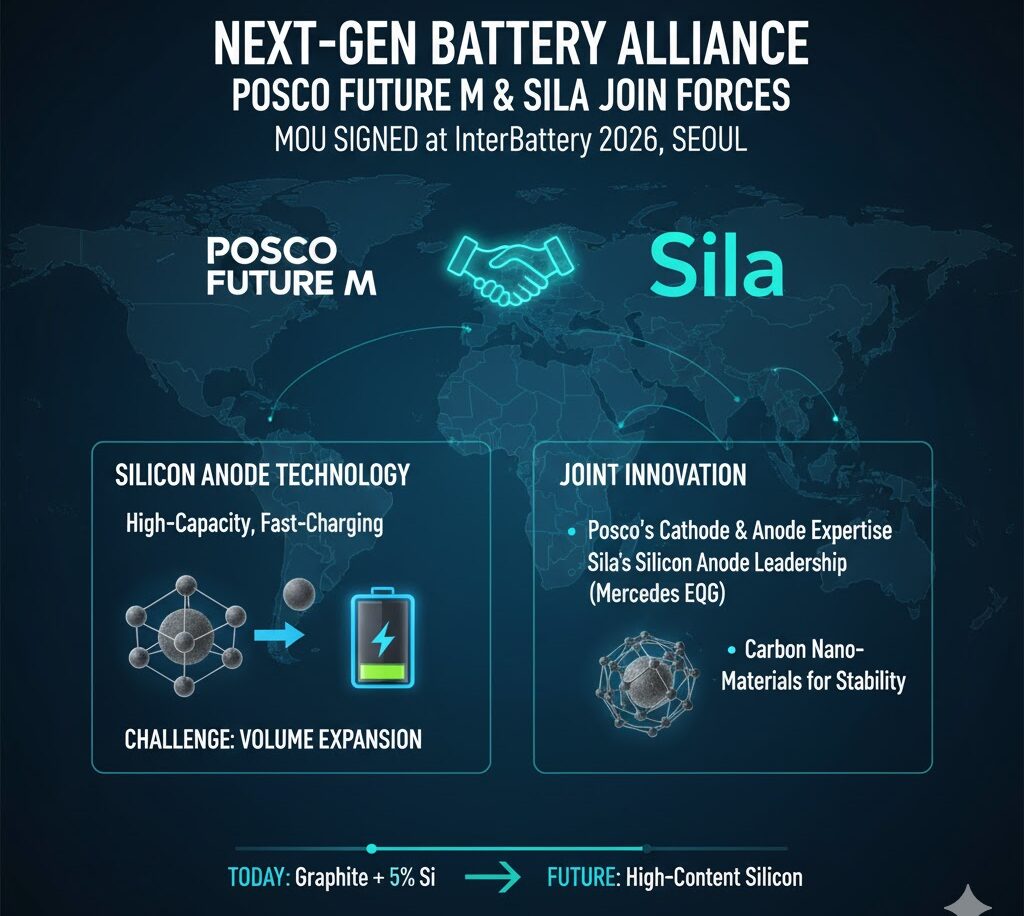
2026年3月11日、ソウルで開催された「InterBattery 2026」にて、ポスコフューチャーMとSilaは次世代電池材料の共同開発に関する覚書(MOU)を締結しました。
- 提携内容: ポスコフューチャーMの「正極・負極・炭素材料」の知見と、Silaの「シリコン負極技術」を融合。
- 主な目標: シリコン負極の課題である「膨張」の抑制と、コスト競争力の向上。
技術背景:なぜ「シリコン負極」なのか?
現在、多くの電気自動車(EV)にはグラファイト(黒鉛)負極が使用されていますが、性能向上には限界が見え始めています。
シリコン負極のメリット
- 高容量: 理論上、グラファイトの約10倍のエネルギー密度を持ち、EVの航続距離を飛躍的に伸ばせます。
- 急速充電: リチウムイオンの受け入れ性が高く、充電時間の短縮が可能です。
克服すべき課題
- 体積膨張: 充放電時にシリコンが3倍から4倍に膨張し、材料が崩壊して寿命が短くなる問題があります。
- 現在の主流: 安全性の観点から、現在はグラファイトに5%程度のシリコンを混ぜる方式が一般的です。
関連情報:両社の強みと市場の動向
今回の提携をより深く理解するための補足情報です。
1. Sila(シラ)の実績
Silaは、元Teslaのエンジニアとジョージア工科大学の教授(今回出席したグレブ ユシン氏)によって設立されたシリコン負極の先駆者です。同社の技術はすでにメルセデス ベンツの高級SUV「Gクラス」の電気自動車モデル(EQG)への採用が決定しており、実用化において世界をリードしています。
2. ポスコフューチャーMの戦略
ポスコグループは、リチウムやニッケルなどの鉱物資源の確保から、正極材・負極材の製造までを一貫して行う「フルバリューチェーン」を構築しています。今回の提携は、従来のグラファイト負極から次世代のシリコン負極、さらには全固体電池用材料へとポートフォリオを広げる狙いがあります。
3. 「炭素ナノ材料」による解決策
記事内で触れられている「炭素ナノ材料(カーボンナノチューブなど)」は、シリコンの周りをコーティングしたり、導電経路を確保したりすることで、膨張によるダメージを防ぐ役割を果たします。ポスコが持つこの技術が、Silaのシリコン負極をより安定させる鍵となります。
今後の展望
両社は技術開発にとどまらず、北米を中心としたバッテリーサプライチェーン全体での協力拡大も視野に入れています。これにより、米国のインフレ抑制法(IRA)などへの対応力を強め、次世代EV市場での主導権争いを有利に進める構えです。
出典:https://www.koreaherald.com/article/10693889
POSCO Future M and Sila Partner for Joint Development of Next-Generation Silicon Anode Materials
On March 11, 2026, at InterBattery 2026 held in Seoul, POSCO Future M and Sila signed a Memorandum of Understanding (MOU) for the joint development of advanced battery materials.
- Partnership Scope: Integrating POSCO Future M’s expertise in cathode, anode, and carbon materials with Sila’s silicon anode technology.
- Primary Goals: Mitigating “swelling” (the main challenge of silicon anodes) and enhancing cost competitiveness.
Technical Background: Why Silicon Anodes?
While graphite anodes are currently used in most electric vehicles (EVs), they are reaching their performance limits.
Advantages of Silicon Anodes
- High Capacity: Theoretically offers approximately 10 times the energy density of graphite, significantly extending EV driving range.
- Fast Charging: High lithium-ion receptivity allows for shorter charging times.
Challenges to Overcome
- Volume Expansion: Silicon expands by 3 to 4 times during charge and discharge cycles, which can cause material degradation and shorten battery life.
- Current Standard: Due to safety concerns, it is currently common to mix only about 5 percent silicon with graphite anodes.
Related Information: Strengths and Market Trends
1. Sila’s Track Record
Sila is a pioneer in silicon anodes, founded by a former Tesla engineer and a Georgia Institute of Technology professor (Gleb Yushin, who attended the ceremony). The company’s technology is already set for use in the Mercedes-Benz electric G-Class (EQG), positioning them as a global leader in commercialization.
2. POSCO Future M’s Strategy
The POSCO Group has established a “Full Value Chain,” ranging from securing mineral resources like lithium and nickel to manufacturing cathode and anode materials. This partnership aims to expand their portfolio from conventional graphite to next-generation silicon and solid-state battery materials.
3. Solution via Carbon Nanomaterials
The “carbon nanomaterials” (such as carbon nanotubes) mentioned in the report act as a coating or conductive path around the silicon, preventing damage caused by expansion. POSCO’s expertise in this area is key to stabilizing Sila’s silicon anodes.
Future Outlook
Both companies look beyond R&D to expand cooperation across the entire battery supply chain, particularly in North America. This strategy aims to strengthen compliance with regulations like the U.S. Inflation Reduction Act (IRA) and secure a leading position in the next-generation EV market.


コメント