米国のナトリウムイオン電池開発スタートアップマナ・バッテリー(Mana Battery)が、BMWグループで次世代電池開発を主導した幹部フレデリック・モーゲンシュテルン(Dr. Frederik Morgenstern)氏をセルエンジニアリング担当副社長に起用しました。目的は、独自開発する「アノードフリー(陽極不要)ナトリウムイオン電池」の顧客認定および量産・商業化スケールアップです。
- 1. 人事とキーパーソンの背景
- 2. マナ社のコア技術「アノードフリー・ナトリウムイオン電池」
- 3. マナ社の企業概要と戦略的アライアンス
- 4. 業界背景と戦略的意義(補足)
- 結論・今後の注目点
1. 人事とキーパーソンの背景
新副社長:フレデリック・モーゲンシュテルン氏(Dr. Frederik Morgenstern) GlobeNewswire
- 経歴:電池および自動車技術分野で15年以上の経験。直近はBMW Group(BMW北米法人)でバッテリー部門シニアテクノロジー&イノベーションリーダーを歴任。
- BMW時代の主な実績:
- 独ミュンヘン本社にて、BMWの第6世代(Gen6)円筒形セルおよびモジュールの量産開発チームを統括。
- 2022年の北米赴任以降、年間最大1,000万ドルのR&D予算を運用し、スタートアップや米国立研究所との30以上の共同プロジェクトを指揮。
- 急速充電技術、リチウム金属/シリコン負極、低コスト正極(LMR、LNMO、LMFPなど)の研究を網羅。
- Mana社でのミッション:白紙状態からのセル設計・OEM量産化ノウハウを活かし、アノードフリー構造の技術実証から商業ライン製造・顧客認定への移行を牽引。
2. マナ社のコア技術「アノードフリー・ナトリウムイオン電池」
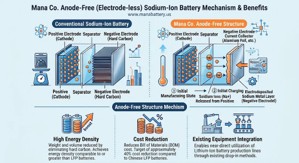
通常、ナトリウムイオン電池は負極にハードカーボン(難黒鉛化炭素)を使用します。Mana社はこれを排したアノードフリー(電極レス)構造を採用しています。
アノードフリー構造の仕組みと利点
- 作動メカニズム:製造時には負極材料を入れず、初回の充電に伴って正極(カソード)から放出されたナトリウムイオンが、直接負極側の集電体(アルミニウム箔等)上に電着(析出)して負極層を形成する。
- メリット:
- 高エネルギー密度化:重く容積を取るハードカーボンを排除することで、LFP(リン酸鉄リチウム)電池と同等以上のエネルギー密度を実現。 www.manabattery.us
- コスト削減:部材コスト(BOM)を削減。中国製LFP電池と比較して約40%のコストカットを目標に設定。
- 既存設備の流用:既存のドロップイン(Drop-in)方式により、リチウムイオン電池の製造ラインをほぼそのまま流用可能。
克服すべき工学的課題(補足情報)
- クーロン効率とサイクル寿命:活性なナトリウム金属は電解液と副反応を起こしやすく、充放電の繰り返しに伴い不可逆容量損失が生じやすい。
- デンドライト(枝状結晶)防止:析出面の均質化が不可欠。Mana社は独自の難燃性・自消性液体電解質(Proprietary Liquid Electrolyte)を自社開発することで、安全性の担保とデンドライト抑制を図っている。
3. マナ社の企業概要と戦略的アライアンス
- 設立:2023年(コロラド大学ボルダー校からのスピンアウト)。コロラド州ブルームフィールド拠点。
- ターゲット市場:防衛、電力網(ESS)、データセンター非常用電源、電気自動車(EV)。
- Saft社との連携:2024年8月、仏TotalEnergies傘下の電池大手Saft社と防衛・重要インフラ向けアノードフリーナトリウムイオン電池の共同開発・検証契約を締結。
4. 業界背景と戦略的意義(補足)
① 中国の電池サプライチェーン依存からの脱却
リチウムイオン電池や従来型ナトリウムイオン電池(ハードカーボン等)は、中国メーカーが供給網や原料の大部分を握っています。Mana社の技術はカリフォルニア・コロラド等で開発され、ナトリウム・鉄・アルミニウムなど米国本土で豊富に産出される地場素材のみで構成できるため、米国の経済安全保障(IRA法適用や地政学リスク回避)に合致しています。
② LFP対抗としての「安価・安全な選択肢」
全固体電池やリチウム金属電池がハイエンド向けを目指すのに対し、アノードフリー・ナトリウムイオン電池は「LFP代替」の超低コスト域(定置用蓄電やエントリーEV)をターゲットとしています。低温性能(-40℃〜60℃動作)にも優れ、定置用蓄電池(ESS)やデータセンター市場での早期普及が期待されています。
結論・今後の注目点
BMWでGen6バッテリーの量産構築を手掛けたトップエンジニアを迎えたことで、Mana社は「ラボでの実験段階」から「実車・産業用でのOEM顧客認定および本格量産化」への転換点に差し掛かっています。独立機関による実効サイクル寿命や往復効率(RTE)のデータ検証結果がいつ公開されるかが、今後の市場の信頼性を左右する焦点となります。
出典:https://www.bestmag.co.uk/mana-hires-former-bmw-scale-sodium-ion-cells/
Former BMW Battery Head Joins US-Based Mana Battery: Accelerating Commercialization of Anode-Free Sodium-Ion Batteries
US-based sodium-ion battery startup Mana Battery has appointed Dr. Frederik Morgenstern, who previously led next-generation battery development at the BMW Group, as Vice President of Cell Engineering. The objective of this hire is to accelerate customer qualification, mass production, and commercial scale-up of the company’s proprietary anode-free sodium-ion batteries.
1. Personnel Background and Key Executive Profile
New Vice President: Dr. Frederik Morgenstern
- Career History: Brings over 15 years of experience in battery and automotive technology. Most recently served as Senior Technology & Innovation Leader in the Battery Department at BMW Group (BMW of North America).
- Key Achievements at BMW: Led an interdisciplinary team at Munich headquarters in developing BMW’s 6th-generation (Gen6) cylindrical cells and module technologies from initial concept through mass production.
- Managed an annual R&D budget of up to $10 million following his relocation to North America in 2022, overseeing over 30 collaborative projects with startups and US national laboratories.
- Research spanned fast charging, lithium metal and silicon anodes, and low-cost cathodes such as LMR, LNMO, and LMFP.
- Mission at Mana Battery: Leverage zero-to-one cell design and OEM mass-production expertise to drive the transition from technical proof-of-concept in anode-free architectures to commercial line manufacturing and customer qualification.
2. Core Technology: Anode-Free Sodium-Ion Batteries
Conventional sodium-ion batteries typically use hard carbon anodes. Mana Battery eliminates this component in favor of an anode-free cell architecture.
Working Mechanism and Benefits
- Operating Principle: The cell is manufactured without anode material. During initial charging, sodium ions released from the cathode directly electrodeposit (plate) onto the anode current collector (aluminum foil) to form the anode layer during operation.
- Higher Energy Density: Eliminating heavy and voluminous hard carbon enables energy densities comparable to or exceeding LFP (lithium iron phosphate) batteries.
- Cost Reduction: Reduces bill-of-materials (BOM) costs, targeting up to a 40% cost reduction compared to Chinese-manufactured LFP batteries.
- Drop-in Manufacturing: Enables the utilization of existing lithium-ion battery manufacturing lines with minimal modification.
Engineering Challenges to Overcome
- Coulombic Efficiency and Cycle Life: Highly reactive sodium metal easily undergoes side reactions with organic electrolytes, leading to capacity loss over repeated cycling.
- Dendrite Mitigation: Uniform sodium deposition is critical. Mana Battery is developing a proprietary flame-retardant, self-extinguishing liquid electrolyte designed to stabilize plating morphology and suppress dendrite formation.
3. Corporate Profile and Strategic Alliances
- Founded: 2023 (Spun out from the University of Colorado Boulder); headquartered in Broomfield, Colorado.
- Target Markets: Defense, grid energy storage systems (ESS), data center backup power, and electric vehicles (EVs).
- Alliance with Saft: Signed a joint development agreement with Saft (a subsidiary of TotalEnergies) in August 2024 to codevelop and validate anode-free sodium-ion batteries for defense and critical infrastructure applications.
4. Industry Context and Strategic Significance
① Reducing Dependence on the Chinese Battery Supply Chain
Conventional lithium-ion and sodium-ion (hard carbon) supply chains are heavily dominated by Chinese manufacturers. Mana Battery’s technology utilizes domestically abundant materials—such as sodium, iron, and aluminum—enabling a localized US supply chain that aligns with economic security goals and IRA compliance.
② A Low-Cost, Safe Alternative to LFP
While solid-state and lithium-metal batteries target high-end applications, anode-free sodium-ion technology targets ultra-low-cost sectors currently dominated by LFP, such as stationary storage and entry-level EVs. Excellent low-temperature performance (-40 degC to 60 degC) further position it for early adoption in grid ESS and data centers.
Conclusion & Future Outlook
With a top engineering executive who spearheaded BMW’s Gen6 battery mass production on board, Mana Battery is entering a pivotal transition phase—moving from laboratory-scale validation toward industrial OEM qualification and full-scale commercial production. The release of third-party validated data regarding effective cycle life and round-trip efficiency (RTE) will be the key metric determining market adoption moving forward.
コメント