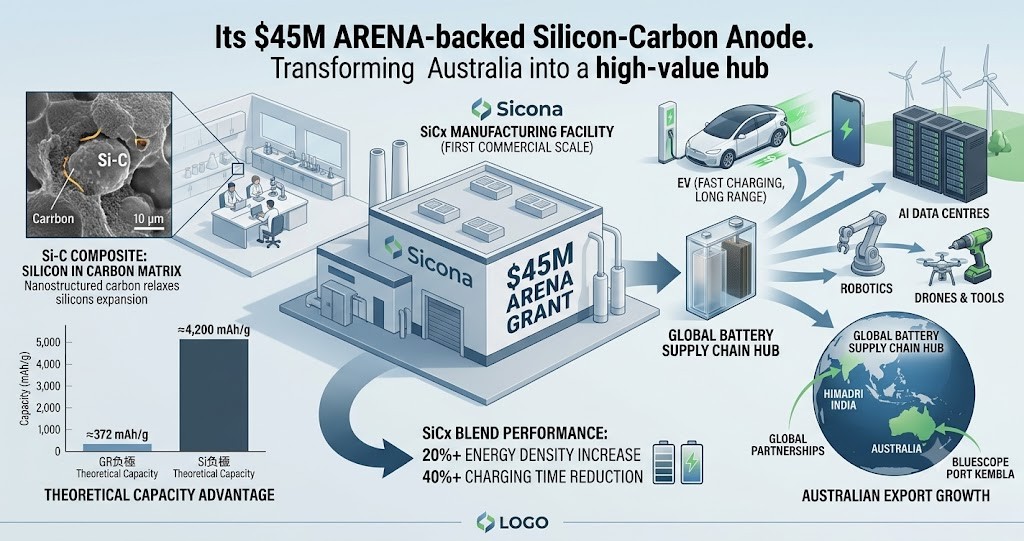
オーストラリアのベンチャー企業であるシコナ・バッテリー・テクノロジーズ(Sicona Battery Technologies)が、オーストラリア再生可能エネルギー庁(ARENA)から4500万豪ドル(約3100万米ドル)の助成金を受け、ニューサウスウェールズ州イラワラ地域に初の商業規模のシリコンカーボン電池負極材(アノード)製造施設を建設することを発表しました。本レポートでは、このニュースの概要とともに、シリコン系負極技術が注目される背景や関連する業界動向についてまとめます。
1. ニュースの概要とシコナ社の計画
シコナ社が開発する「SiCx」は、次世代のリチウムイオン電池向けシリコンカーボン負極材料です。既存の標準的なグラファイト(黒鉛)負極にこのSiCxを混合することで、従来の電池と比較してエネルギー密度を20%以上向上させ、充電時間を40%以上短縮することが可能になります。
- 初期生産計画: 第1段階として年間最大230トンのSiCx材料を生産できる製造施設を開発。
- 長期拡張計画: 将来的に年間6,500トン、長期的には年間26,500トンまで生産能力を拡大する計画。
- 立地・協業: 鉄鋼メーカーのブルースコープと協力し、ポート・ケンブラ地区内への建設を検討中。
- 戦略的提携: シコナ社は昨年、インドの化学大手ヒマドリ(Himadri)社と1500万豪ドルのライセンス契約および戦略的パートナーシップを締結しており、グローバル展開の基盤を整えています。
2. 関連情報:シリコン系負極技術が求められる背景と技術的課題
現在、リチウムイオン電池の負極材には主にグラファイトが使用されていますが、グラファイトの理論容量には限界(約372 mAh/g)があり、さらなる高エネルギー密度化へのボトルネックとなっています。これに対し、シリコンは非常に高い理論容量(約4,200 mAh/g)を持つため、次世代の負極材料として世界中で研究開発が進められています。
- 体積膨張の課題: シリコンは充放電時に約4倍の劇的な体積膨張・収縮を起こします。これにより、粒子が崩壊(微粉化)したり、電極層から剥離したりして、サイクル寿命が著しく低下するという致命的な課題があります。
- シリコンカーボン(Si-C)複合化による解決: シコナ社をはじめとする先端材料企業は、シリコンを炭素(カーボン)と複合化させたり、ナノ構造化したりすることで、膨張による応力を緩和し、導電性を確保する技術を開発しています。グラファイトに適量を「ブレンド」して使用する手法が現在の商業化の主流です。
3. 変化する市場ニーズ
シコナ社のCEOであるクリスティアン・ジョーダン氏が指摘するように、シリコン系負極の需要はEV(電気自動車)だけでなく、多方面で急増しています。
- EV市場: 航続距離の延長と、超急速充電(XFC: Extreme Fast Charging)の実現にシリコン負極は不可欠とされています。
- 新領域の台頭: 大量の電力を消費するAIデータセンターのバックアップ電源、ドローン、ロボット工学、電動工具など、限られた重量・体積で高いエネルギー密度と高出力を同時に求められる用途において、シリコン系負極の採用検討が急速に進んでいます。
4. サプライチェーンにおける重要性
今回のARENAによる巨額の資金援助は、オーストラリア政府が推進する「バッテリー・ブレークスルー・イニシアチブ」の一環です。オーストラリアはリチウムやその他の重要鉱物の世界有数の産出国ですが、これまでは未加工の原材料を輸出する比率が非常に高い状態でした。シコナ社のような先端材料の国内製造能力を育成することは、未加工鉱物の輸出国家から「高付加価値なバッテリーサプライチェーンのハブ」へと転換を図る国家戦略を反映したものです。これにより、グローバルなバッテリーサプライチェーンにおけるオーストラリアの地位向上が期待されています。
Australia’s Sicona Moves Forward with Commercialization of Silicon-Carbon Anode Technology, Targeting an Annual Capacity of Up to 26,500 Tons
Introduction
Sicona Battery Technologies, an Australian venture company, has announced that it received a 45 million AUD (approximately 31 million USD) grant from the Australian Renewable Energy Agency (ARENA) to build and operate its first commercial-scale silicon-carbon battery anode material manufacturing facility in the Illawarra region of New South Wales. This report summarizes the overview of this news, along with the background of why silicon-based anode technology is drawing attention and the relevant industry trends.
1. News Overview and Sicona’s Plans
The “SiCx” developed by Sicona is a next-generation silicon-carbon anode material for lithium-ion batteries. By blending this SiCx with existing standard graphite anodes, it is possible to improve energy density by more than 20% and reduce charging times by over 40% compared to conventional batteries.
- Initial Production Plan: Developing a manufacturing facility capable of producing up to 230 tons of SiCx material annually as the first phase.
- Long-Term Expansion Plan: Planning to scale production capacity to 6,500 tons per year in the future, and eventually to 26,500 tons per year over the long term.
- Location and Collaboration: Currently evaluating the possibility of building the facility within BlueScope Steel’s Port Kembla site in cooperation with the steelmaker.
- Strategic Partnership: Sicona signed a 15 million AUD license agreement and strategic partnership with Indian chemical major Himadri last year, laying the foundation for global expansion.
2. Relevant Information: Background and Technical Challenges of Silicon-Based Anode Technology
Currently, graphite is predominantly used as the anode material in lithium-ion batteries. However, the theoretical capacity of graphite has a limit (approximately 372 mAh/g), creating a bottleneck for further increasing energy density. In contrast, silicon has an exceptionally high theoretical capacity (approximately 4,200 mAh/g), which is why research and development are being pursued globally as a next-generation anode material.
- The Challenge of Volume Expansion: Silicon undergoes a dramatic volume expansion and contraction of about 4 times during charging and discharging. This causes a critical issue where particles collapse (pulverize) or delaminate from the electrode layer, significantly reducing cycle life.
- Solution via Silicon-Carbon (Si-C) Composites: Advanced materials companies, including Sicona, are developing technologies to relieve stress from expansion and ensure electrical conductivity by compositing silicon with carbon or nanostructuring it. The current mainstream approach for commercialization is to “blend” an appropriate amount into graphite.
3. Changing Market Needs
As Sicona’s CEO, Christian Jordan, points out, demand for silicon-based anodes is surging in various sectors beyond just EVs (electric vehicles).
- EV Market: Silicon anodes are considered essential for extending driving range and achieving Extreme Fast Charging (XFC).
- Emergence of New Sectors: The adoption of silicon-based anodes is being rapidly evaluated for applications requiring high energy density and high power output within limited weight and volume, such as backup power supplies for power-hungry AI data centers, drones, robotics, and power tools.
4. Importance in the Supply Chain
This large-scale funding from ARENA is part of the Australian Government’s “Battery Breakthrough Initiative.” Australia is one of the world’s leading producers of lithium and other critical minerals, but it has historically had a very high ratio of exporting unprocessed raw materials. Cultivating domestic manufacturing capabilities for advanced materials like Sicona’s reflects a national strategy to transition from being an exporter of raw minerals to becoming a “high-value battery supply chain hub.” This is expected to enhance Australia’s position in the global battery supply chain.
コメント