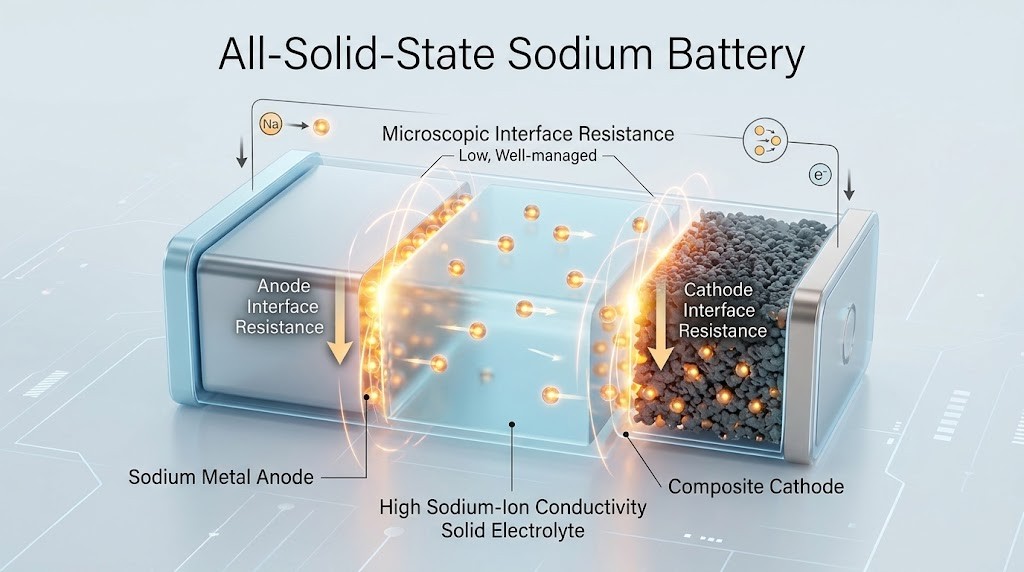
次世代の蓄電技術として、地球上に豊富に存在するナトリウム資源を活用した「全固体ナトリウム電池(SSNB)」への注目が急増しています。しかし、これまでの研究開発や報道では「イオン伝導度が〇〇 S/cmに達した」「〇〇サイクル達成」といった単一の性能指標(単一メトリクス)で語られることがほとんどでした。
しかし、2024年から2026年にかけて発表された55件の最新実データ(コインセルレベル)を多次元的に分析した研究により、「単一のスペックが高くても、長期的な電池寿命や実用性は保証されない」という現実が浮き彫りになりました。本稿では、最新のデータ解析に基づき、全固体ナトリウム電池の現在地と実用化に向けた課題を記事形式でわかりやすく解説します。
1. 「イオン伝導度が高い=長寿命」ではないという事実
これまでの全固体電池開発では、電解質内部をナトリウムイオンがいかに速く移動できるかを示す「イオン伝導度」が最も重視されてきました。しかし、55件のシステムデータを統合した分析により、バルクのイオン伝導度と電極との間の「界面抵抗」には直接的な相関が見られないことが判明しました。
具体的にデータを見ると、非常に高いイオン伝導度(10-3 S/cm 超)を達成している23のシステムのうち、高い容量維持率(90%以上)を維持できたのはわずか11件(約半分)にとどまり、95%以上を維持できたのは5件(約20%)しかありませんでした。
どれだけ電解質自体のイオン透過性が良くても、電極と電解質の接触面(界面)で劣化が進んだり抵抗が増大したりすれば、電池全体としての寿命は急速に縮んでしまうことを示しています。
2. 隠れた最大の壁:「スタック圧力(機械的拘束)」の課題
実用化に向けて最も見落とされがちなのが、「電池にどれだけの圧力をかけ続けなければならないか」という機械的拘束(スタック圧力)の問題です。
今回のデータ分析において、評価対象となったシステムの78%(38件)が 10 MPa(約100気圧)を超える非常に高いスタック圧力を必要としていました。特に、優れたイオン伝導性を持つことで知られる硫化物系やハロゲン化物系電解質では、70〜400 MPaもの圧力を加える条件でデータが取得されているケースが多く存在します。
圧力あたりのサイクル寿命(PNCL)を評価すると、高圧を要するシステムの多くは 100 サイクル/MPa 未満にとどまっています。車載や定置用電源としてモジュール化・パック化する際、常に数百気圧の圧力を維持する機構を組み込むことはコストや重量の面で現実的ではありません。「高圧力をかけないと動作しない」問題の解決こそが、現在の全固体ナトリウム電池における最大のボトルネックと言えます。
3. 電解質ファミリ別の特徴と傾向(アーキタイプ)
本研究で分析された主要な電解質ファミリには、それぞれ明確なトレードオフが存在します。
- NASICON型・酸化物系(23件)
- 特徴: 最もバランスが取れており、低リスクに分類されるシステムが多い(12/23件)。
- 強み: 2025年以降のドープ型NASICONなどでは、わずか 0.5 MPa(5気圧程度)という低圧環境でも安定して駆動し、高い圧力正規化サイクル寿命(PNCL: 400〜6000 サイクル/MPa)を達成している例が報告されています。
- ポリマー系(17件)
- 特徴: 柔軟性があり加工しやすい反面、界面品質指数(IQI)の中央値が全ファミリ中で最も低く、界面抵抗が 100Ω・cm2 以上に留まりやすい傾向があります。
- 可能性: 界面抵抗の課題はあるものの、一部の最適化されたシステムでは 12,000 サイクルを超える超長寿命が報告されるなど、特定の用途で強いポテンシャルを秘めています。
- 硫化物・セレン化物系(3件) / ハロゲン化物系(7件)
- 特徴: 非常に高いバルクイオン伝導度を誇り、初期特性に優れます。
- 課題: 構造を維持するために極めて高い外部拘束圧力(中央値 300 MPa)を必要とし、多次元評価では「高リスククラス」に分類される割合が高くなっています。
4. これからの全固体ナトリウム電池に必要な4つの設計方針
これらの多次元データに基づき、研究開発を実用化へ繋げるための新たなガイドラインとして以下の4点が示されています。
- 界面品質と伝導度の同時最適化 単に電解質単体の伝導度を追うのではなく、電極との界面抵抗を抑え、界面品質指数(IQI)を同時に高める設計が必要です。
- スタック圧力への依存度低減 実用的なセルモジュールに組み込めるよう、低圧(~数MPa以下)でも高いサイクル寿命を維持できる材料・界面設計へのシフトが不可欠です。
- 多次元指標(FRIやPNCLなど)による包括的評価 容量低下率(CFR)、界面抵抗(Rint)、必要圧力(P)などを統合した故障リスクインデックス(FRI)のような多角的な基準で性能を評価・報告する標準化が求められます。
- 大型・実用フォーマットでの検証 コインセルレベルでの優れた成果を、今後は実用化に近い高厚み・多層の大型セル(ポーチセル等)へ展開した際にも再現できるかの検証が次のステップとなります。
まとめ
2024〜2026年のデータは、全固体ナトリウム電池が「単一のスペック指標を競う段階」から、「機械的・化学的・電気化学的なバランスを総合的に最適化する段階」へと移行したことを明確に示しています。今後は、低圧力・低界面抵抗を両立する材料開発とセル設計が進むことで、実用化への道筋がより現実的なものとなっていくでしょう。
Can solid-state sodium batteries be measured by ionic conductivity alone? Degradation mechanisms and challenges toward practical application of all-solid-state sodium batteries.
As a next-generation energy storage technology, there is a rapid surge of interest in all-solid-state sodium batteries (ASSNBs), which utilize sodium resources that are abundant on Earth. However, past research, development, and reporting have mostly been discussed through single performance metrics (single metrics), such as “ionic conductivity reaching XX S/cm” or “achieving XX cycles”.
However, a study published between 2024 and 2026 that multidimensionally analyzed 55 pieces of latest actual data (at the coin-cell level) brought to light the reality that “even if a single specification is high, long-term battery life and practicality are not guaranteed.” Based on the latest data analysis, this article provides an easy-to-understand explanation of the current standing of solid-state sodium batteries and the challenges toward their practical application in an article format.
- The Fact That “High Ionic Conductivity Does Not Equal Long Life” In conventional solid-state battery development, “ionic conductivity”—which indicates how fast sodium ions can move inside the electrolyte—has been given the highest priority. However, analysis integrating data from 55 systems revealed that there is no direct correlation between bulk ionic conductivity and the “interfacial resistance” between the electrolyte and electrodes.
Looking specifically at the data, among the 23 systems achieving very high ionic conductivity (exceeding $10^{-3} \text{ S cm}^{-1}$), only 11 systems (about half) maintained a high capacity retention rate (90% or higher), and only 5 systems (about 20%) maintained 95% or higher.
This indicates that no matter how good the ion permeability of the electrolyte itself is, if degradation progresses or resistance increases at the contact surface (interface) between the electrode and the electrolyte, the lifespan of the battery as a whole will rapidly shorten.
- The Hidden Greatest Wall: The Challenge of “Stack Pressure (Mechanical Confinement)” The issue of mechanical confinement (stack pressure)—specifically, how much pressure must be continuously applied to the battery—is most easily overlooked for practical application.
In this data analysis, 78% (38 systems) of the evaluated systems required extremely high stack pressure exceeding 10 MPa (about 100 atmospheres). In particular, for sulfide-based and halide-based electrolytes, which are known for their excellent ionic conductivity, data is often acquired under conditions requiring pressures as high as 70 to 400 MPa.
When evaluating the pressure-normalized cycle life (PNCL), many systems requiring high pressure remain below 100 cycles per MPa. When modularizing and packaging for automotive or stationary power sources, incorporating a mechanism that constantly maintains pressures of several hundred atmospheres is not realistic in terms of cost and weight. Solving the problem of “not working unless high pressure is applied” can be said to be the greatest bottleneck in current solid-state sodium batteries.
- Characteristics and Trends by Electrolyte Family (Archetypes) Clear trade-offs exist for each of the major electrolyte families analyzed in this study.
- NASICON-type / Oxide-based (23 systems)
- Characteristics: Most balanced, with many systems classified as low-risk (12 of 23 systems).
- Strengths: Doped NASICON systems from 2025 onwards have been reported to operate stably even in low-pressure environments of just 0.5 MPa (about 5 atmospheres) and achieve high pressure-normalized cycle life (PNCL: 400 to 6,000 cycles per MPa).
- Polymer-based (17 systems)
- Characteristics: While flexible and easy to process, the median interface quality index (IQI) is the lowest among all families, and interfacial resistance tends to remain at $100 \ \Omega \cdot \text{cm}^2$ or higher.
- Potential: Despite interfacial resistance challenges, some optimized systems have reported ultra-long lifespans exceeding 12,000 cycles, holding strong potential for specific applications.
- Sulfide/Selenide-based (3 systems) / Halide-based (7 systems)
- Characteristics: Boast very high bulk ionic conductivity and excel in initial characteristics.
- Challenges: Require extremely high external confinement pressure (median of 300 MPa) to maintain structure, and have a high proportion classified into the “high-risk class” in multidimensional evaluations.
- Four Design Policies Needed for Future Solid-State Sodium Batteries Based on these multidimensional data, the following four points are presented as new guidelines for connecting research and development to practical application:
- Simultaneous Optimization of Interface Quality and Conductivity: Instead of simply pursuing the conductivity of the electrolyte alone, it is necessary to suppress interfacial resistance with the electrode and simultaneously increase the interface quality index (IQI).
- Reduction of Dependence on Stack Pressure: A shift to materials and interface design that can maintain high cycle life even under low pressure (~several MPa or less) is essential so that they can be incorporated into practical cell modules.
- Comprehensive Evaluation Using Multidimensional Metrics (such as FRI and PNCL): Standardization is required to evaluate and report performance using multifaceted criteria, such as the Failure Risk Index (FRI), which integrates the capacity fade rate (CFR), interfacial resistance ($R_{\text{int}}$), and required pressure ($P$).
- Validation in Large-Scale, Practical Formats: The next step is to verify whether the excellent results achieved at the coin-cell level can be reproduced when deployed to large-scale cells close to practical application, such as high-loading, multi-layer pouch cells.
Conclusion The data from 2024 to 2026 clearly shows that solid-state sodium batteries have transitioned from the “stage of competing for single specification metrics” to the “stage of comprehensively optimizing mechanical, chemical, and electrochemical balance.” Moving forward, the development of materials and cell design that balance low pressure and low interfacial resistance will make the path to practical application much more realistic.

コメント