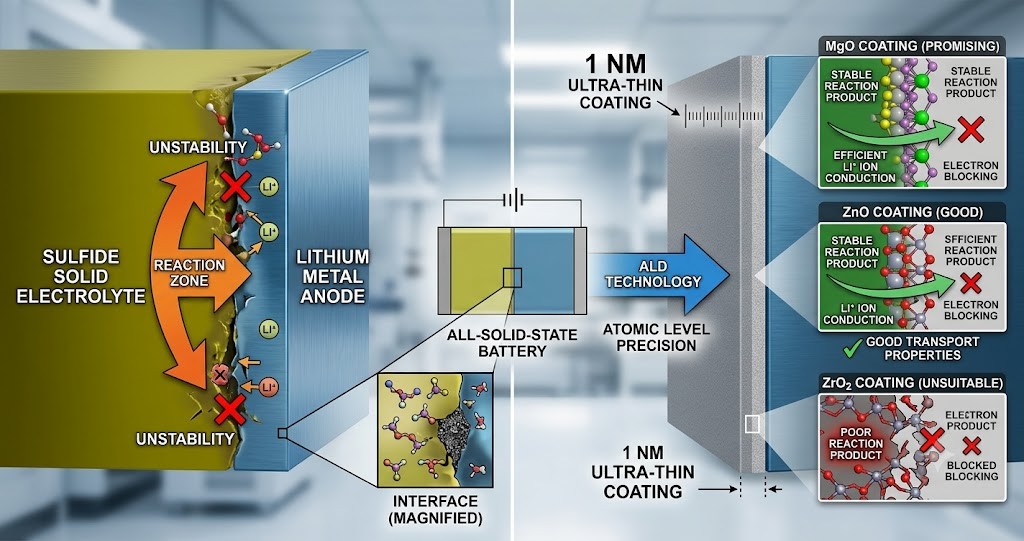
全固体電池の商業化に向けた最大の課題の一つは、材料間の化学的「不安定性」にあります。米国エネルギー省(DOE)アルゴンヌ国立研究所による今回の研究成果は、計算科学と高度な実験手法を融合させることで、この課題を克服する新しいアプローチを提示しています。
本記事の要点に、全固体電池におけるコーティングの役割やALD技術の意義などの関連情報を付け加えて分かりやすくまとめました。
1. 研究の背景と全固体電池の課題
全固体電池は、現在主流のリチウムイオン電池よりも多くのエネルギーを蓄えることができ、液体の電解質を使わないため安全性が大幅に向上すると期待されています。
- 硫化物系固体電解質の弱点: 最も有望視されている「硫化物系」の固体電解質は、化学的に非常に不安定です。特にリチウム金属や正極材料と接触する「界面」で不要な化学反応を起こしやすく、これが電池の性能低下や寿命短縮の大きな原因となっていました。
- 解決策としての超薄膜コーティング: この界面反応を防ぐため、髪の毛の約10万分の1にあたる「わずか1ナノメートル」という極薄の保護層(コーティング)を施すアプローチが注目されています。
2. アルゴンヌ国立研究所による画期的な発見
研究チームは、リチウムリン硫黄塩化物(LPSCl)と呼ばれる硫化物固体電解質を対象に、計算(密度汎関数理論)と実験を組み合わせて最適なコーティング材料を探索しました。
- 「反応しないこと」よりも重要な条件の発見: 従来は単に「反応性が低い(安定した)材料」が良いと予測されがちでした。しかし今回の研究により、最も重要なのは「コーティングが界面で反応した際に、どのような化合物が形成されるか」であると判明しました。
- 理想的な界面のメカニズム: 優れたコーティング材料は、反応によって「リチウムイオンはスムーズに通すが、電子の流れはしっかり遮断する」という理想的な副産物を形成することが分かりました。
3. スクリーニングされた材料とその結果
研究チームは、原子レベルで均一な薄膜を形成できる「原子層堆積法(ALD)」を用い、複数の酸化物コーティングの性能を検証しました。
| コーティング材料 | 実験結果と評価 | 反応生成物の特徴 PDF |
| 酸化マグネシウム | 極めて有望 | リチウム金属との接触時の安定性を高め、界面抵抗を低減。電子を遮断しつつリチウムイオンを効率的に移動させる。 |
| 酸化亜鉛 | 良好 | 事前の計算では全体的な反応性が高いと予測されていたが、形成された反応生成物のおかげで優れた輸送特性を示した。 |
| 酸化ジルコニウム | 不適合(性能劣悪) | 好ましくない反応生成物を形成してしまい、電池性能を悪化させた。 |
※ナノスケール材料センターの最新顕微鏡等により、コーティングが粉末表面に均一に分布していることも確認されています。
4. 【関連情報】この研究がもたらすブレイクスルーとは?
今回の発表には、単に「酸化マグネシウムが良い」という結果以上の重要な意味が含まれています。
背景1:ALD(原子層堆積法)の重要性
ALDは、気体状の原料を交互に供給することで、材料の表面に原子1層ずつ(ナノメートル単位)の膜をきれいに積み重ねる技術です。固体電解質は細かな「粉末」であることが多く、従来のコーティング技術では隙間やムラができがちでした。ALDを用いることで、複雑な粉末の表面すべてに均一な1ナノメートルの保護壁を作ることが可能になります。
背景2:材料探索のスピードアップ(マテリアルズ・インフォマティクスへの貢献)
新しい材料を一つずつ実験で作って試す手法では、膨大な時間とコストがかかります。今回、アルゴンヌ国立研究所が「計算(予測)モデル」を確立し、さらに「反応生成物の性質が鍵である」という明確な評価基準(指標)を見出したことで、今後は世界中の研究者がより広範な材料設計空間から、次の有望なコーティング候補をハイスピードでスクリーニングできるようになります。
5. まとめ
今回の研究は、全固体電池の寿命と安全性を大きく左右する「界面の制御」に明快な答えを与えました。
計算科学によって界面での挙動を正確に予測し、それをALDによるナノメートル単位の精密コーティング実験で実証したこのプロセスは、硫化物系固体電解質の実用化を大きく手繰り寄せる一歩となります。
[New Development in All-Solid-State Battery Industry] Ultra-Thin Coating Technology to Prevent Degradation of Sulfide-Based Electrolytes
One of the greatest challenges for the commercialization of all-solid-state batteries lies in the chemical “instability” between materials. The recent research outcome from the U.S. Department of Energy (DOE) Argonne National Laboratory presents a novel approach to overcoming this hurdle by blending computational science with advanced experimental methods. This report provides a clear, comprehensive summary of the key points, supplemented with relevant context such as the role of coatings in all-solid-state batteries and the significance of ALD technology.
1. Research Background and Challenges in All-Solid-State Batteries
All-solid-state batteries are highly anticipated to store more energy than current mainstream lithium-ion batteries and offer significantly improved safety since they do not use liquid electrolytes.
- Weakness of Sulfide-Based Solid Electrolytes: The highly promising “sulfide-based” solid electrolytes are chemically very unstable. They are prone to unwanted chemical reactions particularly at the “interfaces” where they contact lithium metal or cathode materials, which has been a major cause of degraded battery performance and shortened lifespan.
- Ultra-Thin Coating as a Solution: To prevent these interfacial reactions, an approach of applying an extremely thin protective layer (coating) of “just 1 nanometer”—about 100,000 times thinner than a human hair—has been drawing significant attention.
2. Breakthrough Discovery by Argonne National Laboratory
Focusing on a type of sulfide solid electrolyte called lithium phosphorus sulfur chloride (LPSCl), the research team searched for the optimal coating materials by combining computations (Density Functional Theory) and experiments.
- Discovery of a Condition More Critical Than “Not Reacting”: Previously, it was often assumed that simply choosing a “low-reactivity (stable) material” would be ideal. However, this study revealed that the most critical factor is actually “what kind of compounds are formed when the coating reacts at the interface”.
- Mechanism of an Ideal Interface: It was discovered that excellent coating materials form an ideal byproduct through reaction: one that allows lithium ions to pass through smoothly while tightly blocking the flow of electrons.
3. Screened Materials and Their Results
Using Atomic Layer Deposition (ALD), a method capable of forming uniform thin films at the atomic level, the research team verified the performance of multiple oxide coatings.
- Magnesium Oxide (Highly Promising): It enhances the stability of the electrolyte when contacting lithium metal and reduces interfacial resistance. It efficiently moves lithium ions while blocking electron flow.
- Zinc Oxide (Good): Although pre-computation predicted high overall reactivity, it still demonstrated excellent transport properties thanks to the formed reaction products.
- Zirconium Oxide (Unsuitable / Poor Performance): It formed unfavorable reaction products, which ultimately degraded battery performance.
Note: The uniform distribution of the coating on the powder surface was also confirmed using advanced microscopes at the Center for Nanoscale Materials.
4. Contextual Analysis: What Breakthrough Does This Research Bring?
This announcement carries profound significance that goes far beyond the simple conclusion that “magnesium oxide is good.”
- Background 1: The Importance of ALD (Atomic Layer Deposition)ALD is a technique that cleanly stacks a film layer by layer at the atomic scale (nanometer level) onto a material’s surface by alternately supplying gaseous precursors. Solid electrolytes are frequently fine “powders,” and conventional coating techniques often left gaps or unevenness. By utilizing ALD, it becomes possible to create a uniform 1-nanometer protective wall over the entire intricate surface of the powder.
- Background 2: Accelerating Material Discovery (Contribution to Materials Informatics) The traditional method of fabricating and testing new materials one by one in experiments requires an enormous amount of time and cost. Now that Argonne National Laboratory has established a “computational (predictive) model” and uncovered a clear evaluation standard—that “the properties of the reaction products hold the key”—researchers worldwide will be able to screen next promising coating candidates from a broader material design space at high speed.
5. Conclusion
This study provides a clear answer to “interfacial control,” a factor that heavily dictates the lifespan and safety of all-solid-state batteries. This process—accurately predicting interfacial behavior through computational science and validating it via nanometer-scale precision coating experiments with ALD—represents a major leap forward in bringing sulfide-based solid electrolytes into practical application.


コメント