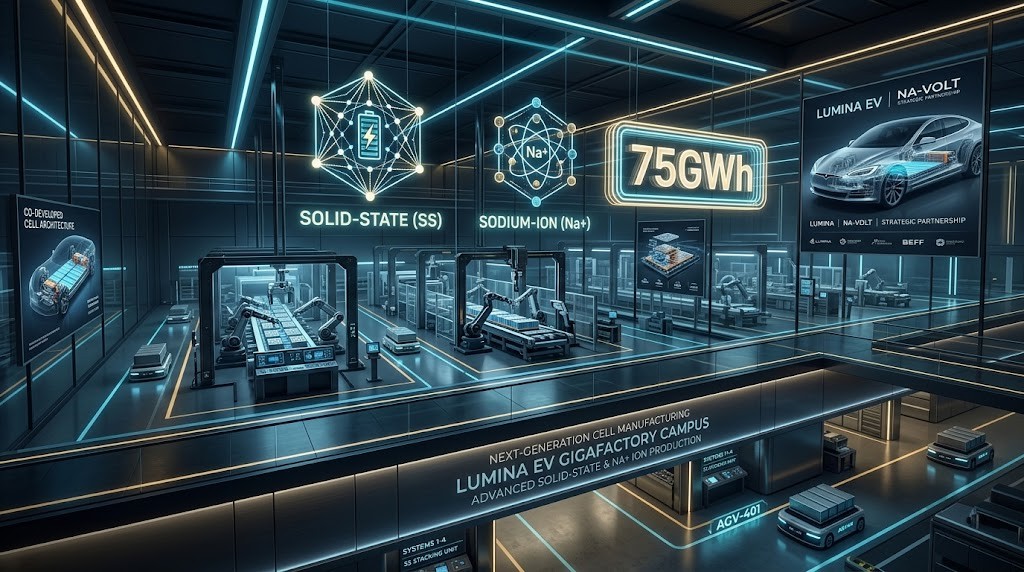
長安汽車とCATLは、既存の合弁事業におけるバッテリーセル生産能力を従来の50GWhから75GWhへと増強する計画を発表しました。今回の合意は、短期的なギガファクトリーの生産能力拡大にとどまらず、全固体電池やナトリウムイオン電池といった次世代電池化学の領域における技術提携の深化を含む、中長期的な戦略的パートナーシップの強化を意味しています。
1. 生産能力増強と新工場の概要
- 生産能力の拡大:従来計画の50GWhに対し、25GWhを追加して合計75GWhへ拡大。
- 新工場の計画:重慶市と四川省にまたがるハイテクゾーンに、敷地面積約70万平方メートルの新施設を建設。
- 投資額とスケジュール:投資額は約50億元(約1,000億円規模)。2027年に操業を開始し、3年以内に増強分の25GWhを達成予定。
- 供給先ブランド:合弁会社(2023年設立)は、すでに長安汽車グループのEVブランドであるAvatr(阿維塔)、Deepal(深藍)、Nevo(啓源)へバッテリーを供給中。新工場ではCATLの最新技術を投入したセルを製造。
2. ナトリウムイオン電池における具体的成果
両社はすでにナトリウムイオン電池の実装において具体的な成果を上げています。
- Naxtraセルの採用:CATLが開発したナトリウムイオン電池「Naxtra」を長安汽車の乗用車プロジェクトで試験導入。
- 量産モデル「Nevo A06」:Naxtraセルを採用した45kWhのバッテリーパックを搭載したセダン。CLTCモードで航続距離400km以上を達成見込み。
- エネルギー密度:セルのエネルギー密度は175Wh/kgに達し、従来のLFP(リン酸鉄リチウム)電池の領域に肉薄しています。
3. 全固体電池の開発動向と業界規格の標準化
次世代電池の主導権争いに向け、自社開発と業界標準化の双方が進んでいます。
- 長安汽車の「Golden Bell(金鐘罩)」計画:
- エネルギー密度:最大400Wh/kgを目指す。
- 性能目標:航続距離1,500km以上、サイクル寿命5,000回以上、6C超急速充電に対応。
- ロードマップ:2026年に搭載車両を市場投入し、2027年の量産化を目指す(※開発目標値であり、量産時の実効性能は検証段階)。
- 中国国家規格の策定(GB/T 48093.1-2026):
- 2026年8月末、全固体、半固体、ハイブリッド電池の分類・用語を厳格に定義する新規格が発行(2028年初頭に正式施行予定)。
- Greater Bay Technology(巨湾技研)などのメーカーが、すでに同規格に準拠した試験済み電池を発表するなど、標準化への対応が加速しています。
4. 関連情報・補足解説
【OEMと電池メーカーの新たな協調モデル】
近年、中国NEVメーカー各社がCATL依存からの脱却を目指して電池の自社開発やマルチサプライヤー化を進める中、長安汽車はCATLとの資本・技術的な結びつきを一層強化する道を選びました。OEM側の自社技術開発(Golden Bell)と、大手電池メーカー(CATL)の先端量産ラインや次世代セル(Naxtra等)のプラットフォーム活用を組み合わせる「共同開発・合弁生産モデル」の代表例と言えます。
【ナトリウムイオン電池の商用化インパクト】
175Wh/kg級のナトリウムイオン電池が実用セダン(Nevo A06)に採用されたことは、リチウム資源のリスクヘッジおよびエントリークラスEVの低価格化において重要な節目となります。低温特性に優れるナトリウムイオン電池と、エネルギー密度の高いLFP/三元系を併用・相互補完させる動きが今後さらに広がると見られます。
出典:https://batteryindustry.net/changan-and-catl-plan-to-boost-battery-production-capacity-to-75-gwh/
Changan Automobile and CATL Expand Battery Production Capacity to 75GWh: Deepening Cooperation in All-Solid-State and Sodium-Ion Batteries
Changan Automobile and CATL have announced plans to expand battery cell production capacity in their existing joint venture from the previously planned 50GWh to 75GWh. This agreement signifies not only a short-term expansion of gigafactory production capacity, but also the strengthening of a medium- to long-term strategic partnership, including deeper technical cooperation in next-generation battery chemistries such as all-solid-state batteries and sodium-ion batteries.
1. Overview of Capacity Expansion and New Facility
- Capacity Expansion: Adding 25GWh to the original 50GWh plan, bringing the total capacity to 75GWh.
- New Facility Plan: Construction of a new facility covering approximately 700,000 square meters in a high-tech zone spanning Chongqing City and Sichuan Province.
- Investment and Timeline: Estimated investment is approximately 5 billion RMB (approx. 100 billion JPY). Operations are scheduled to begin in 2027, with the additional 25GWh capacity expected to be achieved within 3 years.
- Target Brands: The joint venture (established in 2023) already supplies batteries to Changan Automobile Group EV brands including Avatr, Deepal, and Nevo. The new facility will manufacture cells utilizing CATL latest battery technology.
2. Concrete Achievements in Sodium-Ion Batteries
The two companies have already achieved concrete progress in the commercial deployment of sodium-ion batteries.
- Adoption of Naxtra Cells: Trial introduction of CATL newly developed sodium-ion battery cells, “Naxtra,” across multiple passenger car projects at Changan Automobile.
- Mass Production Model “Nevo A06”: A sedan equipped with a 45kWh battery pack using Naxtra cells, expected to achieve a driving range of over 400km under the CLTC standard.
- Energy Density: Cell energy density reaches 175Wh/kg, closely approaching the performance levels of conventional LFP (lithium iron phosphate) batteries.
3. All-Solid-State Battery Development Trends and Industry Standardizing
Both in-house technological development and industry standardization are advancing rapidly in the race for leadership in next-generation battery technology.
- Changan Automobile “Golden Bell” Plan:
- Target Energy Density: Aiming for up to 400Wh/kg.
- Performance Targets: Driving range of over 1,500km, cycle life of over 5,000 cycles, and support for 6C ultra-fast charging.
- Roadmap: Planning to introduce equipped vehicles to the market in 2026, aiming for mass production in 2027 (Note: These figures represent development targets, and performance verification for full mass production is ongoing).
- Establishment of Chinese National Standard (GB/T 48093.1-2026):
- In late August 2026, a new standard defining classifications and terminology for all-solid-state, semi-solid-state, and hybrid batteries was issued, scheduled for official enforcement in early 2028.
- Manufacturers such as Greater Bay Technology have already announced batteries tested in compliance with these new requirements, accelerating industry alignment.
4. Relevant Context and Supplementary Analysis
[A New Collaborative Model Between OEMs and Battery Manufacturers]
While many Chinese NEV makers are currently accelerating in-house battery development and multi-sourcing to reduce dependence on CATL, Changan Automobile has chosen to further strengthen its capital and technical alliance with CATL. This represents a prime example of a “co-development and joint manufacturing model,” combining the OEM’s internal technology roadmap (Golden Bell) with a battery giant’s advanced mass-production infrastructure and next-generation cell platforms (such as Naxtra).
[Commercial Impact of Sodium-Ion Batteries]
The deployment of 175Wh/kg-class sodium-ion batteries in a practical production sedan (Nevo A06) serves as a key milestone for hedging lithium resource risks and lowering entry-level EV manufacturing costs. Complementary utilization strategies—pairing sodium-ion batteries (which offer superior low-temperature performance) alongside high-energy-density LFP or ternary chemistries—are expected to gain further momentum.


コメント