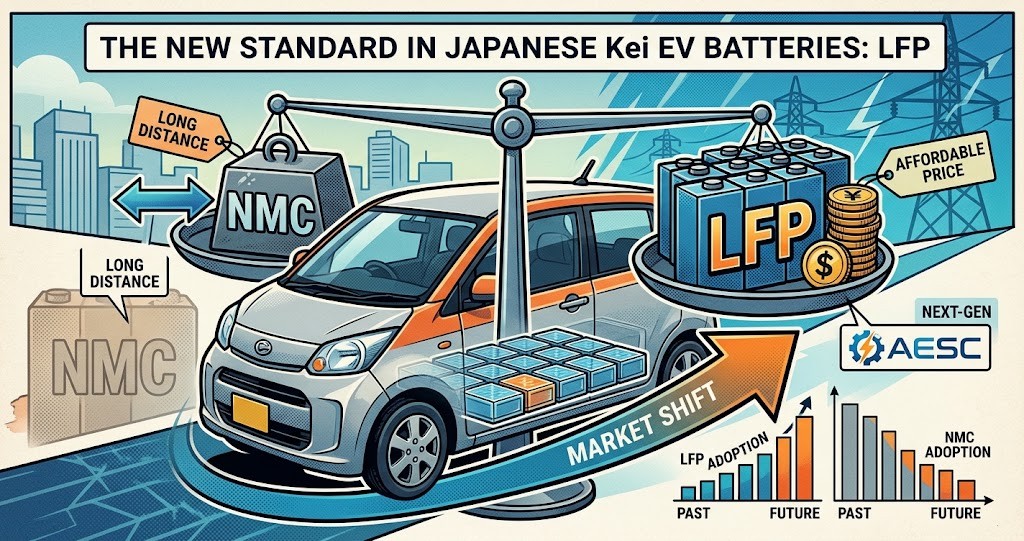
電気自動車(EV)の普及に伴い、バッテリーには「航続距離の長さ」だけでなく、「車両価格を抑えるためのコストパフォーマンス」が強く求められるようになっています。
これまで日本のEV市場では、エネルギー密度が高く航続距離を伸ばしやすい「三元系リチウムイオン電池」が主流でした。しかし、世界的には安価で安全性の高い「リン酸鉄リチウムイオン電池(LFP)」への移行が進んでいます。
このような市場環境の変化を受け、車載電池メーカーのAESCジャパンが軽EVなどをターゲットとした「次世代LFP」の提案を開始しました。記事の要点と、背景となる関連情報を以下にまとめています。
ニュースの要約とポイント
1. AESCジャパンによる次世代LFPの提案
- 主な対象: 軽EVをはじめとする低価格帯・エントリーモデルのEV。
- 投入時期: 早くて2028年度以降の新型車への搭載を目指す。
- 性能と目標: 体積エネルギー密度が現行LFPと現行三元系の中間に位置し、約10年前(前世代)の三元系リチウムイオン電池に相当するレベルまで向上。
- 国内生産の可能性: 自動車メーカーからの需要次第で、茨城工場(茨城県茨城町)での生産も検討。
2. 国内市場とAESCの現状
- 国内におけるLFPの現状: 日本国内には現在LFPを生産する工場がなく、採用車も一部の軽EVや輸入車に限られている(日産が北九州で計画していたLFP工場建設は投資見直しにより断念)。
- 茨城工場の稼働状況: 年間生産能力6 GWh(ギガワット時)。日産の新型「リーフ」やホンダの「N-VAN e:」、小型EV「N-ONE e:(スーパーワン)」向けに第5世代三元系電池をフル生産中。
- 今後の二本柱戦略: 航続距離を重視する「第6世代三元系」と、コスト面で優れる「次世代LFP」の2ラインナップで国内完成車メーカーへ提案していく。
補足・関連情報
電池種類の比較(三元系 vs LFP)
- 三元系リチウムイオン電池(NMC/NCAなど)
- 長所: エネルギー密度が高く、1回の充電で長く走れる。低温環境でも性能が落ちにくい。
- 短所: コバルトやニッケルなどの希少金属(レアメタル)を使用するため高価。発火時のリスク管理が厳しく求められる。
- リン酸鉄リチウムイオン電池(LFP)
- 長所: 希少金属を使わないため製造コストが安く、材料調達のリスクが低い。熱安定性が非常に高く長寿命。
- 短所: 重くかさばるためエネルギー密度が低い(航続距離が短くなりやすい)。
企業背景(AESCについて)
- もともとは日産自動車とNECなどの合弁会社「オートモーティブエナジーサプライ(AESC)」として設立。
- 現在は中国の再生可能エネルギー大手「エンビジョングループ(Envision Group)」の傘下(日産も引き続き出資)。
- グローバルでは中国、米国、欧州(スペインなど)でLFP生産を展開しており、技術や生産ノウハウを蓄積している。
出典:https://news.yahoo.co.jp/articles/b62ec3dca8acbb72d9137c29fcf15cba1a66579e
AESC Proposes Next-Generation LFP Batteries for Kei EVs, Eyeing Domestic Production from 2028 Onward
As electric vehicles (EVs) become more widespread, batteries are increasingly required to offer not only a long driving range, but also cost performance to keep vehicle prices low.
In the Japanese EV market, ternary lithium-ion batteries—which feature high energy density and make it easier to extend driving range—have traditionally been the mainstream. Globally, however, there is a growing shift toward lithium iron phosphate (LFP) batteries, which are lower in cost and offer high safety.
In response to these changing market conditions, automotive battery manufacturer AESC Japan has begun proposing a next-generation LFP battery targeted at mini-EVs (Kei EVs) and other models. The main points of the news and relevant background information are summarized below.
Summary and Key Points of the News
- AESC Japan’s Proposal for Next-Generation LFP
- Primary Target: Low-priced and entry-level EVs, including Kei EVs.
- Timeline: Aiming for adoption in new vehicle models from fiscal year 2028 at the earliest.
- Performance and Goals: Volumetric energy density is targeted to sit midway between current LFP and current ternary batteries, reaching a level equivalent to ternary lithium-ion batteries from about 10 years ago (previous generation).
- Potential for Domestic Production: Depending on demand from automakers, production at the Ibaraki Plant (Ibaraki Town, Ibaraki Prefecture) is also under consideration.
- Current Status of the Domestic Market and AESC
- Current Status of LFP in Japan: There are currently no plants producing LFP batteries in Japan, and their adoption is limited to some Kei EVs and imported vehicles (Nissan abandoned its plan to build an LFP plant in Kitakyushu due to an investment review).
- Operating Status of the Ibaraki Plant: Annual production capacity is 6 GWh (gigawatt-hours). It is currently running at full capacity, producing 5th-generation ternary batteries for Nissan’s new Leaf, Honda’s N-VAN e:, and Honda’s compact EV N-ONE e: (Super One).
- Future Two-Pillar Strategy: AESC will propose two lineups to domestic automakers: the 6th-generation ternary battery focusing on driving range, and the next-generation LFP battery focusing on cost competitiveness.
Supplementary and Related Information
Comparison of Battery Types (Ternary vs. LFP)
- Ternary Lithium-ion Battery (NMC/NCA, etc.)
- Pros: High energy density, allowing longer driving distance on a single charge. Performance does not degrade easily in low-temperature environments.
- Cons: Expensive due to the use of rare metals such as cobalt and nickel. Strict risk management for thermal runaway/fire risk is required.
- Lithium Iron Phosphate Battery (LFP)
- Pros: Low manufacturing cost because it does not use rare metals, resulting in lower raw material procurement risks. Very high thermal stability and long service life.
- Cons: Heavy and bulky, leading to lower energy density (tends to result in shorter driving ranges).
Corporate Background (About AESC)
- Originally established as Automotive Energy Supply Corporation (AESC), a joint venture between Nissan Motor, NEC, and others.
- It is currently a subsidiary of Envision Group, a major Chinese renewable energy company (Nissan continues to hold a minority stake).
- Globally, AESC produces LFP batteries in China and the US, and plans to start production in Europe (Spain), accumulating extensive technology and manufacturing expertise.
コメント