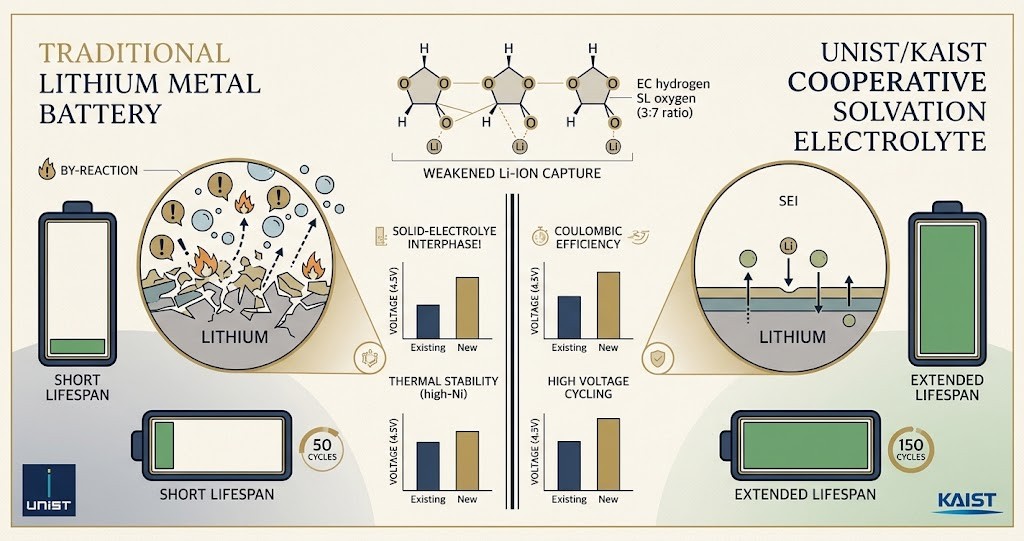
リチウム金属電池の実用化に向けた最大の課題である「短寿命・副反応」に対し、韓国の蔚山科学技術院(UNIST)と韓国科学技術院(KAIST)の共同研究チームが、従来の電解液設計の常識を覆す画期的な研究成果を発表しました。高価な特殊溶媒や高濃度塩に頼らず、汎用的な商用溶媒の組み合わせによって高電圧環境下での寿命を大幅に延ばす新電解液技術の最新成果と、その背景・関連情報についてまとめます。
UNIST/KAIST共同研究:次世代電解液技術の要点
1. 「協同溶媒和(Cooperative Solvation)」による設計パラダイムの転換
- 従来の課題: エチレンカーボネート(EC)とスルホラン(SL)はリチウムイオンとの結合力が極めて強く、充電時にリチウムイオンから溶媒分子が円滑に脱離(脱溶媒和)しないため、不均一なリチウム電着や過剰な副反応を引き起こし、リチウム金属電池への適用は困難とされていました。
- メカニズム: 研究チームはECとSLを重量比 3対7 で混合。ECの水素とSLの酸素の間に強い水素結合などの分子間引力が発生することで、溶媒同士が相互作用し、リチウムイオンを捕捉する結合力が意図的に弱まる「協同溶媒和」現象を発見・解明しました。
- 低コスト化の意義: 高価なフッ素系溶媒や高濃度塩(Concentrated Electrolyte)を用いず、入手が容易で安価な汎用商用溶媒のみで優れた電解液特性を実現しました。
2. 高電圧(4.5V)・ハイニッケル正極における耐久性向上
- 充放電寿命: ハイニッケル正極(NCM811)を用いた4.5Vの高電圧動作環境(25度)において、既存の炭酸塩系電解液が約50サイクルで容量保持率80%を下回ったのに対し、新電解液は 150サイクル まで初期容量の80%を維持し、寿命を約3倍に延伸しました。
- 高いクーロン効率: 初期クーロン効率 98.24%、平均クーロン効率 99.35% を記録し、充放電時の不可逆なリチウム消耗を大幅に抑制しました。
- ガス発生とニッケル溶出の抑制: 高電圧環境下での電解液分解によるガス発生や、正極からのニッケルイオンの溶出といった電池劣化要因を同時に制御することに成功しました。
3. 今後の課題と応用展開
- 実用化に向けた課題: 電気自動車(EV)やエネルギー貯蔵装置(ESS)への適用には数千サイクル規模の超長期寿命が必要とされるため、さらなる長期サイクル特性、低温・高温などの広範な動作温度範囲、急速充放電条件での追加検証が課題となります。
- 多用途への拡張性: 本設計原理はリチウム金属電池にとどまらず、高電圧リチウムイオン電池、ナトリウムイオン電池、カリウムイオン電池など、次世代の各種蓄電システムへ幅広く応用できる可能性を秘めています。
関連情報・背景解説
リチウム金属電池(LMB)の重要性と電解液の役割
- 理論容量の飛躍: 負極に金属リチウムを直接用いるリチウム金属電池は、現行の黒鉛(グラファイト)負極(理論容量 372mAh/g)に対して 3860mAh/g と約10倍の理論容量を持ち、セルレベルのエネルギー密度を大幅に高められる次世代技術です。
- SEI(固体電解質界面)形成と副反応: リチウム金属負極は還元力が極めて高く、充放電時に樹枝状析出(デンドライト)や電解液との継続的な副反応を引き起こします。これらを防ぐには、負極表面に安定で緻密な保護膜(SEI)を迅速に形成し、かつ脱溶媒和エネルギー障壁を下げる電解液設計が不可欠です。
脱溶媒和構造(Solvation Structure)制御のトレンド
- 高濃度電解液と局所高濃度電解液(LHCE): これまで高電圧・高安定化を狙う手法として、溶媒に対する塩の比率を高めた高濃度電解液や、非溶媒性稀釈剤を加えたLHCEが盛んに研究されてきました。しかし、高価なフッ素系塩(LiFSIなど)やフッ素系溶媒を大量に使用するため、製造コストが高く実用化の障壁となっていました。
- 本研究の位置付け: 商用溶媒同士の分子間相互作用を活用してリチウムイオンの溶媒和エネルギーを制御する本アプローチは、材料コストを抑えつつ高電圧耐性と負極安定性を同時に確保できるため、電解液産業における極めて実用的な設計指針として期待されています。
出典:https://finance.biggo.jp/news/a00a076f-2196-4e62-bd00-fce0b41eba50
Overcoming Challenges Without Expensive Special Materials! Novel Electrolyte Developed by South Korean Research Team Advances High-Voltage Lithium-Metal Batteries
Addressing short cycle life and side reactions—the primary hurdles to commercializing lithium-metal batteries—a joint research team from Ulsan National Institute of Science and Technology (UNIST) and Korea Advanced Institute of Science and Technology (KAIST) has announced a breakthrough study that overturns conventional wisdom in electrolyte design. Below is a summary of the latest results, technical background, and relevant information regarding a new electrolyte technology that significantly extends battery lifespan under high-voltage conditions using a combination of commercial solvents without relying on expensive specialty solvents or high-concentration salts.
UNIST/KAIST Joint Research: Key Highlights of Next-Generation Electrolyte Technology
- Design Paradigm Shift via “Cooperative Solvation”
- Conventional Challenge: Ethylene carbonate (EC) and sulfolane (SL) possess extremely strong binding affinity with lithium ions. Because solvent molecules do not readily detach (desolvate) from lithium ions during charging, this leads to non-uniform lithium electrodeposition and excessive side reactions, making them difficult to apply to lithium-metal batteries.
- Mechanism: The research team mixed EC and SL at a 3:7 weight ratio. Intermolecular attractive forces, such as strong hydrogen bonding between the hydrogen in EC and the oxygen in SL, cause the solvents to interact with each other, intentionally weakening their binding affinity for lithium ions through a newly discovered “cooperative solvation” phenomenon.
- Cost-Reduction Significance: Excellent electrolyte properties were achieved using only readily available, low-cost commercial solvents without resorting to expensive fluorinated solvents or concentrated electrolytes.
- Enhanced Durability in High-Voltage (4.5V) and High-Nickel Cathode Systems
- Charge/Discharge Cycle Life: Under 4.5V high-voltage operating conditions (25 degrees C) using a high-nickel cathode (NCM811), conventional carbonate-based electrolytes dropped below 80% capacity retention in approximately 50 cycles. In contrast, the new electrolyte maintained 80% of its initial capacity up to 150 cycles, extending cycle life by approximately 3 times.
- High Coulombic Efficiency: Recorded an initial Coulombic efficiency of 98.24% and an average Coulombic efficiency of 99.35%, significantly suppressing irreversible lithium consumption during charge/discharge processes.
- Suppression of Gas Generation and Nickel Dissolution: Successfully controlled major battery degradation factors simultaneously, including gas generation from electrolyte decomposition and nickel ion dissolution from the cathode under high-voltage conditions.
- Future Challenges and Application Prospects
- Challenges for Commercialization: Application in electric vehicles (EVs) and energy storage systems (ESS) requires ultra-long lifespans on the scale of several thousand cycles. Further validation is needed regarding long-term cycling performance, wide operating temperature ranges (low and high temperatures), and fast-charging conditions.
- Versatile Extensibility: This design principle holds strong potential for broad application beyond lithium-metal batteries to various next-generation energy storage systems, including high-voltage lithium-ion, sodium-ion, and potassium-ion batteries.
Related Information and Technical Background
Importance of Lithium-Metal Batteries (LMBs) and the Role of Electrolytes
- Breakthrough in Theoretical Capacity: Using lithium metal directly as the anode provides a theoretical capacity of 3860mAh/g—nearly 10 times that of current graphite anodes (372mAh/g)—making it a key next-generation technology capable of significantly boosting cell-level energy density.
- SEI (Solid Electrolyte Interphase) Formation and Side Reactions: Lithium-metal anodes exhibit extremely high reducing power, causing dendritic deposition and continuous side reactions with the electrolyte during charging and discharging. To prevent these issues, electrolyte design must rapidly form a stable, dense protective layer (SEI) on the anode surface while lowering the desolvation energy barrier.
Trends in Solvation Structure Control
- High-Concentration Electrolytes and Localized High-Concentration Electrolytes (LHCE): Increasing the salt-to-solvent ratio in high-concentration electrolytes or adding non-solvating diluents in LHCEs has been widely researched to achieve high-voltage stability. However, heavy use of costly fluorinated salts (such as LiFSI) and fluorinated solvents results in high manufacturing costs, posing a barrier to commercialization.
- Positioning of This Research: By leveraging intermolecular interactions between commercial solvents to regulate lithium-ion solvation energy, this approach maintains high-voltage tolerance and anode stability while minimizing material costs, offering a highly practical design guideline for the electrolyte industry.

コメント