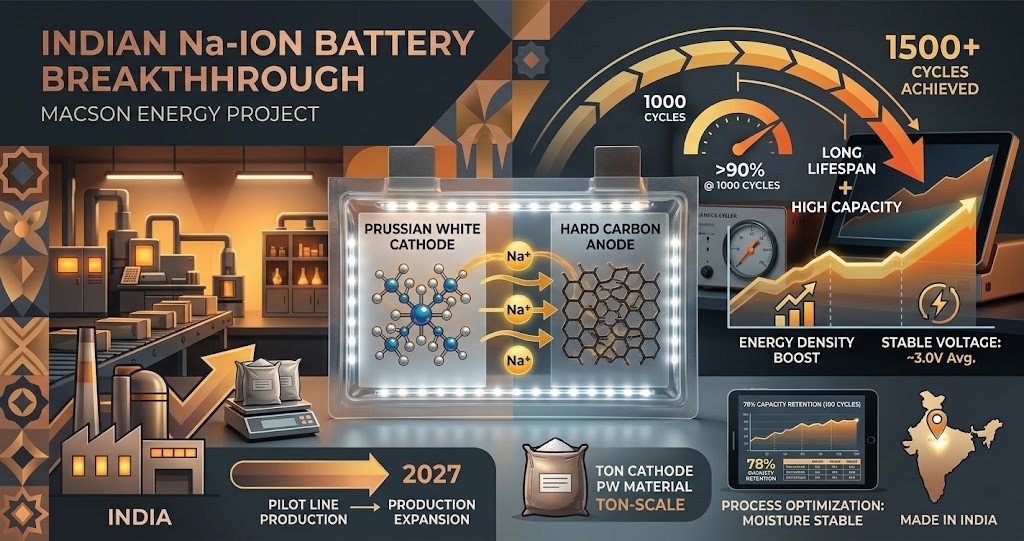
インドのエネルギー分野において、次世代バッテリーとして期待される「ナトリウムイオン電池」の実用化に向けた新たな動きが見られます。新興企業のMacsen Energyが開発したプルシアンホワイト正極材採用セルが、長寿命化の指標となる1,500サイクル以上の動作と高い容量維持率を記録したと発表しました。
1. Macsen Energyの発表概要と実験結果
- サイクル特性: 実験室環境において1,500回以上の充放電サイクルを達成。1,000サイクル時点でも初期容量の90%以上を維持。
- 主要スペック:
- 正極材: 高結晶性・完全ナトリウム化されたプルシアンホワイト(Prussian White)
- 負極材: ハードカーボン(Hard Carbon)を基本構成とし、アノードフリー構造なども研究中
- 比容量: 150 mAh/g 超
- クーロン効率: 約 99.9%
- 動作電圧範囲: 2.2V ~ 4.0V(平均放電電圧 約2.5V ~ 3.6V)
- 製造プロセスの特徴: 水分感受性や酸素曝露といった従来の製造課題を克服し、低含水率で空気安定性に優れた高結晶性材料を合成。
2. 量産化および事業展開計画
- パイロットラインおよび工場建設: 1万平方メートルの用地を確保しており、2027年に建設開始予定(場所は非公開)。
- 事業内容: プルシアンホワイト正極材のトン規模への生産拡大に加え、電極製造、セル組み立て、検証、商業生産に近い環境での試験を行う試作(パイロット)ラインを設置予定。
- 周辺技術開発: 全電池技術の発展に向け、負極用ハードカーボンの合成研究開発にも着手。
3. 関連情報・背景解説
- プルシアンホワイト(Prussian White)の強みと課題:
- 特命: 鉄とナトリウムを主成分とする有機錯体で、希少金属(リチウム、コバルト、ニッケルなど)を使用しないため低コスト。
- 構造的特徴: 開放的な結晶構造を持ち、ナトリウムイオンの迅速かつ可逆的な挿入・脱離が可能で高出力・長寿命に適する。
- 課題: 構造中の水分(結晶水)が性能劣化やガス発生を引き起こしやすく、厳格な水分制御および空気安定性の維持が高品質合成における最大の障壁となっている。
- ナトリウムイオン電池(SIB)全体のグローバル情勢:
- 市場動向: リチウム価格の乱高下や供給リスクに対する解決策として、地殻中に豊富に存在するナトリウムを利用する電池技術に世界的な投資が集まっている。
- 主要用途: エネルギー貯蔵システム(ESS)や低速電気自動車(2輪・3輪車、小型EV)を中心に、リチウムイオン電池(特にLFP)の代替・補完技術として期待されている。
- グローバル競合: 中国のCATLやHiNa Batteryなどが商業化を進めており、特に中国企業が大量生産体制で先行している。
- 今後の注目ポイントと検証課題:
- 第三者検証: 現時点でMacsen Energyの成果は自社研究室におけるデータであり、公的機関や第三者認証による独立した性能検証が今後の市場信頼性獲得の鍵となる。
- エネルギー密度の比較: プルシアンホワイト系は安全性とコストに優れる一方、三元系(NCM)リチウムイオン電池等と比較するとエネルギー密度が低いため、車載用よりも固定型蓄電池(ESS)市場での実用化が先行すると予想される。
Indian Startup Achieves Over 1,500 Cycles with Prussian White Sodium-Ion Battery
In India’s energy sector, new developments are emerging toward the commercialization of sodium-ion batteries, which are highly anticipated as a next-generation battery technology. Startup Macsen Energy announced that its battery cell featuring a Prussian White cathode material achieved over 1,500 cycles—a key benchmark for longevity—along with high capacity retention.
Based on this announcement, the report summarizes the key results, commercialization plans, and industry context surrounding sodium-ion technology.
Indian Startup Achieves Over 1,500 Cycles with Prussian White Sodium-Ion Battery
1. Macsen Energy Announcement & Experimental Results
- Cycle Life: Achieved over 1,500 charge-discharge cycles under laboratory conditions, maintaining over 90% of its initial capacity at the 1,000-cycle mark.
- Key Specifications:
- Cathode Material: Highly crystalline, fully sodiated Prussian White
- Anode Material: Hard Carbon as the core design, with research underway into anode-free configurations
- Specific Capacity: Exceeding 150 mAh/g
- Coulombic Efficiency: Approximately 99.9%
- Operating Voltage Range: 2.2V to 4.0V (average discharge voltage approx. 2.5V to 3.6V)
- Manufacturing Features: Overcame traditional production hurdles such as moisture sensitivity and oxygen exposure, synthesizing a highly crystalline material with low water content and enhanced air stability.
2. Mass Production & Business Expansion Plans
- Pilot Line & Facility Construction: Secured 10,000 square meters of land, with construction scheduled to begin in 2027 (location undisclosed).
- Scope of Operations: Scaling up Prussian White cathode material production to ton-scale levels, alongside establishing a pilot line for electrode manufacturing, cell assembly, validation, and near-commercial testing.
- Peripheral R&D: Initiated research and development into hard carbon synthesis for anodes to advance overall battery technology.
3. Key Perspectives & Background
- Strengths & Challenges of Prussian White:
- Core Advantage: An iron- and sodium-based complex that eliminates the need for scarce materials like lithium, cobalt, and nickel, offering low production costs.
- Structural Characteristics: Its open crystalline structure enables rapid, reversible insertion and extraction of sodium ions, making it well-suited for high power output and long cycle life.
- Challenges: Structural moisture (crystallization water) can trigger performance degradation and gas generation, making strict moisture control and air stability maintenance the main barriers in high-quality synthesis.
- Global Sodium-Ion Battery (SIB) Landscape:
- Market Trends: Amid lithium price volatility and supply chain risks, global investments are flowing into sodium-based battery technologies due to the natural abundance of sodium in the Earth’s crust.
- Primary Applications: Expected to serve as an alternative or complementary technology to lithium-ion batteries (particularly LFP), primarily targeting Energy Storage Systems (ESS) and low-speed electric vehicles (micro-EVs, 2-wheelers, and 3-wheelers).
- Global Competitors: Companies like CATL and HiNa Battery in China are advancing commercialization, with Chinese firms leading the way in mass-production scaling.
- Future Outlook & Verification Challenges:
- Third-Party Verification: Macsen Energy’s findings currently represent internal laboratory data. Independent performance validation by accredited third-party organizations will be essential for establishing market trust.
- Energy Density Comparison: While Prussian White systems excel in cost and safety, their energy density remains lower than ternary (NCM) lithium-ion batteries. Consequently, commercial deployment is expected to gain traction first in stationary energy storage (ESS) rather than mainstream automotive applications.
コメント