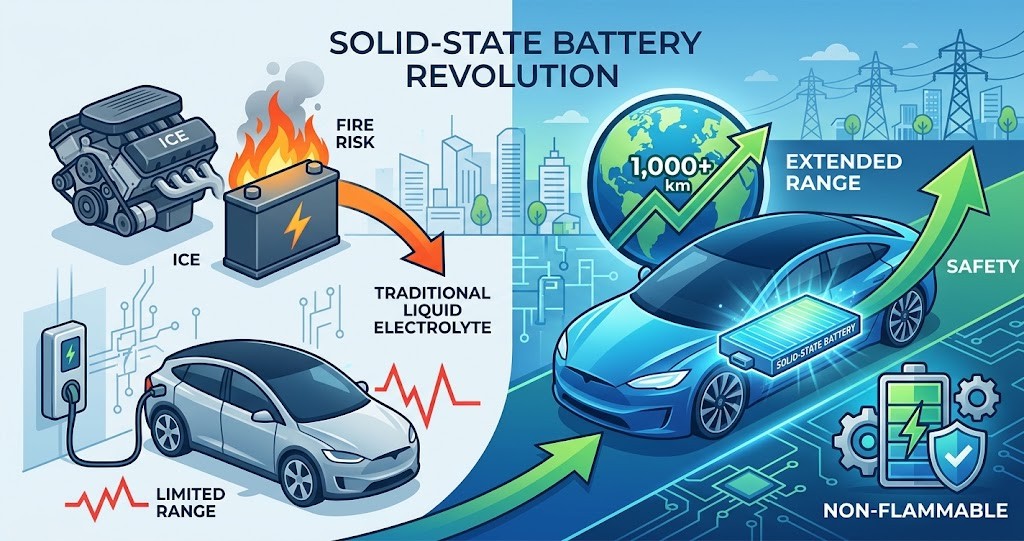
次世代電気自動車(EV)向け技術として、液体電解質を不燃性の固体電解質に置き換えた「全固体電池」の開発競争が世界規模で本格化しています。従来の可燃性液体電解質で懸念されていた発火リスクを解消するだけでなく、エネルギー密度の向上により1回の充電で1,000km以上の航続距離を実現できることから、次世代EV市場の構図を塗り替える「夢の電池」として期待が集まっています。
開発の最前線では、日米欧中韓の自動車メーカーおよび電池メーカーが主導権争いを繰り広げています。技術的には電解質の種類によって「硫化物系」「酸化物系」「高分子(ポリマー)系」などに分類され、特に高いイオン電導度を持つ硫化物系が自動車向けの本命とされています。各社の具体的な動きと目標時期は以下の通りです。
メーカーごとのロードマップと主なアプローチ
- Honda:2024年11月に栃木県さくら市の研究所内にパイロットラインを公開し、2025年1月よりセル生産を開始。2026年6月には米QuantumScapeと共同研究契約を締結。
- Geely Auto(吉利汽車):2026年内に全固体電池の自社開発を完了し、検証段階へ移行予定。
- ProLogium(輝能科技):2026年9月に台湾のギガ級工場で3.5世代リチウムセラミック電池の量産を開始。エネルギー密度381Wh/kg(903Wh/L)を記録し、EV以外にデータセンターや航空宇宙分野もターゲットに設定。
- Toyota:出光興産と協業し、2027から2028年の実用化を目指す。
- CATL:四川省宜賓に約2GWh規模のパイロットラインを構築中。2027年の小規模・少量生産計画を維持。
- BYD:2027年第1四半期に試験生産を開始し、2028年の量産化、2030年以降の一般普及を目指す。
- Samsung SDI:韓国・蔚山工場を中心に硫化物系全固体電池の開発を進め、2027年下半期の量産をターゲットとする。
- Nissan:横浜工場にパイロットラインを設置し、2028年度(2028年4月から2029年3月)の実用化を目指す。
- Hyundai Motor Group:京畿道義王研究所にパイロットラインを構築し、セルの内製化戦略を推進。2030年前後の量産を目標に設定。
量産化に向けた課題と慎重論
早期実用化を目指す動きの一方で、本格的な大衆化・大容量化には時間を要するとの見方も強く存在します。
技術面および製造面では、充放電に伴う電極の膨張・収縮により固体電解質との界面で剥離が生じ、電池性能が低下(抵抗増加)する課題の克服や、精密な製造プロセスの確立が必要です。また、使用されるリチウム超イオン導電体などの材料コストが高く、量産初期段階では既存のリチウムイオン電池の3倍以上の製造コストがかかると試算されています。
CATLの曾毓群会長は、全固体電池の技術成熟度を9段階中の4段階目と評価しており、まずは「半固体電池(液体と固体を混合した方式)」の車両搭載が進み、全固体電池の大規模商用化は2030年以降になると予測しています。Hyundai Motor Groupのマンフレッド・ハラー社長も、5年以内に全固体電池搭載の高性能車が登場する可能性を示唆しつつも、原材料コストの即時解決は困難であるとの認識を示しています。
市場へのインパクト
全固体電池の商用化が実現した場合、現在のEV市場における競争環境は激変すると予想されます。足元では価格優位性を強みとする安価なLFP(リン酸鉄リチウム)電池を採用した中国勢が市場を牽引していますが、高い安全性と長距離航続性能を兼ね備えた全固体電池が普及すれば、市場の優先順位が価格から性能・安全性へとシフトし、EV産業のパワーバランスが大きく変わる可能性があります。
出典:https://finance.biggo.jp/news/fd1548d8-1522-43b3-98dd-1b590f1a010f
Global Development Trends in All-Solid-State Batteries: Target Timelines of Major Players and Commercialization Challenges
The global race to develop all-solid-state batteries, a next-generation technology for electric vehicles (EVs) that replaces flammable liquid electrolytes with non-flammable solid electrolytes, is intensifying. Beyond eliminating the fire risks associated with conventional liquid electrolytes, all-solid-state batteries offer higher energy density, enabling a driving range of over 1,000 km on a single charge. Consequently, expectations are high for this technology as a game-changer that could reshape the next-generation EV landscape.
At the forefront of development, automakers and battery manufacturers across Japan, the United States, Europe, China, and South Korea are competing for leadership. Technically, these batteries are categorized by electrolyte type into sulfide-based, oxide-based, and polymer-based systems. Sulfide-based electrolytes, in particular, offer high ionic conductivity and are considered the leading candidate for automotive applications. The specific moves and target timelines of major companies are as follows:
Company Roadmaps and Key Approaches
- Honda: Unveiled a pilot production line at its Sakura Research Center in Tochigi Prefecture in November 2024 and began cell production in January 2025. In June 2026, Honda signed a joint research agreement with US-based QuantumScape.
- Geely Auto: Plans to complete in-house development of all-solid-state batteries within 2026 and transition to the validation phase.
- ProLogium: Started mass production of its 3.5-generation lithium ceramic batteries at its gigafactory in Taiwan in September 2026. Achieving energy densities of 381 Wh/kg (903 Wh/L), ProLogium is targeting data centers and aerospace in addition to EVs.
- Toyota: Collaborating with Idemitsu Kosan to aim for practical application between 2027 and 2028.
- CATL: Constructing an approximately 2 GWh pilot line in Yibin, Sichuan Province, maintaining its plan for small-scale pilot production in 2027.
- BYD: Aims to begin trial production in Q1 2027, move to mass production in 2028, and achieve widespread adoption after 2030.
- Samsung SDI: Developing sulfide-based all-solid-state batteries centered at its Ulsan plant, targeting mass production in the second half of 2027.
- Nissan: Setting up a pilot line at its Yokohama Plant, aiming for practical application in fiscal year 2028 (April 2028 to March 2029).
- Hyundai Motor Group: Built a pilot line at its Uiwang Research Institute in Gyeonggi Province, pushing an in-house cell production strategy with a goal of mass production around 2030.
Commercialization Challenges and Cautious Views
Despite efforts toward early practical application, there is a strong consensus that full-scale mass adoption and large-capacity scaling will take time.
Technical and manufacturing hurdles include addressing interfacial delamination caused by electrode expansion and contraction during charge-discharge cycles, which deteriorates performance by increasing internal resistance, as well as establishing precise manufacturing processes. Furthermore, high raw material costs, such as superionic lithium conductors, mean initial manufacturing costs could exceed three times those of current lithium-ion batteries.
CATL Chairman Robin Zeng rated the technical readiness of all-solid-state batteries at a level 4 on a 9-point scale, predicting that semi-solid-state batteries (combining liquid and solid electrolytes) will be adopted first, with large-scale commercialization of all-solid-state batteries occurring after 2030. Manfred Harrer, President of Hyundai Motor Group R&D, similarly noted that while high-performance EVs equipped with all-solid-state batteries may appear within five years, resolving raw material cost challenges immediately remains difficult.
Market Impact
If commercialized, all-solid-state batteries are expected to drastically alter the competitive environment in the EV market. Currently, Chinese manufacturers lead the market with low-cost LFP (lithium iron phosphate) batteries. However, if all-solid-state batteries offering high safety and long driving range become widespread, market priorities could shift from price to performance and safety, potentially shifting the power dynamics of the EV industry.
コメント