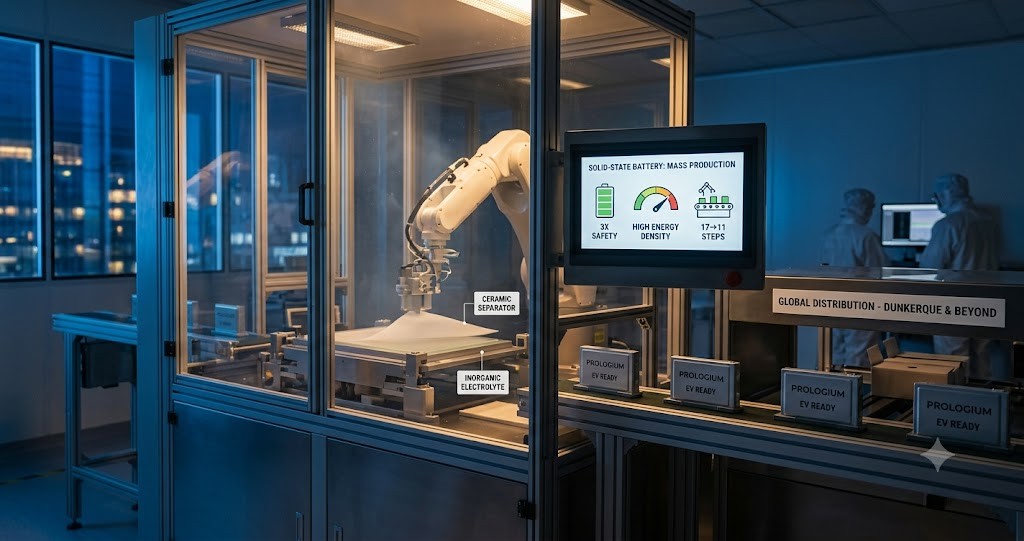
次世代のエネルギー貯蔵を担う全固体電池(Solid-State Battery)は、電気自動車(EV)の航続距離や安全性を劇的に向上させる技術として世界中で開発競争が激化しています。多くの企業が研究開発や試作段階に留まるなか、台湾のProLogium(輝能科技)は一歩先をリードし、すでにギガファクトリークラスの量産体制へ移行しています。本稿は、同社CEOのヴィンセント・ヤン氏へのインタビューをもとに、同社が量産化を実現できた技術的ブレークスルー、製造コストの優位性、欧州をはじめとするグローバル戦略、そしてEVを超えた多分野への応用展望について分かりやすくまとめたものです。
- 1. 独自技術による「三重の安全性」と「高エネルギー密度」
- 2. 構造的優位性をもたらす製造イノベーションとコスト競争力
- 3. グローバルサプライチェーンの強化:フランス・ダンケルク計画
- 4. EVを超えた多分野への応用とパートナーシップ
- 5. 地政学リスクへの耐性と今後の展望(5年間の業界動向)
- ProLogium CEO Shares the State of Solid-State Batteries: Proven Breakthroughs in Mass Production
- 1. Proprietary Technology Delivering “Triple Safety” and “High Energy Density”
- 2. Manufacturing Innovation and Cost Competitiveness Yielding Structural Advantages
- 3. Strengthening the Global Supply Chain: The Dunkirk Project in France
- 4. Multi-Sector Applications Beyond EVs and Strategic Partnerships
- 5. Resilience to Geopolitical Risks and Future Outlook (5-Year Industry Trends)
1. 独自技術による「三重の安全性」と「高エネルギー密度」
ProLogiumは、他社に先駆けて固体電池の量産化を達成しました。その核心は、独自の材料開発と安全機構の統合にあります。
- 超流動化全無機電解質希少元素を使わずに製造され、世界最高水準のイオン導電率を誇ります。材料レベルで自動分解して火災リスクを排除する「アクティブセーフティメカニズム(ASM)」を搭載しています。
- 高安定性セラミックセパレータ充電された正極と負極の接触を防ぎ、危険な熱連鎖反応(熱暴走)を根本から遮断します。
- 高エネルギー密度の追求この高い安全性を基盤に、NMC 955(ニッケル比率95%の正極材)、シリコン系負極、リチウム金属などの反応性の高い活物質を採用し、エネルギー密度を継続的に高めています。
2. 構造的優位性をもたらす製造イノベーションとコスト競争力
研究室(ラボ)の成果を大量生産へと結びつけるため、同社は従来の電池製造工程を根本から再設計しました。
製造工程の削減と時間短縮
従来の液式リチウムイオン電池製造における複雑な工程(セパレータフィルムの配置、電解液の注入、真空浸漬、脱気など)を排除。コアとなる製造工程を「17」から「11」へと大幅に削減しました。また、独自の「ホットフロー脱水工程」により、従来8時間かかっていた処理をわずか8分へと短縮しています。
コスト削減の要因
- アノード(負極)コスト: シリコン負極の単位エネルギーコストは、従来のグラファイト(黒鉛)の3分の2に抑制。
- 電解質コスト: 独自の電解液合成コストを、従来の液体電解液とほぼ同等に管理。
- 設備コスト: 製造に必要なドライルームの面積(容積)を、従来のEV用バッテリー製造の30%から40%にまで削減。
量産の実績
これまでに240万個以上のセルを出荷。このうち約80万個は、2024年第3四半期に台湾で稼働を開始したGWh(ギガワット時)クラスの新生産ラインから供給されています。
3. グローバルサプライチェーンの強化:フランス・ダンケルク計画
欧州および世界市場の需要に対応するため、フランスのダンケルクに新設されるギガファクトリーは、同社の世界戦略の要となっています。
- 生産能力の拡大第1段階として年間4GWhの生産能力からスタートし、第2段階の完了に伴い徐々に12GWhまで引き上げる計画です。
- 欧州「バッテリーバレー」との統合フランス北部の広範なリチウムイオン電池・サプライチェーンの集積地(バッテリーバレー)に参入。人材、材料、リサイクル、技術パートナーのエコシステムをフルに活用します。
- 政府からの強力な支援フランス政府の「フランス2030」計画から、15億ユーロに上る歴史的な補助金(政府支援)を獲得。地域の低炭素でクリーンな電力を利用した、持続可能な現地生産体制を構築しています。
4. EVを超えた多分野への応用とパートナーシップ
ProLogiumは、安全性とエネルギー密度という強みを活かし、EV以外の新興産業への展開を「パートナー主導型モデル」で進めています。
| 応用分野 | 特有の要求課題 | ProLogiumのアプローチ・提携事例 |
| 航空宇宙・eVTOL・ドローン | バッテリーの軽量化(同じ容量で30%から50%の軽量化が要求される) | 超流動無機電池の採用による重量エネルギー密度の向上 |
| AIデータセンター・ESS | 2倍から5倍の電力容量、低発熱、最適なコスト効率 | デルタエレクトロニクスとの提携。エネルギー貯蔵およびAIデータセンター向けバッテリー管理システム(BMS)の開発 |
| ロボット工学・建設機械 | ミッション実行時間の延長、高速充電の実現 | 九州電力との協業。ゼロエミッション建設機械向け特殊モジュールの開発 |
※同社は最もコアである「内部セル」の製造に特化し、最終的なシステム統合やパッケージングは、各分野の専門家であるパートナー企業が担当するエコシステム戦略をとっています(EV市場におけるリマックやFEVとの協業と同様)。
5. 地政学リスクへの耐性と今後の展望(5年間の業界動向)
関税と地政学的影響
近年、LFP(リン酸鉄リチウム)電池などは関税や地政学的リスク(サプライチェーンの分断)の影響を強く受けていますが、ProLogiumへの影響は限定的です。同社の化学組成にはLFP正極材や黒鉛(グラファイト)負極材、その他の希少材料を使用していないため、特定の地域への依存度が極めて低く、強靭なグローバルサプライチェーンを維持しています。
今後5年の最大の課題とビジョン
ヤンCEOは、今後5年間を「次世代バッテリーを試験段階から量産段階へと移行させるための競争の時代」と位置づけています。EV市場の成長鈍化の根本的な原因はコストだけでなく「バッテリーの性能問題」にあり、あらゆる温度条件下での確実な航続距離、火災リスクの排除、ガソリン車並みの急速充電の実現が必要不可欠です。
全固体電池が主流(メインストリーム)となるためには、以下の2つのハードルを越える必要があります。
- 実験室と実環境の両方で、安定した性能を実証すること。
- 競争力のあるコストで、大規模な大量生産が可能であることを証明すること。
多くの競合他社が1つ目のハードル(実験室段階)で足踏みするなか、ProLogiumは実績のある化学技術と、すでに確立された量産ライン、そして従来型電池とのコスト同等性を実現する明確なロードマップを武器に、双方の課題をクリアできる強力なポジションを確立しています。
ProLogium CEO Shares the State of Solid-State Batteries: Proven Breakthroughs in Mass Production
The global race to develop solid-state batteries (SSBs), the next generation of energy storage, is intensifying as a technology capable of drastically improving the driving range and safety of electric vehicles (EVs). While many companies remain in the R&D or prototyping stage, Taiwan’s ProLogium has taken a step ahead, transitioning to a gigafactory-class mass production system. Based on an interview with CEO Vincent Yang, this article summarizes the technological breakthroughs that enabled the company to achieve mass production, its manufacturing cost advantages, its global strategy focused on Europe, and its prospects for diverse applications beyond EVs.
1. Proprietary Technology Delivering “Triple Safety” and “High Energy Density”
ProLogium has achieved mass production of solid-state batteries ahead of its competitors. The core of this achievement lies in the integration of its proprietary material development and safety mechanisms.
- Super-Lithified All-Inorganic ElectrolyteManufactured without rare elements, it boasts world-record ionic conductivity. It features an Active Safety Mechanism (ASM) that automatically breaks down at the material level to eliminate fire risks.
- Highly Stable Ceramic SeparatorPrevents contact between the charged cathode and anode, fundamentally blocking dangerous thermal runaway chain reactions.
- Pursuit of High Energy DensityWith this high safety profile as a foundation, the company continuously increases energy density by adopting highly reactive cathode and anode active materials, such as NMC 955 (a cathode material with a 95% nickel ratio), silicon-based anodes, and lithium metal.
2. Manufacturing Innovation and Cost Competitiveness Yielding Structural Advantages
To bridge the gap between laboratory results and mass production, the company fundamentally redesigned the conventional battery manufacturing process.
Reduction of Manufacturing Steps and Time
ProLogium eliminated complex steps required in traditional liquid lithium-ion battery manufacturing, such as separator film placement, electrolyte injection, vacuum soaking, and degassing. This reduced the core manufacturing steps from 17 to 11. Furthermore, its proprietary “hot-flow dehydration process” is completed in just 8 minutes, compared to the 8 hours required for conventional processes.
Key Factors for Cost Reduction
- Anode Cost: The unit energy cost of the silicon anode is restricted to two-thirds of that of conventional graphite.
- Electrolyte Cost: The cost of synthesizing its proprietary electrolyte is managed to be nearly equal to that of conventional liquid electrolytes.
- Facility Cost: The required dry room area (volume) for manufacturing is reduced to 30% to 40% of that used in traditional EV battery manufacturing.
Mass Production Track Record
The company has shipped more than 2.4 million cells to date. This includes approximately 800,000 cells supplied from its new GWh-class production line in Taiwan, which began operations in the third quarter of 2024.
3. Strengthening the Global Supply Chain: The Dunkirk Project in France
To meet demand in Europe and global markets, the new gigafactory in Dunkirk, France, serves as the cornerstone of the company’s global strategy.
- Expansion of Production CapacityThe facility will start with an annual production capacity of 4 GWh in the first phase, gradually increasing to 12 GWh upon completion of the second phase.
- Integration with the European “Battery Valley”The factory integrates into the extensive lithium-ion battery supply chain cluster (Battery Valley) in northern France, leveraging a rich ecosystem of talent, materials, recycling, and technology partners.
- Strong Government SupportProLogium secured a historic 1.5 billion euro grant from the French government’s “France 2030” plan. By localizing production and utilizing local low-carbon, clean power, the company is building a sustainable manufacturing base in Europe.
4. Multi-Sector Applications Beyond EVs and Strategic Partnerships
Leveraging its strengths in safety and energy density, ProLogium is expanding into emerging industries outside the EV sector through a “partner-driven model.”
| Application Field | Specific Demands & Challenges | ProLogium’s Approach & Partnership Examples |
| Aerospace, eVTOL, & Drones | Battery weight reduction (customers demand batteries that are 30% to 50% lighter for the same capacity) | Improving gravimetric energy density by adopting super-lithified inorganic batteries |
| AI Data Centers & ESS | 2 to 5 times the power capacity, low heat generation, and optimal cost efficiency | Partnership with Delta Electronics to focus on developing battery management systems (BMS) for energy storage and AI data centers |
| Robotics & Construction Machinery | Extended mission runtime and faster charging speeds | Collaboration with Kyushu Electric Power to develop specialized modules for zero-emission construction machinery |
Note: ProLogium focuses exclusively on manufacturing the core internal cells, the most technologically advanced component. The final system integration and packaging are handled by partner companies who are experts in their respective fields (similar to its collaboration with Tier 1 partners like Rimac and FEV in the EV market).
5. Resilience to Geopolitical Risks and Future Outlook (5-Year Industry Trends)
Tariffs and Geopolitical Impact
While lithium iron phosphate (LFP) batteries and other technologies have recently been heavily impacted by tariffs and geopolitical risks (supply chain disruptions), the impact on ProLogium is limited. The company’s chemical composition does not use LFP cathode materials, graphite anode materials, or other rare materials. This results in extremely low regional dependence and maintains a resilient global supply chain.
Key Challenges and Vision for the Next 5 Years
CEO Vincent Yang views the next five years as a race to transition next-generation batteries from the testing phase to mass production. The slowdown in EV market growth is not merely a cost issue; fundamentally, it is a battery performance issue. For EVs to achieve widespread adoption, batteries must deliver predictable driving ranges under all temperature conditions, eliminate safety risks, and allow refueling in minutes just like gasoline cars.
For solid-state batteries to become the mainstream solution, they must overcome two major hurdles:
- Demonstrate stable performance in both laboratory and real-world environments.
- Prove the feasibility of large-scale mass production at a competitive cost.
While many competitors remain stalled at the first hurdle (the laboratory stage), ProLogium believes it has a strong position to clear both challenges. It enters this phase armed with proven chemical technology, established manufacturing capabilities, and a clear roadmap to reach cost parity with conventional batteries.


コメント