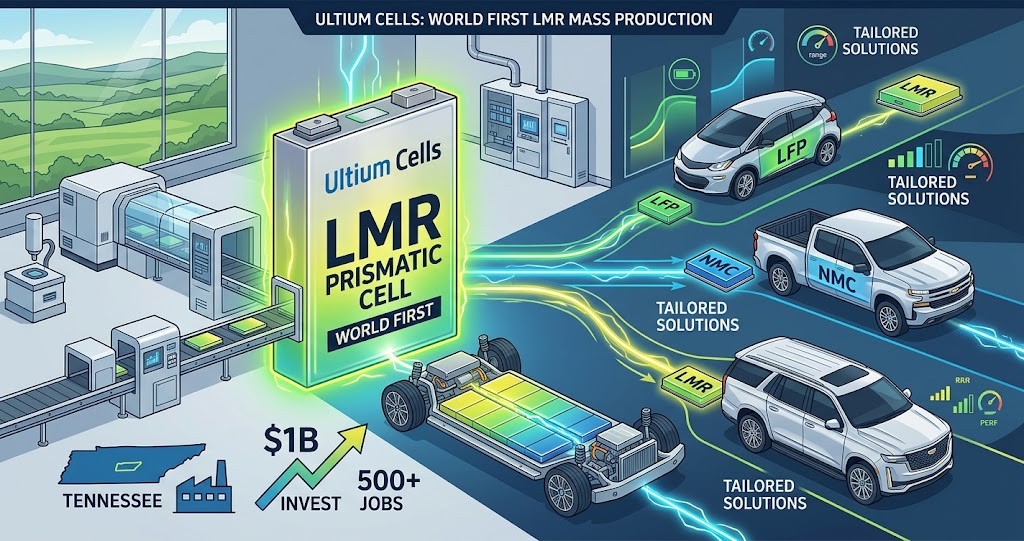
General Motors(GM)とLG Energy Solutionの合弁会社であるUltium Cellsが、テネシー州スプリングヒル工場にて世界初となるLMR(リチウム・マンガン・リッチ)角形セルの量産計画を発表しました。これにより、EVバッテリー業界は単一の標準解から、用途や車種のニーズに応じた「化学系および形状(フォームファクター)の使い分け」という新フェーズへ本格的に移行します。
GMによるLMR角形セル量産計画の概要と関連情報まとめ
1. 計画の全体像と投資規模
- 拠点と投資額: 米国テネシー州スプリングヒルのUltium Cells工場を改修し、約10億ドル(約1,500億円規模)を投資。約500名の新規雇用を創出します。
- スケジュール: 工事は2026年後半に着工し、2028年の完了・量産開始を予定しています。
- 意義: 実用化が困難とされてきたLMR(Lithium-Manganese-Rich)電池を、世界で初めて角形セルとして商業規模で量産するプロジェクトとなります。
2. LMR(リチウム・マンガン・リッチ)技術の特徴と課題克服
- 組成の違い:
- 一般的なNMC(ニッケル・マンガン・コバルト)811等:ニッケル約85% / マンガン約10% / コバルト約5%
- LMR:ニッケル約35% / マンガン約65%(コバルトフリーに近い構成)
- コスト・資源メリット:
- 安価で埋蔵量が豊富なマンガンを主成分とし、高価なコバルトをほぼ排除、ニッケル使用量も大幅削減。
- 現在の低価格電池の主流であるLFP(リン酸鉄リチウム)と同等の低コストを目指しながら、エネルギー密度はLFP比で約33%向上します。
- 技術的ブレイクスルー(関連情報の補足):
- 背景: LMR(別名:O3型/層状マンガン系、Li2MnO3相を含む固溶体構造など)は理論容量が高い反面、充放電の繰り返しに伴う「電圧降下(Voltage Fade)」や「遷移金属の溶出によるサイクル寿命の短縮」が長年の課題でした。
- 解決策: GMのウォレス・バッテリーセル・イノベーションセンターを中心とする開発チームは、独自のドーパント(微量元素添加)、表面コーティング、一次粒子の設計最適化、製造プロセスの革新により構造安定性を確保。NMCと同等のサイクル寿命と信頼性を実現しました。
3. パック・モジュール構造の効率化とモジュールレス化
- 角形セルの採用: LMRの組成は大型セル化に適しており、従来のパウチ型から角形(Prismatic)へ変更。
- 部品削減効果: NMCパウチ型セルを採用した従来パックと比較して、バッテリーモジュール部品を75%削減、パック全体の部品数を50%削減可能。
- 構造的メリット(関連情報の補足): 構造部品の削減は、Cell-to-Pack(CTP)技術など最新のパック設計アプローチとも親和性が高く、エネルギー密度の向上と組付け工数・コストの低減を同時に後押しします。
4. EVバッテリー戦略の転換:「マルチ・ケミストリー」時代へ
- 使い分けの明確化:
- 高ニッケル系(NMC/NCA): 高価格帯・長航続距離モデル(トラック、大型SUV等)向け
- LMR: 中価格帯〜普及帯(高エネルギー密度と低コストのバランス)
- LFP: エントリーモデル・低コスト重視車向け
- 製造の柔軟性: Ultium Cellsは、同一の製造基盤で複数の化学系(ケミストリー)や形状(パウチ型、角形など)を柔軟に生産できるマルチ・フォームファクター体制の確立を進めています。
総括
GMのLMR商業化計画は、中国勢が強みを持つLFP電池に対抗しうる「高エネルギー密度かつ低コストな米国国産電池」の確立を意味します。単一のバッテリー技術に依存せず、車種の価格帯や求められる性能に応じて化学組成とセル構造を最適に使い分ける戦略が、今後のグローバルEV市場における標準(デファクトスタンダード)となっていく見通しです。
出典:https://motor-fan.jp/article/1636460/
GM to Mass-Produce World’s First LMR Prismatic Cells! The Full Picture of Breaking Away from LFP Dependency and Optimizing EV Batteries
Ultium Cells, a joint venture between General Motors (GM) and LG Energy Solution, has announced plans for the world’s first mass production of LMR (Lithium-Manganese-Rich) prismatic cells at its Spring Hill plant in Tennessee. This marks a major transition for the EV battery industry from relying on a single standard solution to entering a new phase of “strategic application of chemistries and form factors” based on specific vehicle and usage requirements.
Summary of GM’s LMR Prismatic Cell Mass Production Plan and Related Insights
1. Project Overview and Investment Scale
- Location and Investment: Converting the Ultium Cells plant in Spring Hill, Tennessee, USA, with an investment of approximately 1 billion USD (around 150 billion JPY). The project is expected to create about 500 new jobs.
- Timeline: Construction is scheduled to begin in the second half of 2026, with completion and the start of mass production planned for 2028.
- Significance: This will be the world’s first project to mass-produce LMR (Lithium-Manganese-Rich) batteries—long considered difficult to commercialize—as prismatic cells on a commercial scale.
2. Features of LMR (Lithium-Manganese-Rich) Technology and Overcoming Challenges
- Composition Differences:
- Typical NMC (Nickel-Manganese-Cobalt) 811, etc.: Approx. 85% Nickel / Approx. 10% Manganese / Approx. 5% Cobalt
- LMR: Approx. 35% Nickel / Approx. 65% Manganese (a nearly cobalt-free composition)
- Cost and Resource Advantages:
- Uses manganese—which is inexpensive and abundant—as the primary material, virtually eliminating expensive cobalt and significantly reducing nickel usage.
- Targets a low cost comparable to LFP (Lithium Iron Phosphate), the current mainstream low-cost battery, while increasing energy density by approximately 33% compared to LFP.
- Technical Breakthroughs (Additional Context):
- Background: While LMR (also known as O3-type / layered manganese-based, solid-solution structures containing a Li2MnO3 phase, etc.) offers high theoretical capacity, it faced long-standing challenges such as “Voltage Fade” during repeated charge-discharge cycles and “shortened cycle life due to transition metal dissolution.”
- Solution: The development team, led by GM’s Wallace Battery Cell Innovation Center, secured structural stability through proprietary dopants (micro-element additions), surface coatings, primary particle design optimization, and manufacturing process innovations. As a result, they achieved cycle life and reliability equivalent to current-generation NMC cells.
3. Module and Pack Structural Efficiency and Module-Less Design
- Adoption of Prismatic Cells: The LMR composition is well-suited for larger cell formats, prompting a shift from conventional pouch cells to prismatic cells.
- Component Reduction Effects: Compared to conventional battery packs using NMC pouch cells, module components can be reduced by 75% and overall pack components by 50%.
- Structural Benefits (Additional Context): The reduction in structural parts aligns seamlessly with modern pack design approaches such as Cell-to-Pack (CTP) technology, simultaneously driving higher energy density and reductions in assembly labor and costs.
4. Shift in EV Battery Strategy: Entering the “Multi-Chemistry” Era
- Clear Categorization:
- High-Nickel Types (NMC/NCA): For premium and long-range vehicles (trucks, large SUVs, etc.)
- LMR: For mid-tier and mainstream vehicles (offering a balance of high energy density and low cost)
- LFP: For entry-level and cost-conscious vehicles
- Manufacturing Flexibility: Ultium Cells is advancing the establishment of a multi-form-factor production framework capable of flexibly producing multiple chemistries and form factors (pouch, prismatic, etc.) on the same manufacturing base.
Summary GM’s LMR commercialization plan signifies the establishment of a “high-energy-density and low-cost domestic US battery” capable of competing with LFP batteries, where Chinese manufacturers currently hold a strong position. Rather than relying on a single battery technology, the strategy of optimizing chemical compositions and cell structures according to vehicle price range and performance requirements is expected to become the future standard (de facto standard) in the global EV market.
コメント