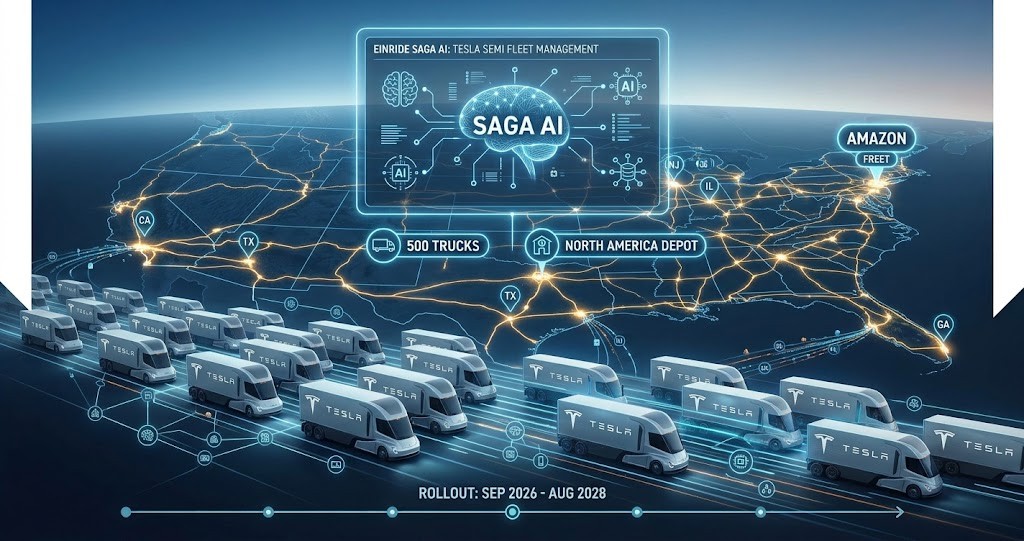
持続可能な貨物輸送テクノロジーを主導するEinride(アインライド)は、テスラの電動大型トラック「Tesla Semi」を500台導入し、同社のAIフリート管理プラットフォーム「Saga AI」に組み込む計画を発表しました。北米(カリフォルニア、テキサス、ニュージャージー、イリノイ、ジョージア州など)の主要輸送回廊にて、Amazonをはじめとする大手顧客向けに2026年9月から24か月間かけて段階的に投入されます。
- プロジェクトの規模と資金調達 本件は単一プロジェクトとして世界最大規模のTesla Semi導入案件です。これによりアインライドの電動トラック保有台数は3倍に拡大します。資金はすべて第三者機関による融資で賄われ、荷主との契約に基づく潜在的な長期年間経常収益(ARR)約8億ドル(約1200億円規模)を実際の収益へと転換する足がかりとなります。
- 独自のAIフリート管理プラットフォーム「Saga AI」 充電時間やエネルギーコスト管理など、EVトラック特有の変動要素を最適化するソフトウェアプラットフォームです。荷主が自ら車両の所有・管理リスク(CAPEX)を負うことなく、サービスとしての貨物輸送(FCaaS: Freight Capacity as a Service)として電気輸送を利用可能にします。Saga AIは7年間の商用運用で1900万マイル(約3050万km)以上の走行データを蓄積しており、走行距離が増えるほど運用の効率性が向上します。
- 経済的・運用上のメリット テスラのSemiトラック担当ディレクターであるダン・プリーストリー氏によると、EV大型トラックは従来のディーゼルトラックと比較して燃料費削減、メンテナンスコスト低減、稼働率向上を実現し、1マイルあたりの輸送コストを大幅に削減します。アインライドのCEOルーズベ・チャーリ氏は、テスラとの強固な連携により次世代長距離EVトラックの実用化が構想から日常運用へと成熟したと強調しています。
【関連情報・技術的背景解説】
1. Tesla Semi(テスラ・セミ)のスペックと megawatt 充電(MCS) テスラ・セミはクラス8(総重量約15トン以上)の大型電動トラックです。
- 長距離航続性能: 満載状態(総重量約37トン)でも1回の充電で約500マイル(約800km)の走行が可能とされています。
- Megawatt Charging System (MCS): 超高出力のメガワット級充電規格に対応しており、30分程度でバッテリー容量の約70パーセントまで急速充電が可能です。これにより長距離物流におけるドライバーの休憩時間と充電プロセスを同期させ、稼働率を維持します。
2. 物流業界における「FCaaS(Freight Capacity as a Service)」モデル 従来の運送会社や荷主が自前で高価なEVトラックを購入・維持するスタイル(所有)から、必要な輸送能力をサービスとして利用するスタイル(利用)への転換が進んでいます。
- 荷主のメリット: バッテリーの劣化リスクや初期購入費用、充電インフラ設置のリスクを回避しつつ、サプライチェーンのCO2排出量削減(Scope 3削減)を達成できます。
- 運行最適化: Saga AIのような運行管理システムが、複数顧客の配送ルーティング、リアルタイム電力価格に応じた充電タイミングの調整、予防保全を一括管理することで、フリート全体の稼働率を最大化します。
3. 北米における「物流回廊(Freight Corridors)」の電動化 米国ではカリフォルニア州のACT(Advanced Clean Trucks)規制をはじめ、大型トラックに対する排出ガス規制が強まっています。今回対象となるカリフォルニア、テキサス、イリノイなどの物流幹線(主要ハイウェイ)沿いに高出力充電ステーション網の整備が急ピッチで進んでおり、地域的な幹線輸送から長距離輸配送へとEVトラックの活用領域が広がりつつあります。
Dramatically Evolving Logistics for Amazon and Beyond: Einride and Tesla Tackle a 500-Unit Heavy-Duty EV Truck Project
Einride, a leader in sustainable freight transport technology, announced plans to deploy 500 units of Tesla’s heavy-duty electric truck, the “Tesla Semi,” integrating them into its AI fleet management platform, “Saga AI.” Rollouts will occur sequentially over 24 months starting in September 2026 across major transportation corridors in North America (including California, Texas, New Jersey, Illinois, and Georgia) for major clients such as Amazon.
- Project Scale and Financing: This represents the world’s largest single-project deployment of Tesla Semis to date, tripling Einride’s electric truck fleet. The project is fully funded by third-party financing and serves as a stepping stone to convert roughly 800 million USD in potential long-term Annual Recurring Revenue (ARR) based on shipper contracts into active revenue.
- Proprietary AI Fleet Management Platform “Saga AI”: A software platform that optimizes variable factors unique to EV trucks, such as charging time and energy cost management. It enables shippers to utilize electric transport as Freight Capacity as a Service (FCaaS) without taking on vehicle ownership or management risks (CAPEX). Over 7 years of commercial operation, Saga AI has accumulated more than 19 million miles (approx. 30.5 million km) of driving data, with operational efficiency improving as mileage grows.
- Economic and Operational Advantages: According to Dan Priestley, Tesla’s Senior Director of Semi Truck Engineering, heavy-duty EV trucks significantly reduce fuel costs, lower maintenance expenses, and increase uptime compared to traditional diesel trucks, sharply cutting costs per mile. Einride CEO Roozbeh Charli emphasized that close collaboration with Tesla demonstrates that next-generation long-haul EV trucks have rapidly matured from concept into daily operations.
[Related Information & Technical Background]
- Tesla Semi Specifications and Megawatt Charging (MCS) The Tesla Semi is a Class 8 heavy-duty electric truck (GVWR over 15 tons).
- Long-Range Performance: Even fully loaded (gross combination weight of approx. 37 tons), it achieves a driving range of approximately 500 miles (approx. 800 km) on a single charge.
- Megawatt Charging System (MCS): Compatible with ultra-high-power megawatt-level charging standards, it can recharge to about 70 percent battery capacity in roughly 30 minutes. This synchronizes driver rest breaks with charging processes in long-haul logistics to maintain high uptime.
- “FCaaS (Freight Capacity as a Service)” Model in Logistics The industry is shifting from a model where transport companies and shippers purchase and maintain expensive EV trucks themselves (ownership) to utilizing required transport capacity as a service (usage).
- Shipper Benefits: Shippers achieve Scope 3 CO2 emissions reductions across their supply chain while avoiding risks associated with battery degradation, upfront purchasing costs, and charging infrastructure installation.
- Operation Optimization: Fleet management systems like Saga AI maximize total fleet utilization by centrally managing multi-client dispatch routing, adjusting charging timing based on real-time electricity prices, and performing preventive maintenance.
- Electrification of Freight Corridors in North America Emissions regulations on heavy trucks are tightening across the United States, led by regulations like California’s ACT (Advanced Clean Trucks). High-power charging station networks are rapidly expanding along primary freight arteries in California, Texas, Illinois, and other regions, broadening the scope of EV trucks from local regional routes to long-haul freight corridors.


コメント