脱炭素社会の実現に向けて蓄電システム(ESS)や電気自動車(EV)の需要が急増する中、リチウムイオン電池(LIB)はリチウム資源の局所的な偏在や原材料価格の乱高下といった供給リスクに直面しています。これに対し、資源的に豊富で安価なナトリウムを利用するナトリウムイオン電池(SIB)は、大規模格子型蓄電等におけるLIBの強力な補完技術として急速に注目を集めています。
しかし、SIBの実用化においては負極材料の特性改善が必須の課題となっています。
- 黒鉛(グラファイト)の適用限界: LIBで標準的に用いられる黒鉛は、Na+のイオン半径(1.02 Å)が$Li+(0.76 Å)よりも大きいため、層間(約0.335 nm)への可逆的な挿入・脱離(Intercalation)が困難であり、十分な容量を得られません。
- ハードカーボン(HC)の課題: 結晶構造が不規則で面間隔が広く、欠陥・空隙に富むハードカーボン(HC)は、最も有望なSIB負極材料とされています。特にフェノール樹脂(PR)由来のHCは炭化収率が高く高品質ですが、本質的に電子伝導性が低く、Na+の拡散速度が遅いため、高電流密度(急速充放電)下での容量低下(レート特性の悪化)が大きな障壁となっていました。
本研究では、この伝導性とキャプチャ速度のトレードオフを克服するため、海洋生物である「サンゴ(Coral Polyps)」の生体構造に着想を得た機能分離型2Dテンプレート炭素骨格を創出しました。
2. 材料設計コンセプトと合成プロセス(サンゴ模倣バイオミメティクス)
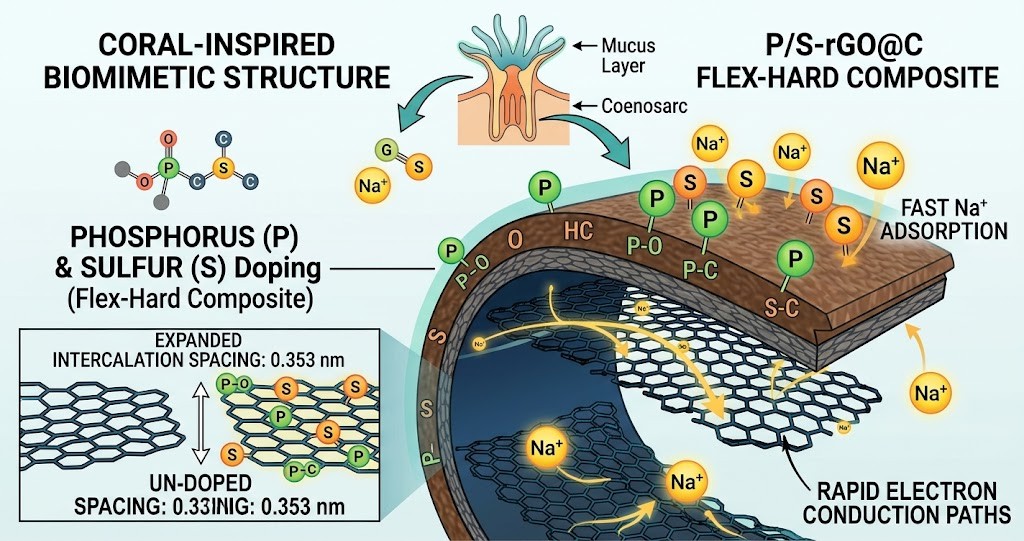
サンゴのポリプ(外胚葉の粘液層で栄養・プランクトンを捕獲し、内部の共肉部で高速輸送する構造)の機能分担から着想を得て、「フレキシブル・ハード(Flex-Hard)」ハイブリッド層状構造を設計しました。
【サンゴの生体構造】               【P/S-rGO@C の機能分担】
 外層: 粘液層(プランクトン捕獲)  ⇒  外層: PR由来HC + P/S/O極性基(Na+高速吸着・擬似容量)
 内層: 共肉部(高速栄養輸送)    ⇒  内層: 2D rGOナノシート(高速電子伝導ネットワーク)
合成ステップ
- 2Dテンプレート形成: 酸化グラフェン(GO)水溶液中でレゾルシノールとホルムアルデヒドを縮合させ、GO表面にフェノール樹脂皮膜(PR)を均一形成(
GO@PR)。 - 赤リン・硫黄を用いた熱処理(P/S共ドープ): アルゴン雰囲気下で段階的に加熱し、リン(P)および硫黄(S)を炭素骨格内へ同時に導入。最終物として
P/S-rGO@Cを獲得。
3. 材料・表面構造特性解析
- 層間距離の拡大: XRD解析により、無ドープ(rGO@C)の(002)面間隔が約0.335 nmであるのに対し、
P/S-rGO@Cでは 0.353 nm まで拡大していることを確認(大きな原子半径を持つP, Sの導入と欠陥形成による)。 - 欠陥・無秩序度の向上: Raman分光における AD/AG比が
rGO@C(1.48) からP/S-rGO@C(2.04) へ著しく増大。Na+吸着に適した構造欠陥領域が増加。 - 表面化学状態(XPS解析):
- P元素: P-C結合および P-O結合の形成(P-O結合は骨格安定性と極性の向上に寄与)。
- S元素: C-S-C結合、P-S結合、および oxidized sulfur 構造の形成(ステップ状のS/Na酸化還元反応に与与)。
- O元素: C=O, C-O, O-C=O などのカルボニル/カルボキシル基が維持され、Na+の極性吸着サイトとして機能。
4. 充放電・電極特性評価(エレクトロケミカルパフォーマンス)
半電池(対極:Na金属)による評価結果:
- 高可逆容量: 0.1 A g⁻¹ において 311 mAh g⁻¹ の放電容量を達成(未ドープ品 163.2 mAh g⁻¹ の約2倍)。
- 優秀な高レート特性: 10 A g⁻¹ の超高電流密度においても 152.1 mAh g⁻¹ を維持。
- 優れた長期サイクル耐久性: 3 A g⁻¹ での1000サイクル連続充放電後も 206.6 mAh g⁻¹ の容量を保持。
- 構造の自己適応(活性化現象): サイクル初期に容量が緩やかに増加する現象を観測。100サイクル後の Ex-situ HRTEM 解析から、骨格を破壊することなく層間距離が 0.353 nm から 0.384 nm へ拡大し、Na+ のアクセス性が向上していることが判明。
5. ナトリウム貯蔵メカニズムとDFT理論計算
反応解析(CV & GITT)
- Scan rate を変化させた Cyclic Voltammetry (CV) 解析より、2 mV s⁻¹ における全容量への擬似容量(Pseudocapacitive)寄与率は 93.49% に達する。
- GITT測定により算出された Na+ 拡散係数(DNa+)は、P/S共ドープ処理によって大幅に向上しており、極めてスピーディーなイオン移動速度を維持可能。
密度汎関数理論(DFT)計算の知見
- 電子伝導性の飛躍(DOS解析): 高濃度P/Sドープモデルは、フェルミ準位(EF)近傍の全状態密度(Total DOS)が大きく増加。バンギャップ内に不純物準位が形成され、材料固有の伝導度が向上。
- 電荷移動量の増大(Bader Charge解析): $Na$ イオンから炭素基板への移動電荷量が、酸素修飾モデル(0.11 e⁻)や低ドープモデル(0.16 e⁻)に対し、高ドープモデルでは 0.26 e⁻ まで拡大。
- 吸着エネルギーの最適化(Ead): Na+ の吸着エネルギーが、酸素モデル(-2.47 eV)から高ドープモデル(-2.92 eV)へとより負の値(強力な結合)となり、表面吸着サイトの熱力学的安定性が向上。
6. まとめ・技術的インサイト
- 機能の空間的分離(Decoupling): GO導電ネットワーク(内部電子高速道路)と、P/S/O多元素ドープHC(外部イオンキャプチャ層)を分離配置することで、従来ハードカーボンの課題であった「導電性不足」と「高密度充放電時の容量ドロップ」を同時にクリアした。
- 活性化プロセスの活用: 充放電に伴う適度な層間アライメントの自己微調整(0.353 nm → 0.384 nm)により、長期のサイクリング後も強固な構造安定性と高い運動学的特性を両立している。
- SIB負極開発の指針: 次世代SIB用炭素材料において、単なる幾何学的な孔径制御だけでなく、2Dテンプレート技術とヘテロ元素(P/S/O)の組み合わせによる「表面電子状態のチューニング」が極めて有効なアプローチであることを実証した。
出典:https://www.nature.com/articles/s43246-026-01376-7
[Paper Digest] Coral-Inspired P/S-Codoped Hard Carbon Enables High-Rate and Long-Life Sodium-Ion Batteries
As the demand for energy storage systems (ESS) and electric vehicles (EVs) surges toward achieving a decarbonized society, lithium-ion batteries (LIBs) face significant supply risks, including the geographical concentration of lithium resources and severe fluctuations in raw material prices. In response, sodium-ion batteries (SIBs), which utilize abundant and low-cost sodium, are rapidly attracting attention as a powerful complementary technology to LIBs for large-scale grid storage and other applications.
PDF他 1 件
However, improving the performance of anode materials remains an essential challenge for the practical commercialization of SIBs.
- Limitations of Graphite: Graphite, standardly used in LIBs, struggles to accommodate Na+ via reversible intercalation/deintercalation into its interlayer spacing (~0.335 nm) due to the larger ionic radius of Na+ (1.02 Å) compared to Li+ (0.76 Å), preventing it from delivering sufficient capacity.
- Challenges of Hard Carbon (HC): Hard carbon (HC)—featuring an disordered crystalline structure, wider interlayer spacing, and abundant defects/voids—is considered the most promising anode material for SIBs. In particular, phenol formaldehyde resin (PR)-derived HC offers high carbon yield and superior quality. However, its inherently low electronic conductivity and sluggish Na+ diffusion kinetics lead to severe capacity decay under high current densities (fast charging/discharging), posing a major bottleneck in rate performance.
To overcome this trade-off between conductivity and capture kinetics, this study developed a function-decoupled 2D-templated carbon skeleton inspired by the biological architecture of marine coral polyps.
2. Material Design Concept & Synthesis Process (Coral-Inspired Biomimectics)
Inspired by the functional division of labor in coral polyps—where the ectodermal mucus layer captures nutrients/plankton and the internal coenosarc rapidly transports them—we designed a “Flex-Hard” hybrid layered architecture.
【Coral Biological Architecture】        【Functional Division in P/S-rGO@C】
 Outer: Mucus Layer (Plankton capture) ⇒ Outer: PR-derived HC + P/S/O polar groups (Fast Na+ adsorption & pseudocapacitance)
 Inner: Coenosarc (Fast nutrient transport) ⇒ Inner: 2D rGO nanosheets (Fast electron transport network)
Synthesis Steps
- 2D Template Formation: Resorcinol and formaldehyde were condensed in an aqueous graphene oxide (GO) suspension to form a uniform phenol formaldehyde resin coating on the GO surface (
GO@PR). - Thermal Treatment with Red Phosphorus & Sulfur (P/S Codoping): The precursor was heated stepwise under an argon atmosphere to simultaneously co-incorporate phosphorus (P) and sulfur (S) into the carbon skeleton, yielding the final
P/S-rGO@Ccomposite.
3. Material & Surface Structural Characterization
- Expansion of Interlayer Spacing: XRD analysis confirmed that the (002) interlayer spacing expanded from ~0.335 nm in the undoped sample (
rGO@C) to 0.353 nm inP/S-rGO@C, attributed to defect formation and the incorporation of P and S atoms with larger atomic radii. - Increased Defect Density & Disorder: The AD/AG intensity ratio from Raman spectroscopy increased significantly from 1.48 (
rGO@C) to 2.04 (P/S-rGO@C), indicating a higher density of structural defect sites suitable for Na+ adsorption. - Surface Chemical States (XPS Analysis):
- P Element: Formation of P-C and P-O bonds, with P-O bonds contributing to enhanced skeletal stability and polarity.
- S Element: Presence of C-S-C, P-S, and oxidized sulfur species, facilitating stepwise S/Na redox reactions.
- O Element: Retained carbonyl/carboxyl groups (C=O, C-O, O-C=O) serving as polar adsorption sites for Na+.
4. Electrochemical Performance Evaluation
Half-cell testing results (vs. Na/Na+ counter electrode):
- High Reversible Capacity: Delivered a discharge capacity of 311 mAh g⁻¹ at 0.1 A g⁻¹ (nearly double the 163.2 mAh g⁻¹ of the undoped counterpart).
- Superior High-Rate Capability: Retained 152.1 mAh g⁻¹ even at an ultra-high current density of 10 A g⁻¹.
- Outstanding Long-Term Cycling Stability: Maintained a capacity of 206.6 mAh g⁻¹ after 1,000 continuous cycles at 3 A g⁻¹.
- Self-Adaptive Structural Activation: A gradual capacity increase was observed during early cycling. Ex-situ HRTEM after 100 cycles revealed that the interlayer spacing expanded from 0.353 nm to 0.384 nm without structural collapse, enhancing accessibility for Na+ ions.
5. Sodium Storage Mechanism & DFT Calculations
Kinetic Analysis (CV & GITT)
- Cyclic Voltammetry (CV) analysis at various scan rates demonstrated a pseudocapacitive contribution of 93.49% to the total capacity at 2 mV s⁻¹.
- Galvanostatic Intermittent Titration Technique (GITT) measurements showed that the Na+ diffusion coefficient (DNa+) was significantly enhanced by P/S codoping, maintaining ultrafast ion transport kinetics.
Density Functional Theory (DFT) Insights
- Enhanced Electronic Conductivity (DOS Analysis): The heavily P/S-doped model showed a substantial increase in Total Density of States (Total DOS) near the Fermi level (EF), forming impurity states within the bandgap that inherently boost electrical conductivity.
- Increased Charge Transfer (Bader Charge Analysis): The transferred charge from Na ions to the carbon substrate increased to 0.26 e⁻ in the heavily doped model, compared to oxygen-modified (0.11 e⁻) and low-doped models (0.16 e⁻).
- Optimized Adsorption Energy (Ead): The Na+ adsorption energy shifted to a more negative value (-2.92 eV) in the heavily doped model compared to the oxygen model (-2.47 eV), indicating stronger binding and superior thermodynamic stability at surface adsorption sites.
6. Summary & Technical Insights
- Spatial Decoupling of Functions: Separating the inner GO conductive network (electronic expressways) from the outer P/S/O multi-element-doped HC (ion-capture layer) simultaneously resolves the dual challenges of hard carbon: low electrical conductivity and rapid capacity drop during high-rate operation.
- Leveraging Structural Activation: The self-adaptive fine-tuning of interlayer alignment during cycling (0.353 nm → 0.384 nm) achieves both robust structural stability and rapid kinetic performance over extended cycling.
- Design Guidelines for SIB Anodes: This work demonstrates that tuning the surface electronic state via 2D templating combined with multi-heteroatom doping (P/S/O)—rather than relying solely on geometric pore-size engineering—is an exceptionally effective strategy for next-generation SIB carbon anodes.

コメント