バッテリーの製造工程において、材料を空気に晒すだけで劣化が大幅に加速する一方、化学組成を微調整することでその悪影響をほぼ無効化できることが明らかになりました。
主なポイント
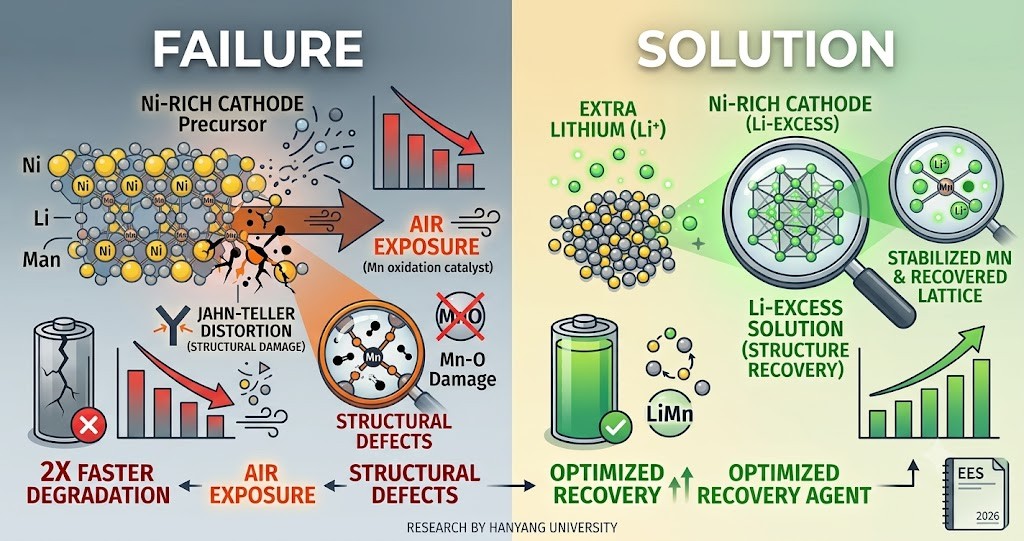
- 問題の発見: 高ニッケル電池の製造時、前駆体材料が空気に接触すると、表面のマンガンが酸化して構造的な欠損(ヤーン・テラー歪み)が生じます。これにより電解質の分解などが進み、充放電時の容量低下の速さがほぼ2倍に悪化します。
- 原因のパラドックス: 従来、正極の安定化を目的に添加されていたマンガンが、前駆体の管理不足(空気曝露)によって逆に劣化の触媒へと変化していました。
- 解決策の提示: 合成時にリチウムの過剰量を増やすことで、歪んだ表面構造が回復し、試験において90パーセント以上の高い容量維持率を達成しました。
- 掲載情報: 本研究は漢陽大学(韓国)のバン・ジン・ホ(Jin Ho Bang)教授らによって実施され、学術誌『Energy and Environmental Science』に掲載されました(記事公開日: 2026年7月30日、執筆: ブライアン・パブリコバー / Bryan Pawlikover)。
背景と関連技術の解説
1. 高ニッケル(Ni-rich)正極とは
リチウムイオン電池のエネルギー密度を高めるため、正極材中のニッケル比率を高めた技術です。電気自動車(EV)などの航続距離を延ばす鍵として広く採用されていますが、熱安定性の低下やサイクル寿命の短縮が課題となっています。
2. ヤーン・テラー歪み(Jahn-Teller distortion)とは
特定の金属イオン(特に3価のマンガンなど)の電子配置によって、結晶構造が物理的に歪んでしまう現象です。この歪みが生じると正極材の結晶格子が破壊されやすく、電池の劣化を招きます。
3. 製造プロセスにおける前駆体管理の重要性
電池の正極材は、本焼成を行う前の「前駆体(Precursor)」段階を経て製造されます。これまでの研究でも水分によるニッケルの劣化は知られていましたが、本研究により「前駆体の段階で空気に曝露されること」自体が正極の耐久性に重大なダメージを与えることが突き止められました。製造時の保管環境の厳密な管理が、今後の電池製造ラインにおいてより重要視されると考えられます。
Discovered by Hanyang University in South Korea: Air Exposure of Precursors Doubles Battery Degradation
It has been revealed that during the battery manufacturing process, simply exposing materials to air significantly accelerates degradation, whereas slightly fine-tuning the chemical composition can almost completely counteract this negative effect.
Key Points
- Discovery of the Problem: During the manufacturing of high-nickel batteries, when precursor materials come into contact with air, manganese on the surface oxidizes, causing a structural defect known as Jahn-Teller distortion. This promotes processes like electrolyte decomposition, nearly doubling the rate of capacity loss during charge-discharge cycling.
- Paradox of the Cause: Manganese, which was conventionally added to stabilize the cathode, turned into a catalyst for degradation when precursors were inadequately managed through air exposure.
- Proposed Solution: By increasing the excess amount of lithium during synthesis, the distorted surface structure was restored, achieving a high capacity retention rate of over 90 percent in tests.
- Publication Details: This study was led by Professor Jin Ho Bang and colleagues at Hanyang University in South Korea and published in the journal Energy and Environmental Science (article published on July 30, 2026, written by Bryan Pawlikover).
Background and Related Technologies
- What are High-Nickel (Ni-rich) Cathodes? This technology increases the proportion of nickel in cathode materials to raise the energy density of lithium-ion batteries. While widely adopted as a key to extending the driving range of electric vehicles (EVs), challenges remain regarding lower thermal stability and shortened cycle life.
- What is Jahn-Teller Distortion? This is a phenomenon where the crystal structure becomes physically distorted due to the electron configuration of specific metal ions, particularly trivalent manganese. When this distortion occurs, the crystal lattice of the cathode material easily breaks down, leading to battery degradation.
- Importance of Precursor Management in Manufacturing Processes Battery cathode materials are manufactured through a precursor stage prior to final calcination. While previous research has shown that moisture causes nickel degradation, this study highlights that exposure to air itself during the precursor stage severely damages cathode durability.


コメント