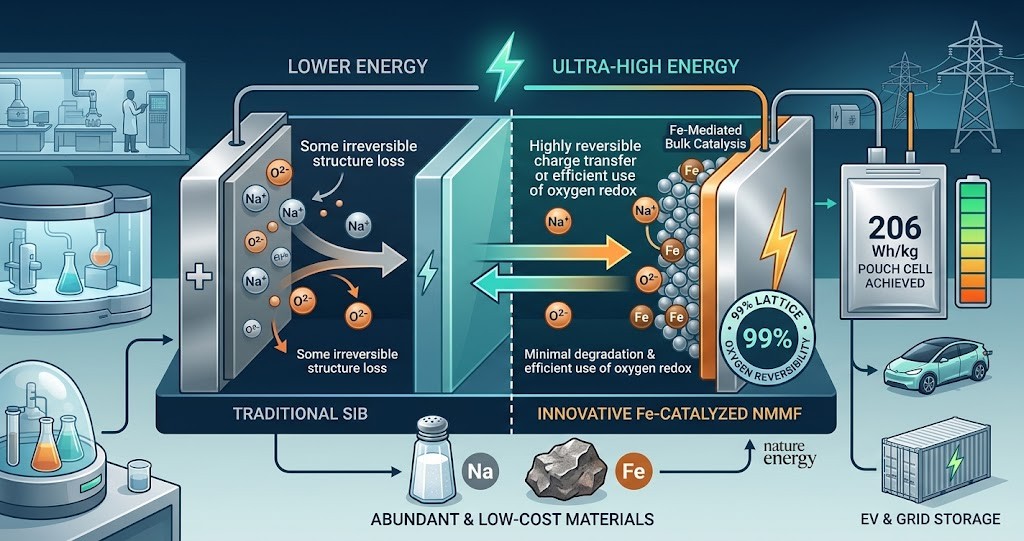
次世代のエネルギー貯蔵技術として、現在主流であるリチウムイオン電池に代わる「ナトリウムイオン電池」への注目が高まっています。ナトリウムはリチウムに比べて資源が豊富かつ安価であるため、定置用蓄電池やEV(電気自動車)向けのコスト削減策として期待されています。しかし、従来技術ではエネルギー密度の低さやサイクルの安定性が課題とされていました。
こうした中、中国の研究グループが正極材料内部で「鉄を介した触媒作用」を活用する新たなアプローチを開発し、エネルギー密度と安定性を大幅に飛躍させることに成功しました。本稿では、 Nature Energy 誌に掲載された最新の研究成果と、その技術的背景について解説します。
1. ナトリウムイオン電池と本研究の背景
- ナトリウムイオン電池のメリット: ナトリウムは地球上に豊富に存在するため、原材料コストを抑えやすく、供給リスクが低いという強みがあります。
- 技術的課題: リチウムに比べてイオン半径が大きいため、充放電時の構造変化が大きく、エネルギー密度の向上や長寿命化が課題とされてきました。
- 格子酸素の活性化とその難点: 電池の容量を増やすため正極中の酸素の酸化還元(格子酸素反応)を利用する手法がありますが、従来は可逆性が低く、繰り返し使うと構造劣化や容量低下を引き起こしやすいという問題がありました。
2. 研究の概要と革新的なメカニズム
中国の研究グループ(南京大学、浙江大学、蘇州大学、HoNa New Energy Technology、米国のローレンス・バークレー国立研究所などの共同研究)は、鉄(Fe)を利用した新しい触媒戦略を開発しました。
- 開発された正極材料: ナトリウム欠乏マンガン・マグネシウム・鉄層状酸化物(Na2/3Mn7/12Mg1/4Fe1/6O2、略称: NMMF)。
- バルク内酸化還元メディエーター(RM)効果:
- 従来のRM(リチウム/ナトリウム-酸素電池など)は電極の表面反応を促進するものでした。
- 本研究では、鉄が正極材料の内部(バルク内)でRMとして機能し、充電・放電時に鉄の酸化状態が変化しながら格子酸素との間で電子を効率よく移動させます。
- 可逆性の飛躍的向上: 鉄を介した作用により、格子酸素の酸化還元可逆性が従来の75%から99%へと向上しました(報告されている格子酸素反応の中で最高レベル)。
3. 正極材料の作製および電池セル構築
- 作製プロセス:
- 炭酸ナトリウム、二酸化マンガン、酸化マグネシウム、酸化鉄を原料に使用。
- 高温処理時のナトリウム損失を補うため、炭酸ナトリウムを5%過剰に添加。
- 高エネルギーボールミルにより300 rpmで5時間混合し、乾燥後に直径15 mmの円筒形に成形。
- 酸素を連続的に流しながら900 deg Cで12時間焼成。
- 評価用セルの試作:
- コイン型ハーフセル: 活性物質80%、アセチレンブラック10%、アルギン酸ナトリウムバインダー10%の組成でアルミホイルに塗布し評価。
- パウチ型フルセル: NMMF正極と硬質炭素(ハードカーボン)負極、ポリプロピレンセパレーター、ナトリウム系電解質を組み合わせた15.8 Ahの大型パウチセルを作製。
4. 達成された性能と今後の展望
- 優れたエネルギー性能:
- NMMF電極単体で 220 mAh g-1 の高比容量を記録。
- 15.8 Ahパウチセル全体(セル重量ベース)で 206 Wh kg-1 という高いエネルギー密度を達成。
- 検証技術: インシチュX線吸収端近傍構造(XANES)分光法、機械学習ベースの分子動力学(MD)シミュレーション、57Feメスバウアー分光法を用いて反応メカニズムを実証。
- 将来の展開:
- 今回の戦略を他の層状酸化物正極やアルカリイオン電池システム全般へ応用。
- 放電電圧の最適化やサイクル寿命のさらなる向上。
- 企業との連携による正極材料の合成スケールアップおよび電池製造の本格化。
まとめ
本研究は、鉄という安価で豊富な元素を活用して正極内部の酸素酸化還元反応を制御し、ナトリウムイオン電池のエネルギー密度を 200 Wh kg-1 超のレベルへと引き上げました。安価で高エネルギー密度な次世代蓄電池の実用化に向け、非常に大きな一歩となる成果です。
One Step Closer to Surpassing Lithium! Next-Gen Sodium-Ion Battery Utilizing Iron Achieves 206 Wh kg-1
Introduction
Sodium-ion batteries are drawing significant attention as a next-generation energy storage technology to replace mainstream lithium-ion batteries. Because sodium is abundant and inexpensive compared to lithium, it is expected to serve as a cost-reduction solution for stationary energy storage and electric vehicles (EVs). However, low energy density and cycle stability have traditionally been major challenges with conventional technology.
Under these circumstances, a research group in China developed a novel approach leveraging iron-mediated catalysis inside the cathode material, successfully achieving a massive leap in both energy density and stability. This article explains the latest research results published in Nature Energy along with their technical background.
1. Background of Sodium-Ion Batteries and This Research
- Advantages of Sodium-Ion Batteries: Sodium is naturally abundant on Earth, making it easy to keep raw material costs low while minimizing supply risks.
- Technical Challenges: Because the ionic radius of sodium is larger than that of lithium, structural changes during charge and discharge are severe, posing challenges for improving energy density and extending battery lifespan.
- Lattice Oxygen Activation and Its Drawbacks: Utilizing the oxidation and reduction of oxygen within the cathode (lattice oxygen redox reaction) is a known method to increase battery capacity. However, conventional techniques suffered from low reversibility, easily causing structural degradation and capacity loss during repeated cycles.
2. Research Overview and Innovative Mechanism
The Chinese research group—a collaboration including Nanjing University, Zhejiang University, Soochow University, HoNa New Energy Technology, and Lawrence Berkeley National Laboratory in the US—developed a novel catalytic strategy utilizing iron (Fe).
- Developed Cathode Material: Sodium-deficient manganese-magnesium-iron layered oxide (Na2/3Mn7/12Mg1/4Fe1/6O2, abbreviated as NMMF).
- Intra-Bulk Redox Mediator (RM) Effect:
- Conventional RMs (such as those used in lithium-oxygen or sodium-oxygen batteries) promote reactions on the electrode surface.
- In this research, iron functions as an RM inside the interior (bulk) of the cathode material. During charging and discharging, changing iron oxidation states efficiently transfer electrons to and from lattice oxygen.
- Dramatic Improvement in Reversibility: Thanks to the iron-mediated mechanism, lattice oxygen redox reversibility improved from the conventional 75% up to 99% (the highest level reported for lattice oxygen redox reactions to date).
3. Cathode Material Preparation and Battery Cell Fabrication
- Preparation Process:
- Sodium carbonate, manganese dioxide, magnesium oxide, and iron oxide were used as raw materials.
- To compensate for sodium loss during high-temperature processing, 5% excess sodium carbonate was added.
- The materials were mixed using a high-energy ball mill at 300 rpm for 5 hours, dried overnight, and pressed into cylindrical pellets with a diameter of 15 mm.
- The mixture was calcined at 900 deg C for 12 hours under a continuous flow of oxygen.
- Fabrication of Test Cells:
- Coin-type Half-Cell: Evaluated by applying a mixture of 80% active material, 10% acetylene black, and 10% sodium alginate binder onto aluminum foil.
- Pouch-type Full-Cell: Assembled into a large 15.8 Ah pouch cell combining the NMMF cathode with a hard carbon anode, a polypropylene separator, and a sodium-based electrolyte.
4. Performance Achieved and Future Outlook
- Outstanding Energy Performance:
- The NMMF electrode alone achieved a high specific capacity of 220 mAh g-1.
- The entire 15.8 Ah pouch cell achieved a high energy density of 206 Wh kg-1 based on total cell weight.
- Validation Techniques: The reaction mechanism was verified using in situ X-ray absorption near-edge structure (XANES) spectroscopy, machine learning-based molecular dynamics (MD) simulations, and 57Fe Mossbauer spectroscopy.
- Future Developments:
- Applying this strategy to other layered oxide cathodes and alkali-ion battery systems in general.
- Optimizing discharge voltage and further enhancing cycle life.
- Scaling up cathode material synthesis and commercializing battery manufacturing through corporate partnerships.
Summary
This study demonstrated that utilizing an inexpensive and abundant element like iron to control internal oxygen redox reactions elevates the energy density of sodium-ion batteries beyond the 200 Wh kg-1 threshold. This represents a major step forward toward the practical application of low-cost, high-energy-density next-generation rechargeable batteries.


コメント