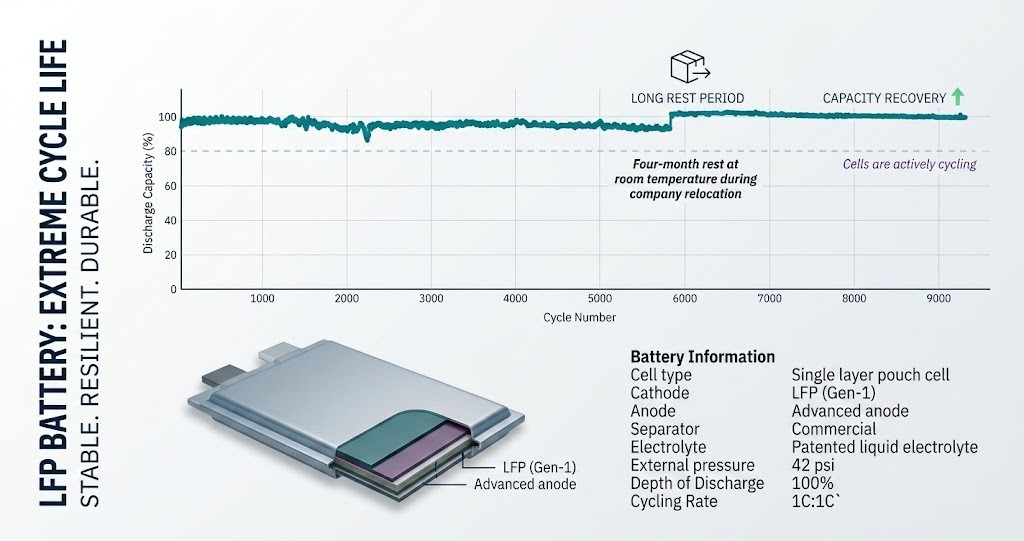
次世代の蓄電池技術として世界中から大きな注目を集める「リチウム金属電池」領域において、非常に大きな技術的ブレイクスルーが発表されました。垂直統合型のリチウム金属電池開発を手がける米Pure Lithium(ピュア・リチウム)社は、超長寿命化を目指して開発した自社の「Advanced Anode」技術を用いたセルが、9,315サイクルを超える充放電試験を達成したと公表しました。
リチウム金属電池はエネルギー密度が高い一方で、短寿命(充放電の繰り返しによる劣化)が実用化への最大の障壁とされていました。今回の実証データは、従来の限界を打ち破り、グリッド向け大型蓄電池やEV(電気自動車)、データセンターなど多様な産業での商業化を現実化する重要な一歩となります。
発表の主要ポイント
- 前例のないサイクル寿命の達成
- 自社ラボでのテストにおいて、100%の放電深度(DoD 100%)、充放電レート 1C:1C という厳しい条件下で 9,315サイクル以上 の連続充放電を記録。
- 容量低下(デグラデーション)はほとんど見られず、現在もサイクル試験を継続中。
- 開発中のリチウム金属電池として、同等条件でこれほどの高耐久性を達成した例は同社が把握する限り存在しません。
- 従来型リチウムイオン電池との比較
- 市販の一般的なリチウムイオン電池の寿命は用途に応じて通常 250〜2,000サイクル 程度ですが、今回の成果はこれを大幅に上回っています。
- LCOS(均等化蓄電コスト)の劇的な削減
- 創業者 兼 CEOのEmilie Bodoin(エミリー・ボドイン)氏によると、サイクル寿命の大幅な伸びにより、エネルギーの均等化蓄電コスト(LCOS)を 最大で75%削減できる可能性 があります。
- 1回目(初期)の波形の乱れに関する背景
- 試験初期に見られた電圧等の相対的に大きなデータ変動は、ボストンにあった初期の「1.0ラボ」における温度管理不足や複数回の停電によるものであり、技術の本質的な不具合によるものではありません(現在はシカゴの専用ラボへ移転済み)。
関連情報・技術的背景の補足
1. リチウム金属電池が「究極の目標」とされる理由
- グラファイトからの脱却: 従来のリチウムイオン電池では負極にグラファイト(黒鉛)が使われていますが、これをリチウム金属に置き換えることで、負極レベルのエネルギー密度が 約10倍 に向上します。
- 高エネルギー密度化と軽量化: セル全体としてもエネルギー密度を約2倍に高めることができ、製品の大幅な軽量化と低コスト化が期待できます。
2. ピュア・リチウム社の独自アプローチ(垂直統合)
- 第一原理(First Principles)からのアプローチ: 単一の部材改良に留まらず、リチウム金属の抽出から負極材の製造、電池セルの組立て、さらにはサプライチェーン全体を一から再構築しています。
- 脱・脱炭素サプライチェーン: 黒鉛、コバルト、ニッケル、マンガンを使用しない設計を採用しており、特定のサプライチェーン(中国等)への依存度を下げ、環境負荷を抑えた製造プロセスを実現しています。
3. 技術進化の歩み
- 2025年1月の発表: 放電深度 100%、1C:1C で 2,200サイクル(80%以上の容量維持)を達成(当時は1,000サイクルを目標に設計された負極を使用)。
- 今回の発表: 改良版の「Advanced Anode」を投入することで、一気に 9,315サイクル超 へと耐久性を躍進させました。
まとめと今後の展望
リチウム金属電池は長年「高エネルギーだが短寿命」という課題に悩まされてきましたが、9,000サイクルを超える耐久性が証明されたことで、ニッチな高容量用途にとどまらず、電力系統用蓄電池(グリッドストレージ)、AI需要で急増するデータセンターの非常用電源、電気自動車(EV) といった広範な主要市場への投入が現実的になりました。今後、研究室レベルの成果から商業用ギガファクトリー規模での大量生産へどのようにスケールアップしていくかが注目されます。
出典:https://www.businesswire.com/news/home/20260826700465/ja
Lithium Metal Battery Achieves 9,315 Cycles: Pure Lithium Announces New “Advanced Anode” Technology
A major technological breakthrough has been announced in the field of lithium metal batteries, a next-generation energy storage technology drawing significant global attention. US-based Pure Lithium, a vertically integrated lithium metal battery developer, announced that cells utilizing its proprietary “Advanced Anode” technology—specifically developed for ultra-long cycle life—achieved over 9,315 charge-discharge cycles.
While lithium metal batteries offer high energy density, short cycle life (degradation from repeated charging and discharging) has historically been the primary barrier to commercialization. This empirical data shatters conventional limitations, marking a crucial step toward bringing lithium metal batteries to commercial reality across various industries, including grid-scale energy storage, electric vehicles (EVs), and data centers.
Key Highlights of the Announcement
- Unprecedented Cycle Life: Recorded over 9,315 continuous cycles in internal lab testing under rigorous conditions: 100% Depth of Discharge (100% DoD) and a 1C:1C charge/discharge rate. Almost no capacity degradation was observed, and cycle testing remains ongoing. To the company’s knowledge, no other developing lithium metal battery has achieved such high durability under comparable test conditions.
- Comparison with Conventional Lithium-Ion Batteries: Commercial lithium-ion batteries typically offer a lifespan of 250 to 2,000 cycles depending on the application. This result drastically surpasses those standard requirements.
- Dramatic Reduction in LCOS (Levelized Cost of Storage): According to Founder and CEO Emilie Bodoin, the substantial extension in cycle life has the potential to reduce the Levelized Cost of Storage (LCOS) by up to 75%.
- Background on Initial Data Fluctuations: Relatively large fluctuations observed in early test data were caused by unmanaged temperatures and multiple power outages at the company’s initial “1.0 Lab” in Boston, rather than an intrinsic fault in the technology. (Testing operations have since relocated to a dedicated facility in Chicago.)
Supplementary Technical Background & Context
- Why Lithium Metal is the “Holy Grail”:
- Moving Beyond Graphite: Traditional lithium-ion batteries use graphite for the anode. Replacing graphite with lithium metal increases energy density at the anode level by roughly 10x.
- Higher Energy Density and Weight Reduction: At the cell level, energy density can be roughly doubled, enabling significant weight reduction and lower production costs.
- Pure Lithium’s Unique Vertically Integrated Approach:
- First-Principles Design: Rather than improving a single component, the company rebuilt the entire process from scratch—from lithium metal extraction and anode manufacturing to battery cell assembly and the broader supply chain.
- Streamlined Supply Chain: The design eliminates the need for graphite, cobalt, nickel, and manganese, reducing reliance on specific foreign supply chains while minimizing environmental impact.
- Timeline of Technological Evolution:
- January 2025 Announcement: Achieved over 2,200 cycles with over 80% capacity retention at 100% DoD and 1C:1C (using an anode engineered for a 1,000-cycle goal).
- Current Announcement: Introducing the enhanced “Advanced Anode” pushed durability past the 9,315-cycle mark.
Summary and Future Outlook
Lithium metal batteries have long been hindered by the trade-off between high energy density and short lifespan. Proving a durability of over 9,000 cycles transitions this technology from a niche, high-capacity concept into a practical reality for major mainstream markets—such as grid storage, backup power for AI-driven data center demand, and electric vehicles. The industry’s focus now turns to how these lab-scale results will scale up into gigafactory-level mass production.

コメント