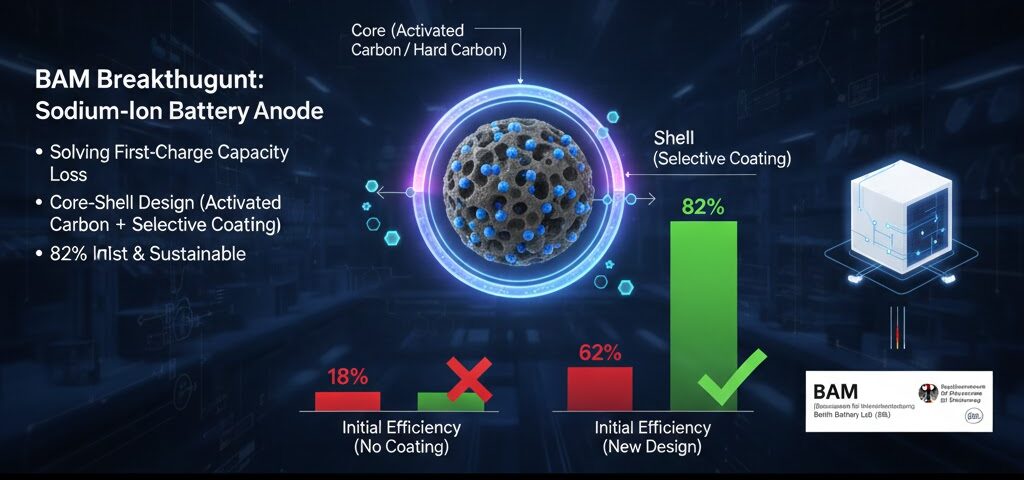
ドイツ連邦材料試験研究所(BAM)の研究チームが、ナトリウムイオン電池の最大の弱点の一つであった「初回充電時の容量損失」を大幅に改善する新しいアノード(負極)設計を発表しました。
1. ナトリウムイオン電池(NIB)の現状と課題
- 期待される理由: リチウムに比べ資源が豊富で安価。環境負荷が低く、持続可能な次世代電池として注目されています。
- 技術的障壁: 初回充電時に電解質が分解され、アノード表面に保護膜(SEI)を形成する際、多くのナトリウムイオンが消費されてしまいます。これにより、電池として使える容量が大幅に減る「初期効率の低さ」が課題でした。
- 材料の違い: リチウム電池で使われるグラファイト(黒鉛)はナトリウムをうまく貯蔵できません。そのため「ハードカーボン(難黒鉛化性炭素)」が使われますが、この材料は多孔質(穴が多い)であるため、電解質が内部まで入り込みすぎて過剰な反応を起こしていました。
2. 革新的な「コアシェル設計」の仕組み
BAMの研究チームは、アノード材料を「中心部(コア)」と「外殻(シェル)」に分ける新しい構造を開発しました。
- コア(核): 安価で環境に優しい「活性炭」をベースにした、スポンジ状の多孔質ハードカーボン。ここに大量のナトリウムイオンを蓄えます。
- シェル(殻): コアの表面に施された極めて薄いコーティング層。
- フィルター機能: ナトリウムイオンは通過させますが、サイズが大きい電解質分子の侵入をブロックします。
- 効果: 電解質がコアの細孔(スキマ)を埋めてしまうのを防ぎ、ナトリウムイオンが収まるスペースを確保します。
3. 研究成果と性能の向上
この「形成(膜作り)」と「蓄電(イオン貯蔵)」の役割を分離するアプローチにより、以下の成果が得られました。
- 初期効率の劇的向上: コーティングなしのアノードではわずか18%だった初期効率が、この新設計により82%まで向上しました。
- 経済性: 原料に安価な活性炭を使用しているため、コスト面でも非常に有利です。
- 将来性: これまで電池の改良はカソード(正極)側が中心でしたが、今回の成果はアノード側の材料革新によってさらなる高容量化が可能であることを示しました。
関連・補足情報:なぜ「82%」が重要なのか?
通常、商用化されているリチウムイオン電池の初期効率は90%を超えています。ナトリウムイオン電池がこれに対抗するには、80%台後半から90%を目指す必要があります。 今回の研究で18%から82%へ跳ね上がったことは、「使い物にならなかったレベル」から「実用化の土俵に乗るレベル」へ一気に進歩したことを意味します。
今後の展開
この技術は、ベルリン・バッテリー・ラボ(BBL)において、さらなる効率向上と市場投入に向けた開発が進められます。ドイツ政府(ドイツ連邦研究技術宇宙省)の資金援助を受けており、エネルギー貯蔵システム(定置用蓄電池)や安価な電気自動車(EV)への応用が期待されています。
Suppressing Electrolyte Decomposition in Hard Carbon Anodes for Sodium-Ion Batteries: A Core-Shell Design Approach
A research team at the Federal Institute for Materials Research and Testing (BAM) has announced a new anode design that significantly improves “initial capacity loss” during the first charge, which has been one of the biggest weaknesses of sodium-ion batteries.
1. Current Status and Challenges of Sodium-Ion Batteries (NIBs)
- Reasons for high expectations: Sodium is more abundant and cheaper than lithium. NIBs are gaining attention as sustainable, next-generation batteries with a low environmental impact.
- Technical barriers: During the first charge, the electrolyte decomposes and forms a protective layer (SEI) on the anode surface, consuming many sodium ions in the process. This leads to “low initial efficiency,” where the usable capacity of the battery is significantly reduced.
- Material differences: Graphite, used in lithium batteries, cannot store sodium effectively. Therefore, “hard carbon” is used instead. However, because hard carbon is highly porous, the electrolyte penetrates too deeply, causing excessive reactions.
2. Innovative “Core-Shell Design” Mechanism
The BAM research team developed a new structure that separates the anode material into a “core” and a “shell.”
- Core: A sponge-like porous hard carbon based on inexpensive and eco-friendly “activated carbon.” This is where a large number of sodium ions are stored.
- Shell: An extremely thin coating layer applied to the surface of the core.
- Filter Function: It allows sodium ions to pass through while blocking larger electrolyte molecules.
- Effect: It prevents the electrolyte from clogging the pores of the core, ensuring enough space for sodium ions to be stored.
3. Research Results and Performance Improvements
By separating the roles of “formation” (layer building) and “storage” (ion capacity), the following results were achieved:
- Dramatic Increase in Initial Efficiency: The initial efficiency, which was only 18% for uncoated anodes, skyrocketed to 82% with this new design.
- Economic Viability: Since the process uses inexpensive activated carbon as a raw material, it is highly cost-effective.
- Future Potential: While battery improvements have historically focused on the cathode (positive electrode), this achievement demonstrates that material innovation on the anode side can enable even higher capacities.
Related/Supplementary Info: Why is “82%” Significant?
The initial efficiency of commercially available lithium-ion batteries typically exceeds 90%. For sodium-ion batteries to compete, they need to reach the high 80s or 90% range. The jump from 18% to 82% in this study means the technology has advanced from a “non-viable level” to a “commercially competitive level” in one giant leap.
Future Outlook
This technology will be further developed at the Berlin Battery Lab (BBL) to enhance efficiency and prepare for market entry. Funded by the German Federal Ministry of Education and Research, it is expected to be applied to energy storage systems (stationary batteries) and affordable electric vehicles (EVs).

コメント