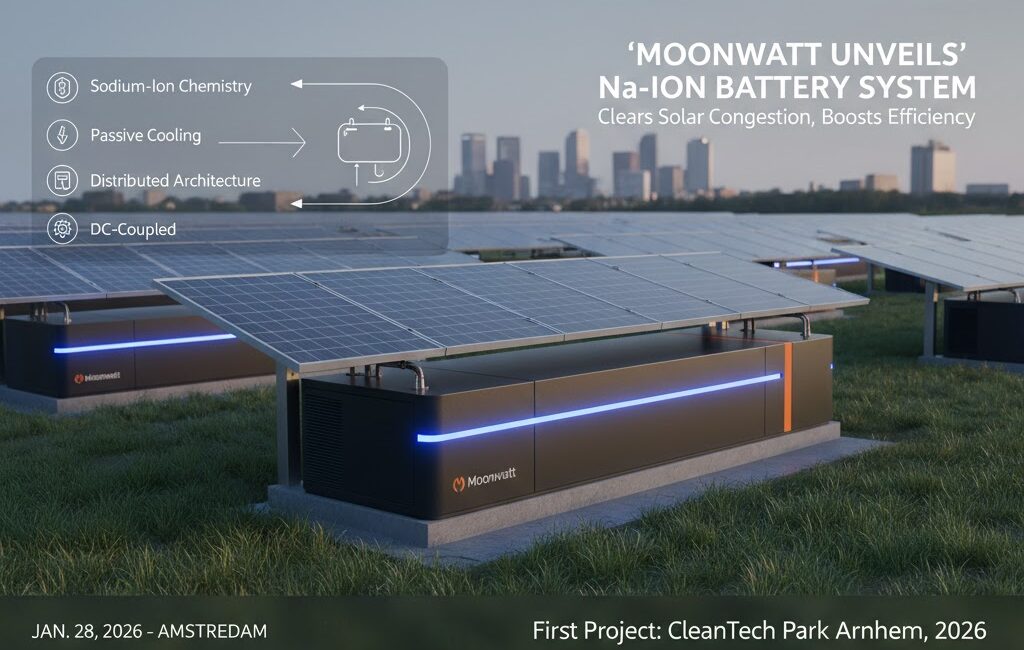
オランダのアムステルダムに本拠を置くスタートアップ、Moonwatt(ムーンワット)社が、次世代の太陽光発電市場を塗り替える革新的な蓄電システムを発表しました。
以下に、ニュースの要約と技術的背景をまとめたレポートをお届けします。
【次世代エネルギーニュース】ナトリウムイオン電池が太陽光発電の「混雑」を解消、Moonwattがオランダで始動
【2026年1月28日 アムステルダム】 太陽光発電の急速な普及に伴い、送電網の容量不足や価格下落が世界的な課題となっています。この問題に終止符を打つべく、Moonwatt社は、ハイブリッド太陽光発電所に特化した新しい「ナトリウムイオン電池エネルギー貯蔵システム(BESS)」を導入しました。オランダビジネス庁(RVO)から115万ユーロの助成金を獲得したこの技術は、2026年にクリーンテックパーク・アーネムで初のプロジェクトが展開される予定です。
1. ニュースのハイライト
- ナトリウムイオン(NFPP)の採用: 希少金属のリチウムに代わり、資源が豊富なナトリウムを利用。熱安定性に優れ、発火リスクを最小限に抑えます。
- 革新的な「ストリングバッテリー」: 太陽光パネルの直下に設置可能な分散型アーキテクチャ。基礎工事不要で、フォークリフトによる迅速な設置が可能です。
- 完全DC結合設計: ハイブリッドインバータを介してパネルと電池を直接接続。AC/DC変換のロスを減らし、余剰電力を効率よく蓄えます。
- パッシブ冷却システム: 可動部品(ファンや空調)を排除した静音設計により、メンテナンスコスト(OPEX)を大幅に削減します。
2. Moonwatt技術の4つの柱
| 特徴 | 詳細・メリット |
| ナトリウムイオン化学 | 高温・低温下でも劣化が少なく、高いサイクル耐性を維持。安全性と持続可能性を両立。 |
| 高度パッシブ冷却 | 密閉されたケース内で熱を管理。埃や水に強い高いIP保護等級を実現。 |
| 分散型設計 | キロワット(kW)からギガワット(GW)までシームレスに拡張可能。土地を有効活用。 |
| DC結合 | 中圧変圧器を減らし、設備投資(CAPEX)を抑制。システム全体の収益性を向上。 |
【関連知識:なぜ今「ナトリウムイオン」なのか?】
今回の発表の鍵となる「ナトリウムイオン電池」について、関連情報を補足します。
- 脱リチウムの動き: リチウムは価格変動が激しく、供給網が特定の国に集中しています。一方、ナトリウム(塩の主成分)は地球上に広く存在し、安価で安定した調達が可能です。
- 低温特性: ナトリウムイオン電池は、リチウムイオン電池が苦手とするマイナス20度といった極低温環境でも高い性能を維持できるため、屋外設置の蓄電池に適しています。
- 安全性: 過放電(電圧ゼロの状態)での輸送が可能であり、輸送中の発火リスクが極めて低いため、物流コストと安全性が向上します。
出典:https://www.moonwatt.com/news/20260128
Silent, Safe, and Affordable: Moonwatt Leads the Social Implementation of Sodium-Ion Batteries
Amsterdam-based startup Moonwatt has announced a revolutionary energy storage system designed to reshape the next-generation solar power market. Below is a report summarizing the news and the technical background of this innovation.
Next-Gen Energy News: Sodium-Ion Batteries Solve Solar “Grid Congestion” – Moonwatt Launches in the Netherlands
[Amsterdam, January 28, 2026] – As solar power adoption surges globally, grid capacity shortages and “price cannibalization” have become urgent challenges. To address these issues, Moonwatt has introduced a new Sodium-Ion Battery Energy Storage System (BESS) specifically engineered for hybrid solar plants. This technology, which recently secured a 1.15 million Euro DEI+ grant from the Netherlands Enterprise Agency (RVO), is scheduled for its first project deployment at Cleantech Park Arnhem in 2026.
1. News Highlights
- Adoption of Sodium-Ion (NFPP): Utilizing abundant sodium instead of rare-earth lithium. This chemistry offers superior thermal stability and minimizes fire risks.
- Innovative “String Battery”: A decentralized architecture that can be installed directly beneath solar panels. The design requires no specialized foundation and can be quickly deployed using a standard forklift.
- Full DC-Coupled Design: Connects solar panels and batteries directly through a shared hybrid inverter. This reduces AC/DC conversion losses and allows for the efficient storage of excess energy.
- Passive Cooling System: A silent design that eliminates moving parts (such as fans or air conditioning), significantly reducing maintenance costs (OPEX).
2. The Four Pillars of Moonwatt Technology
| Feature | Details and Benefits |
| Sodium-Ion Chemistry | Minimal degradation in high or low temperatures; maintains high cycle resilience. Balances safety with sustainability. |
| Advanced Passive Cooling | Manages heat within a hermetically sealed enclosure. Achieves high IP protection against dust and water. |
| Distributed Design | Seamlessly scalable from kilowatts (kW) to gigawatts (GW). Optimizes land use by utilizing space under PV panels. |
| DC Coupling | Reduces the need for medium-voltage transformers, lowering capital expenditure (CAPEX). Enhances overall asset profitability. |
[Related Knowledge: Why Sodium-Ion Now?]
To better understand this announcement, here is supplementary information on why sodium-ion technology is gaining traction:
- The Shift Away from Lithium: Lithium prices are volatile, and the supply chain is concentrated in specific regions. In contrast, sodium (the main component of salt) is globally abundant, enabling affordable and stable procurement.
- Low-Temperature Performance: Sodium-ion batteries maintain high performance even in extreme cold (as low as -20 degrees Celsius)—an area where lithium-ion batteries often struggle. This makes them ideal for outdoor storage installations.
- Safety and Logistics: These batteries can be transported in a “zero-voltage” (fully discharged) state, which virtually eliminates the risk of fire during transit. This significantly improves safety and reduces logistics costs.

コメント