全固体リチウムイオン電池のさらなる高性能化に向けて、実用化の鍵を握る固体電解質の開発で大きなブレイクスルーとなる研究成果が発表されました。本記事の要点と、技術的な背景や意義などの関連情報をまとめて解説します。
研究成果の要点
- 発表主体: 名古屋大学大学院工学研究科(矢島健准教授、入山恭寿教授らの研究グループ)
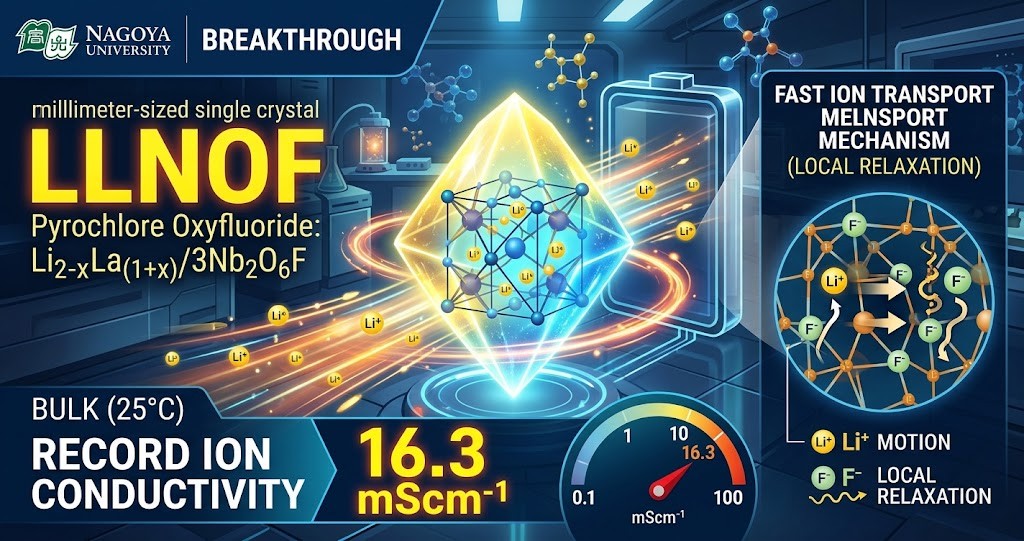
- 開発素材: パイロクロア型酸フッ化物「Li2-xLa(1+x)/3Nb2O6F(LLNOF)」のミリメートルサイズ単結晶
- 達成スペック: 25℃におけるバルクリチウムイオン伝導率で世界最高値となる 16.3 mScm-1 を記録(x=0.61の組成時)
- イオン伝導の仕組み: 単結晶X線回析などを通じ、Liイオンの移動に伴ってフッ化物イオンが局所的に位置を変える「局所緩和」が高速伝導を支えているメカニズムを解明
関連情報・解説
1. 固体電解質における「酸化物系・フッ化物系」の位置づけ 全固体電池の電解質には主に「硫化物系」と「酸化物系・フッ化物系」があります。
- 硫化物系: イオン伝導率が高い反面、大気中の水分と反応して有害な硫化水素が発生しやすい課題があります。
- 酸化物系・フッ化物系: 大気中で極めて安定し安全性が高い一方、従来はイオン伝導率が低い点がネックでした。
今回の成果は、安全性の高い酸フッ化物系でありながら、既存の硫化物系電解質と同等以上のトップクラスの伝導率を達成した点に大きな価値があります。
2. 「単結晶」育成がもたらした意義 従来の多結晶体(小さな結晶の集まり)では、結晶同士のつなぎ目(結晶粒界)が抵抗となり、素材本来の性能を正しく測定するのが困難でした。今回ミリメートルサイズの単結晶育成に成功したことで、粒界抵抗の影響を排除した純粋な「バルク性能」の評価が可能となり、異次元の伝導率と伝導メカニズムの解明につながりました。
3. 今後の期待と実用化への課題 高いイオン伝導率は電池の「高出力化(急速充放電)」に直結します。一方で、単結晶の大量生産コストや、電極と固体電解質との良好な接合面の形成といった量産化プロセスにおける課題の克服が、今後の実用化に向けた焦点となります。
出典:https://eetimes.itmedia.co.jp/ee/articles/2608/27/news035.html
Paving the Way for Fast Charging in All-Solid-State Batteries! Nagoya University Achieves World-Class Ionic Conductivity with Oxide-Fluoride Single Crystals
To achieve even higher performance in all-solid-state lithium-ion batteries, a major breakthrough has been announced in the development of solid electrolytes—the key to commercial application. This article summarizes the main points of the research, along with relevant context such as technical background and significance.
Key Highlights of the Research Findings
- Research Entity: Graduate School of Engineering, Nagoya University (Research group led by Associate Professor Takeshi Yajima and Professor Yasutoshi Iriyama)
- Developed Material: Millimeter-sized single crystals of pyrochlore-type oxyfluoride “Li2-xLa(1+x)/3Nb2O6F (LLNOF)”
- Achieved Performance: Recorded a world-record bulk lithium-ion conductivity of 16.3 mScm-1 at 25 degrees C (at a composition of x = 0.61)
- Mechanism of Ionic Conduction: Through single-crystal X-ray diffraction and other techniques, the researchers clarified that “local relaxation”—where fluoride ions shift their position locally in sync with the movement of Li ions—supports the high-speed conduction.
Related Context and Analysis
1. Positioning of “Oxide and Fluoride Systems” in Solid Electrolytes Electrolytes for all-solid-state batteries mainly fall into “sulfide-based” and “oxide- or fluoride-based” categories:
- Sulfide-based: While possessing high ionic conductivity, they present the challenge of generating harmful hydrogen sulfide when reacting with moisture in the air.
- Oxide- and fluoride-based: Highly stable and safe in the atmosphere, though low ionic conductivity was traditionally a bottleneck.
The key significance of this achievement lies in reaching a top-tier conductivity comparable to or exceeding existing sulfide-based electrolytes, while using a safe oxyfluoride system.
2. The Significance of Growing “Single Crystals” In conventional polycrystals (aggregates of tiny crystals), grain boundaries between crystals act as resistance, making it difficult to measure the true intrinsic performance of the material. By succeeding in growing millimeter-sized single crystals, the team eliminated the impact of grain boundary resistance to evaluate pure “bulk performance,” leading to exceptional conductivity and the discovery of the underlying transport mechanism.
3. Future Prospects and Commercialization Challenges High ionic conductivity directly leads to high battery output (fast charging and discharging). On the other hand, overcoming mass-production process challenges—such as the high production cost of single crystals and forming solid interfaces between electrodes and the solid electrolyte—will be the main focus for practical application.

コメント