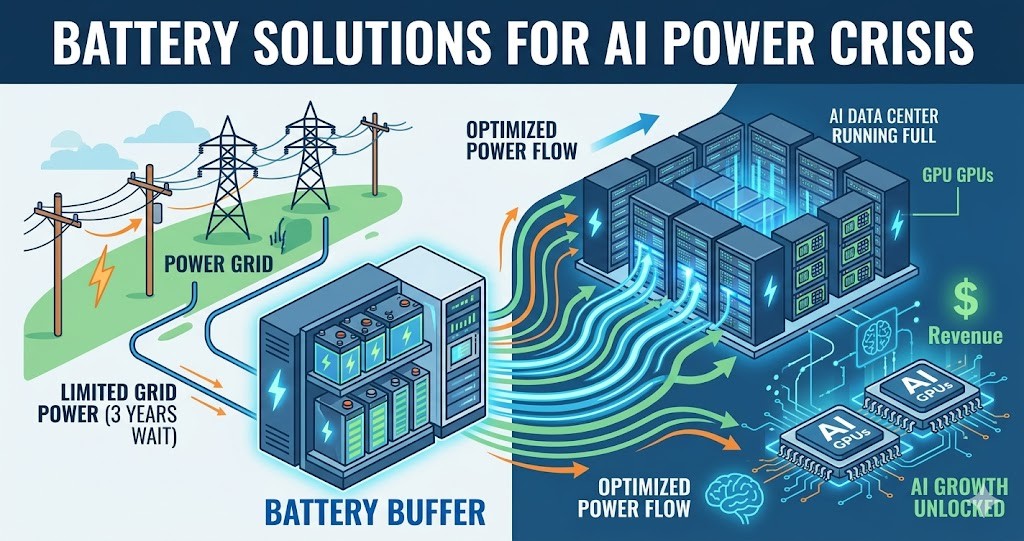
現在、データセンター業界が直面している最大の課題は、計算リソース(GPU)の不足ではなく、それらを動かすための「電力供給」です。新しいデータセンターを電力網(グリッド)に接続するための待ち時間は数年に及ぶこともあり、これがAIビジネスの成長を阻害しています。
こうした中、バッテリーを「バッファ(緩衝材)」として活用することで、既存の限られた電力契約の枠内で、より多くのAIチップをフル稼働させる手法が急速に普及しています。
- バッテリー貯蔵がAI成長の鍵となる3つの理由
- 関連情報:ITとエネルギーの「壁」を壊す技術動向
- データセンターにおける蓄電池の役割比較
- Absorbing Power Spikes with Storage: Next-Gen Infrastructure to Maximize AI Computing Within Existing Power Constraints
バッテリー貯蔵がAI成長の鍵となる3つの理由
1. 新たな評価指標「CPM(メガワット当たりのコンピューティング)」
これまでのバッテリー導入は、コスト削減や停電対策が主目的でした。しかし現在、ハイパースケーラー(巨大IT企業)の間では、CPM (Computing Per Megawatt) という概念が登場しています。
- 投資判断の変化: バッテリーの価値を「電力市場での売電収益」ではなく、その電力によって追加で稼働できる「AIサーバーが稼ぐ収益」で評価します。これにより、蓄電池導入の投資対効果(ROI)が劇的に向上します。
- 制約の解除: 個々のGPUの効率は変わりませんが、電力供給の制約で眠らせていたハードウェアを最大限に活用できるようになります。
2. 「電力スパイク」の吸収による効率化
AIのワークロード(処理負荷)は極めて動的で、数秒の間に消費電力が急激に跳ね上がります(スパイク)。
- 柔軟な運用: バッテリーがこのスパイクを吸収することで、データセンター事業者はグリッドとの契約容量を超えた演算能力を一時的に運用することが可能になります。
- 過剰設計の回避: 最悪のピーク負荷に合わせて巨大な受電設備を作る必要がなくなり、建設コストの抑制につながります。
3. 「市場投入までの時間(Time-to-Market)」の短縮
電力会社は、AIによる負荷急増が地域の電力網を不安定にすることを懸念しています。
- グリッド対応(Grid-Ready): データセンターが自前のバッテリーと制御ソフトウェアを備え、需要を柔軟に調整できることを証明できれば、電力網への接続許可が下りやすくなり、施設を早期に稼働させることが可能になります。
関連情報:ITとエネルギーの「壁」を壊す技術動向
この変化を支える技術的・市場的背景を補足します。
ITと設備(エネルギー)の統合管理
従来、サーバーを管理するIT部門と、電源を管理する設備部門は別々の組織(サイロ)として動いていました。
- Pado AIなどのSaaSスタートアップ: ITのワークロードとバッテリーの充放電をリアルタイムで同期させるソフトウェアを開発しています。これにより、サーバーを1台も落とすことなく、データセンター全体を「仮想発電所(VPP)」のように制御することが可能になります。
ターコイズ水素や分散型電源との連携
バッテリーは、太陽光や風力などの変動電源、あるいはメタン熱分解で得られる水素発電などと組み合わせることで、グリッドに依存しない「自立型データセンター」を実現するための重要なピースとなります。
データセンターにおける蓄電池の役割比較
| 項目 | 従来モデル(コストセンター) | 現代モデル(CPM最大化/収益源) |
| 主な用途 | 停電時のバックアップ、ピークカット | AI稼働率の向上、電力枠の拡張 |
| 価値の源泉 | 1kWhあたりの電力料金削減 | 1MWあたりのコンピューティング収益 |
| グリッドとの関係 | 受動的な電力消費者 | 柔軟な調整力を持つ「グリッド資産」 |
| IT運用 | 一定の電力枠内でワークロードを制限 | バッテリーをバッファにIT出力を最大化 |
Modo Energy アナリスト アレハンドロ・デ・ディエゴ氏のコメント
「バッテリーの価値は、もはや電力網における電力の価値ではなく、それが可能にするコンピューティングの価値によって決まります。この違いによって、投資判断は完全に変わります。」
出典:https://www.ess-news.com/2026/03/24/why-battery-storage-is-becoming-the-new-engine-of-ai-growth/
Absorbing Power Spikes with Storage: Next-Gen Infrastructure to Maximize AI Computing Within Existing Power Constraints
The greatest challenge currently facing the data center industry is not a shortage of computing resources (GPUs), but rather the “power supply” required to run them. Wait times for connecting new data centers to the power grid can span several years, creating a major bottleneck for the growth of the AI business.
In response, a method to run more AI chips at full capacity within the limits of existing power contracts is rapidly gaining traction: using batteries as an “enabling buffer.”
3 Reasons Why Battery Storage is Key to AI Growth
1. A New Metric: CPM (Computing Per Megawatt)
In the past, battery implementation was primarily for cost reduction or outage protection. Today, a new concept is emerging among hyperscalers: CPM (Computing Per Megawatt).
- Shift in Investment Logic: The value of a battery is no longer judged by “revenue from selling power to the grid,” but by the “revenue generated by the AI servers” that the battery allows to operate. This dramatically improves the Return on Investment (ROI) for storage systems.
- Removing Constraints: While batteries do not change individual GPU efficiency, they allow hardware that was previously idle due to power limits to be utilized to its maximum potential.
2. Efficiency Gains through “Power Spike” Absorption
AI workloads are extremely dynamic, with power consumption surging rapidly (spiking) within seconds.
- Flexible Operations: By absorbing these spikes, batteries allow data center operators to effectively run more computing power than their grid contract technically permits.
- Avoiding Over-Engineering: There is no longer a need to build massive electrical intake infrastructure designed for the worst-case peak load, leading to significant savings in construction costs.
3. Reducing “Time-to-Market”
Utility companies are concerned that massive AI-driven load increases will destabilize local power grids.
- Grid-Ready Status: If a data center can prove it is “Grid-Ready”—equipped with its own batteries and control software to flexibly adjust demand—it is more likely to receive grid connection approval, allowing facilities to become operational much sooner.
Related Information: Breaking Down the Wall Between IT and Energy
The following technical and market trends are supporting this shift:
Integrated Management of IT and Facilities
Traditionally, the IT department (managing servers) and the facilities department (managing power) operated in separate silos.
- SaaS Startups (e.g., Pado AI): These companies are developing software that synchronizes IT workloads with battery charging and discharging in real-time. This allows the entire data center to function as a Virtual Power Plant (VPP) without the risk of a single server rack going down.
Synergy with Turquoise Hydrogen and Distributed Power
Batteries are a critical piece of the puzzle for “self-sustaining data centers.” By combining storage with variable renewable sources like solar and wind, or hydrogen power generated via methane pyrolysis, data centers can reduce or eliminate their dependence on the grid.
Comparison of Battery Roles in Data Centers
| Item | Traditional Model (Cost Center) | Modern Model (CPM Maximization / Revenue Source) |
| Primary Use | Backup during outages, Peak cutting | Increasing AI uptime, Expanding power capacity |
| Value Source | Electricity bill savings per 1 kWh | Computing revenue per 1 MW |
| Grid Relation | Passive power consumer | “Grid Asset” with flexible adjustment capacity |
| IT Operation | Capping workloads within a fixed power budget | Maximizing IT output using batteries as a buffer |
Comment from Alejandro de Diego, Market Analyst at Modo Energy:
“The value of storage is no longer determined by the value of power in the grid, but by the value of the computing it enables. This difference completely changes the investment decision.”

コメント