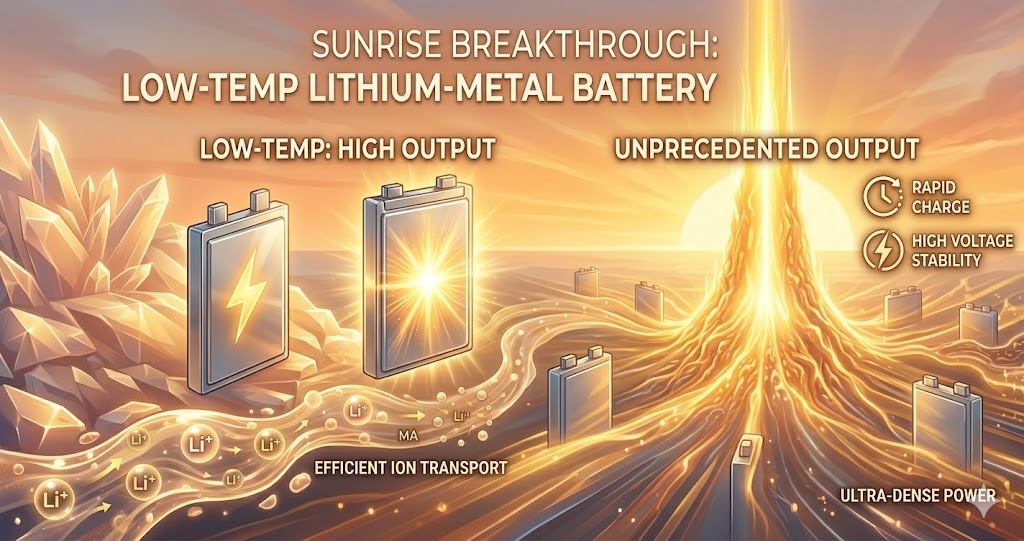
この研究は、次世代のエネルギー貯蔵源として期待されるリチウム金属電池(LMB)が抱える「低温でのイオン輸送の遅さ」と「高電圧での界面不安定性」を、電解質の分子設計によって解決したものです。
核心となる技術:共溶媒エンジニアリング
従来のフッ素系電解液(FBE)は、分子間の強い相互作用により「コンパクト(緻密)すぎる溶媒和構造」を形成しており、これが低温での粘度上昇やイオン伝導率の低下を招いていました。
- 解決策: 小さな線状分子である酢酸メチル(MA)を共溶媒として導入。
- メカニズム: MAはLiイオンと強く結合する一方で、他の溶媒分子やアニオン(PF6-)とは弱く反発します。この「弱い反発」が、ガチガチに固まっていた溶媒の塊(クラスター)を解きほぐし、リチウムイオンが動きやすい環境を作ります。
主な研究成果とスペック
開発された「MA-FBE」電解液を用いることで、極限環境下でも優れた性能が実証されました。
- 超低温動作: -70度という極低温下でも動作を確認(0.05Cで159.1 mAh/g)。
- 高電圧安定性: 4.8Vの高電圧充電においても、200サイクル以上の安定した動作を実現。
- 急速充放電: 10Cという高レートで142.8 mAh/gの容量を維持。
- 実用性: N/P比(正極と負極の容量比)を2という低値に抑えたフルセルや、パウチセル(275.9 Wh/kg)での動作を実証。
関連情報と背景解説
1. なぜ「酢酸メチル(MA)」なのか?
MAは、超低粘度(0.37 mPa s)かつ広い液相範囲(-98度から57度)を持つ優れた溶媒です。
また、MAは他の成分よりも先に酸化分解される特性(高いHOMOエネルギー)を持っており、これが正極表面に「弾力性のある有機・無機ハイブリッド界面(CEI)」を形成します。この弾力性が、充放電時の体積変化を吸収し、高電圧下での劣化を防いでいます。
2. 「低N/P比」の重要性
通常、リチウム金属電池の研究では負極のリチウムを過剰(高いN/P比)に使い、寿命を稼ぐことが多いですが、それでは電池全体のエネルギー密度が下がります。今回の研究でN/P比 = 2という厳しい条件下で安定動作させたことは、実用化に向けた大きな進歩を意味します。
3. 他の次世代電解液(HCE/LHCE)との比較
研究グループは、既存の戦略と比較してMA-FBEの優位性を強調しています。
| 電解質タイプ | 特徴 | 課題 |
| HCE(高濃度電解質) | 界面が安定する | 高粘度、コスト高 |
| LHCE(局所高濃度電解質) | 低粘度化 | 希釈剤によるイオン伝導の阻害 |
| MA-FBE(本研究) | 低粘度・高伝導・高電圧 | -70度から60度まで対応可能 |
出典:https://pubs.rsc.org/en/content/articlelanding/2026/eb/d5eb00208g
Optimizing Solvation Structure via Methyl Acetate Co-solvent: Development of High-Voltage Lithium Metal Batteries Operating at -70 degrees C
This research addresses the critical challenges of “slow ion transport at low temperatures” and “interfacial instability at high voltages” in lithium metal batteries (LMBs)—a promising next-generation energy storage source—through precise electrolyte molecular engineering.
Core Technology: Co-solvent Engineering
Conventional fluorinated electrolytes (FBEs) form an excessively “compact solvation structure” due to strong intermolecular interactions. This lead to increased viscosity and decreased ionic conductivity at low temperatures.
- Solution: Introduction of Methyl Acetate (MA), a small linear molecule, as a co-solvent.
- Mechanism: MA binds strongly with Li ions while exhibiting weak repulsion toward other solvent molecules and anions (PF6-). This “weak repulsion” breaks up the rigid solvent clusters, creating an environment where lithium ions can move more freely.
Key Research Results and Specifications
The developed “MA-FBE” electrolyte demonstrated exceptional performance under extreme conditions:
- Ultra-low Temperature Operation: Confirmed operation at temperatures as low as -70 degrees C (159.1 mAh/g at 0.05C).
- High-Voltage Stability: Achieved stable operation for over 200 cycles even under 4.8V high-voltage charging.
- Fast Charge/Discharge: Maintained a capacity of 142.8 mAh/g at a high rate of 10C.
- Practical Viability: Demonstrated performance in full cells with a low N/P ratio of 2, and in pouch cells achieving 275.9 Wh/kg.
Context and Background
1. Why Methyl Acetate (MA)?
MA is an outstanding solvent with ultra-low viscosity (0.37 mPa s) and a wide liquid-phase range (-98 degrees C to 57 degrees C). Additionally, MA possesses a high HOMO energy level, meaning it undergoes oxidative decomposition before other components. This forms a “flexible organic-inorganic hybrid Cathode-Electrolyte Interface (CEI)” on the positive electrode surface. This elasticity absorbs volume changes during charging/discharging and prevents degradation under high voltage.
2. The Importance of “Low N/P Ratio”
In typical LMB research, an excess of lithium (high N/P ratio) is often used to extend cycle life, but this reduces the overall energy density of the battery. Successfully operating under the strict condition of N/P ratio = 2 in this study represents a major step toward commercialization.
3. Comparison with Other Next-Generation Electrolytes
The research group emphasizes the advantages of MA-FBE compared to existing strategies:
| Electrolyte Type | Features | Challenges |
| HCE (High-Concentration) | Stable interface | High viscosity, high cost |
| LHCE (Localized High-Concentration) | Lower viscosity | Ion transport hindered by diluents |
| MA-FBE (This Study) | Low viscosity, high conductivity, high voltage | Operational from -70 to 60 degrees C |
コメント