近年、宇宙空間でのAIデータセンターの構築が注目を集めています。特に、衛星データのリアルタイム処理や軌道上での高度な計算を行うため、低軌道(LEO)へのインフラ配置が進められようとしています。
しかし、宇宙空間では太陽光発電が途切れる「食(地球の影に入る期間)」の時間が存在するため、信頼性の高い無停電電源装置(UPS)が不可欠です。限られた積載重量で最大の電力を確保するためには、現在のリチウムイオン電池を遥かに凌ぐ「超高エネルギー密度」を持つ次世代電池が必要とされており、その筆頭候補がリチウム金属電池です。
ニュースの要約と関連情報の補足
1. 特許取得の概要と技術的背景
Solidion Technology社は、リチウム金属負極(アノード)の保護プラットフォームに関する30件以上の特許を保有しており、これが宇宙・地上双方の次世代電池の商業化を加速させると主張しています。
超高エネルギー密度を誇るリチウム金属電池、リチウム硫黄電池、リチウム空気電池には、これまで主に3つの深刻な技術的障壁がありました。
- 電解質とリチウム金属の継続的な反応: リチウム金属は化学的活性が非常に高く、液体電解質と反応して電解質を枯渇させ、電池の寿命を著しく縮めます。
- リチウムデンドライト(樹枝状結晶)の成長: 充放電を繰り返すうちにリチウムが不均一に析出し、セパレーターや固体電解質を突き破るデンドライト(ひげ状の結晶)に成長します。これが正極に達すると内部短絡(ショート)を起こし、最悪の場合は発火や爆発につながります。
- 固体電解質との界面の隙間: 充放電に伴うリチウム金属の膨張・収縮(体積変化)が激しいため、固体電解質との間に大きな隙間(空隙)が生じ、イオンの移動が阻害されて電池性能が急速に低下します。
2. Solidion社が提案する解決策(アーキテクチャ)
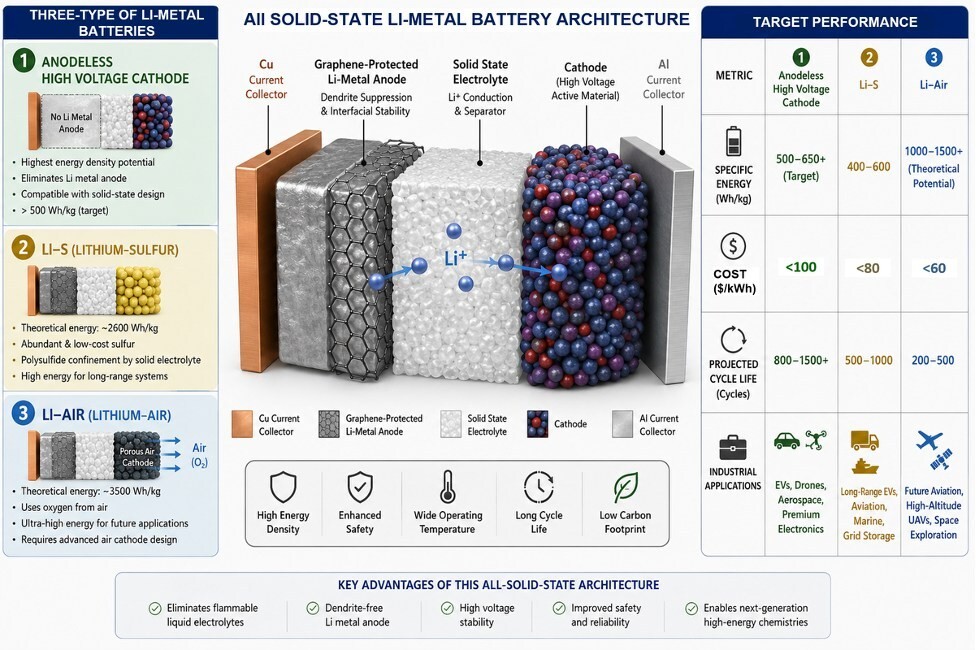
同社は、グラフェン(炭素原子がシート状に並んだ物質)を用いてリチウム金属負極を保護する技術を提案しています。具体的には、銅製の集電体と固体電解質の間にこの保護層を配置する構造です。これにより、デンドライトの抑制や界面の安定化を図ります。
同社の技術は、以下の3つの次世代電池タイプへの応用が期待されています。
| 電池タイプ | 構造・特徴 |
| アノードレス(負極なし)電池 | 製造時には負極にリチウム金属を配置せず、初回の充電時に集電体上にリチウムを析出させる。製造コストを下げ、エネルギー密度を極限まで高められる。 |
| リチウム硫黄(Li-S)電池 | 正極に硫黄、負極にリチウム金属を使用。理論エネルギー密度がリチウムイオン電池の数倍と非常に高く、資源的にも豊富な硫黄を使うため安価。 |
| リチウム空気(Li-Air)電池 | 正極に空気中の酸素、負極にリチウム金属を使用。究極の次世代電池と呼ばれ、ガソリンに匹敵する超高エネルギー密度を持つ可能性を秘める。 |
3. 3500万ドルの資金調達と今後の展望
Solidion Technology社は、今回の特許発表と連動して3500万ドル(普通株式の私募増資)の資金調達に成功しました。引受主幹事はAmerican Capital Partners傘下のTitan Partnersで、取引は2026年6月9日頃に完了します。
この資金により、同社は2028年までの事業運転資金を確保したことになります。これにより、研究開発フェーズから、宇宙空間(低軌道データセンター、有人宇宙船、月面インフラ)や地上のハイエンド用途に向けた大規模導入・実証試験フェーズへと移行していくことが予想されます。
Overcoming Dendrite and Interface Challenges: Solidion Announces Patent for Graphene-Protected Lithium-Metal Anode Technology
In recent years, the construction of AI data centers in outer space has been attracting significant attention. In particular, the deployment of infrastructure in Low Earth Orbit (LEO) is underway to perform real-time processing of satellite data and advanced computing in orbit.
However, because periods of “eclipse” (times when the earth blocks the sun) occur in space, interrupting solar power generation, a highly reliable Uninterruptible Power Supply (UPS) is indispensable. To secure maximum power within limited payload weight restrictions, next-generation batteries with “ultra-high energy density” that far surpass current lithium-ion batteries are required, and lithium-metal batteries are the leading candidate.
News Summary and Supplementary Information
1. Overview of Patent Acquisition and Technical Background
Solidion Technology holds more than 30 patents related to its lithium-metal anode protection platform, which the company claims will accelerate the commercialization of next-generation batteries for both space and terrestrial applications.
Lithium-metal, lithium-sulfur, and lithium-air batteries, which boast ultra-high energy density, have previously faced three major technical barriers:
- Continuous reaction between electrolyte and lithium metal: Lithium metal is highly chemically reactive. It reacts with liquid electrolytes, depleting the electrolyte and significantly shortening battery life.
- Growth of lithium dendrites (dendritic crystals): During repeated charging and discharging, lithium deposits unevenly, growing into dendrites (needle-like crystals) that can penetrate separators or solid electrolyte layers. If these reach the positive electrode (cathode), they cause an internal short circuit, which can lead to fire or explosion in the worst-case scenario.
- Gaps at the interface with the solid electrolyte: Due to the severe expansion and contraction (volume change) of lithium metal during charging and discharging, large gaps (voids) form between the lithium metal and the solid electrolyte. This inhibits ion movement and rapidly degrades battery performance.
2. Solutions Proposed by Solidion (Architecture)
The company proposes a technology that uses graphene (a material composed of a single layer of carbon atoms) to protect the lithium-metal anode. Specifically, this protective layer is positioned between a copper current collector and a solid electrolyte to suppress dendrite growth and stabilize the interface.
The company’s technology is expected to be applied to the following three types of next-generation batteries:
| Battery Type | Structure and Features |
| Anode-free battery | No lithium metal is placed on the negative electrode during manufacturing; instead, lithium is deposited on the current collector during the first charge. This reduces manufacturing costs and maximizes energy density. |
| Lithium-sulfur (Li-S) battery | Uses sulfur for the positive electrode and lithium metal for the negative electrode. Its theoretical energy density is several times higher than that of lithium-ion batteries, and it is inexpensive because sulfur is an abundant resource. |
| Lithium-air (Li-Air) battery | Uses oxygen from the air for the positive electrode and lithium metal for the negative electrode. Called the ultimate next-generation battery, it has the potential to achieve an ultra-high energy density comparable to gasoline. |
3. 35 Million Dollar Fundraising and Future Outlook
In conjunction with this patent announcement, Solidion Technology successfully raised 35 million dollars through a private placement of common stock. Titan Partners, an affiliate of American Capital Partners, is acting as the sole book-running manager for the offering, and the transaction is expected to close around June 9, 2026.
With these funds, the company has secured operational capital through 2028. This is expected to allow the company to transition from the research and development phase to the large-scale deployment and demonstration phase for outer space (LEO data centers, manned spacecraft, and lunar infrastructure) as well as high-end terrestrial applications.
コメント