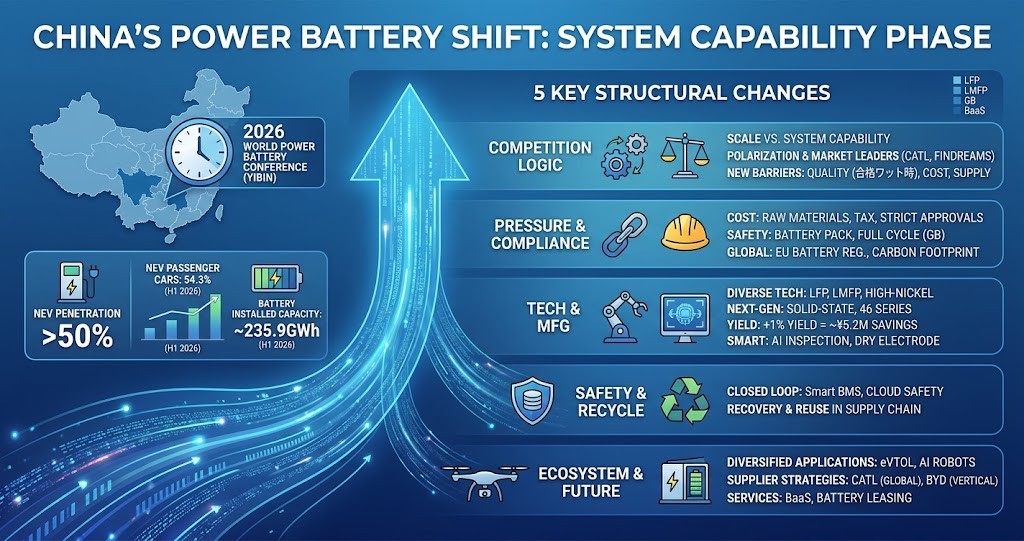
中国の車載用動力電池産業は、従来の単純な「生産能力(GWh)の拡大競争」から、品質・安全・コストの包括的なシステム能力を競う新たなフェーズへと大きくシフトしています。2026年9月3日〜4日に四川省宜賓市で開催された「2026世界動力電池大会」では、新エネルギー車(NEV)の普及率が50%を超過した市場環境を受け、持続可能な産業構造への転換が主要議題となりました。本稿では、同大会の主要論点および業界データを軸に、動力電池競争における5つの構造的変化を整理・解説します。
1. 市場構造と競争ロジックの変容
- 規模の定着と二極化:2026年上半期(1〜6月)、中国のNEV乗用車普及率は54.3%に達し、動力電池搭載量は約235.9GWhを記録。CATL(寧徳時代)とFinDreams Battery(BYD傘下の比亜迪電池)の2大巨頭で合計65%超のシェアを占める一方、二線級メーカーとの差は縮小傾向にある。
- 新規参入障壁の再定義:従来の「計画生産能力」ではなく、「高次元の品質(合格ワット時)」「コスト制御力」「サプライチェーンの安定納入能力」がメーカー選別の新たな基準となっている。
2. コスト・規制・コンプライアンスの多重圧力
- 製造・コスト環境:上流原材料価格の反発、各種税制調整、新規プロジェクト承認の厳格化により、安易な規模拡大が抑制されている。
- 安全基準の強化:新国家規格(GB)の適用により、「発火・爆発を起こさない」という要求が単体セルからバッテリーパック全体、さらには全ライフサイクル管理へ拡張された。
- 国際規制・カーボンフットプリント:EU電池規則をはじめとする環境規制に伴い、資源の対外依存度低減、サプライチェーンのトレーサビリティ、カーボンフットプリント管理がグローバル競争の必須要件に浮上している。
3. 技術進化と製造プロセスの高度化
- 適材適所の技術路線:
- LFP(リン酸鉄リチウム):コストと安全性の強みから市場の主流を維持。
- LMFP(リン酸マンガン鉄リチウム):ミドルレンジ車向けのアップグレード路線。
- 高ニッケル三元系:ハイエンド・高エネルギー密度用途を確保。
- 次世代電池:シリコン系負極、半固体/全固体電池、46系大型円筒、ナトリウムイオン電池などが実用化段階に応じて順次投入される。
- 「合格ワット時」の収益インパクト:
- 1GWh規模の生産ライン(稼働率80%)において、歩留まり率が1%向上すると約8MWhの合格産出が増加し、約520万元(約1.2億円)相当のコスト削減効果を生む。
- AI外観検査、デジタルツイン、乾式電極プロセスの導入により、実験室レベルの性能を工場での量産歩留まりに直結させる技術が不可欠となっている。
- 安全とリサイクルの閉ループ:スマートBMS、車両・クラウド連携システム、広温度域熱管理により、データに基づく事前リスク検出とライフサイクル全般の安全管理を実現。退役電池の回収・再生利用も材料コストの循環体系に組み込まれている。
4. 異業種融合とエコシステム競争
- 新規アプリケーションへの水平展開:電動垂直離着陸機(eVTOL)をはじめとする低空経済領域、人型ロボット・具身知能(Embodied AI)など、電池技術の適用先が拡張し、多様な動作環境に応じた多次元のバランス(出力・重量・熱管理・コスト)が求められている。
- サプライヤーの戦略分岐:
- CATL型:技術開放とグローバルサプライチェーン統合による完成車メーカーの囲い込み。
- BYD(FinDreams)型:垂直統合による自社エコシステム内での高速コスト最適化。
- 二線級メーカー:大型円筒、超急速充電(4C以上)、海外現地生産(ローカライズ)による差別化。
5. 今後の展望:持続可能な事業モデルの構築
- 単なる「製品・設備の規模拡大」から「技術・製造・エコシステム全体の能力リード」へのシフトが確定。
- CTP(Cell to Pack)やCTB(Cell to Body)などのモジュールレス構造、電池交換(スワッピング)、バッテリーリース(BaaS)、AIデータセンター(AIDC)向け蓄電など、サービス化と第二の成長曲線の開拓が勝敗を分ける要因となる。
出典:https://finance.biggo.jp/news/40d9b321-fd24-4bf5-a758-0928ffc6d48d
Moving Beyond Mere Expansion: The Automotive Battery Industry Demands “Qualified Watt-Hours” and True Ecosystem Capabilities
China’s automotive power battery industry is undergoing a major shift from a simple race to expand production capacity (GWh) to a new phase of competing on comprehensive system capabilities across quality, safety, and cost. At the 2026 World Power Battery Conference held in Yibin, Sichuan, on September 3–4, 2026, transitioning to a sustainable industrial structure emerged as a central theme against the backdrop of New Energy Vehicle (NEV) penetration surpassing 50%. Centered on key conference discussions and industry data, this paper outlines and analyzes five structural changes in power battery competition.
1. Shift in Market Structure and Competitive Logic
- Market Consolidation and Two-Tier Polarization: In the first half of 2026 (Jan–Jun), China’s NEV passenger car penetration reached 54.3%, with total power battery installation hitting approximately 235.9 GWh. While the two giants, CATL and FinDreams Battery (BYD’s battery subsidiary), collectively held over 65% of the market share, the gap between them and second-tier manufacturers is gradually narrowing.
- Redefining Entry Barriers: Market survival is no longer governed by “planned production capacity,” but by new benchmarks: high-level quality (“qualified watt-hours”), cost control capabilities, and stable supply chain delivery.
2. Compound Pressures from Costs, Regulations, and Compliance
- Manufacturing and Cost Environment: Rebounding upstream raw material prices, tax policy adjustments, and stricter approvals for new projects are jointly curbing reckless capacity expansion.
- Tighter Safety Standards: Under the new national standard (GB) framework, the mandate to prevent fire and explosion has expanded from individual battery cells to the entire pack, and further to full lifecycle management.
- International Regulations and Carbon Footprint: Environmental regulations, such as the EU Batteries Regulation, have made reducing reliance on external resources, supply chain traceability, and carbon footprint management essential prerequisites for global competitiveness.
3. Technological Evolution and Advanced Manufacturing Processes
- Fit-for-Purpose Technology Roadmaps:
- LFP (Lithium Iron Phosphate): Maintains market dominance due to its cost and safety advantages.
- LMFP (Lithium Manganese Iron Phosphate): Positions itself as an upgrade route for mid-range vehicles.
- High-Nickel Ternary: Secures high-end and high-energy-density applications.
- Next-Generation Batteries: Silicon-based anodes, solid-state/semi-solid-state batteries, 46-series large cylindrical cells, and sodium-ion batteries are being deployed sequentially based on their commercial readiness.
- Financial Impact of “Qualified Watt-Hours”: On a 1 GWh production line (operating at 80% capacity), a 1% increase in yield yields approximately 8 MWh of additional qualified output, generating roughly 5.2 million RMB (~120 million JPY) in cost savings. Technologies like AI visual inspection, digital twins, and dry electrode processes are now critical to bridging lab-level performance directly to factory mass-production yields.
- Closed-Loop Safety and Recycling: Smart BMS, vehicle-cloud synergy systems, and wide-temperature thermal management enable data-driven risk detection and safety management across the entire lifecycle. Retired battery collection and recycling are also being integrated into a closed-loop material cost architecture.
4. Cross-Industry Convergence and Ecosystem Competition
- Horizontal Expansion into New Applications: Battery technology is expanding into new frontiers, such as the low-altitude economy (e.g., eVTOLs) and Embodied AI/humanoid robotics. These emerging sectors demand a multi-dimensional balance among power output, weight, thermal management, and cost under diverse operating environments.
- Divergent Supplier Strategies:
- CATL Model: Lock in global automakers through technology licensing and global supply chain integration.
- BYD (FinDreams) Model: Accelerate cost optimization internally via vertical integration and closed-loop operations.
- Second-Tier Manufacturers: Differentiate through large cylindrical formats, ultra-fast charging (4C+), and localized overseas manufacturing.
5. Future Outlook: Building a Sustainable Business Model
- Definite Shift: The market has permanently shifted from simple expansion of products and facilities to leading in technology, manufacturing, and overall ecosystem capabilities.
- Key Growth Drivers: Winning strategies will depend on service-oriented models and secondary growth curves—such as module-less structures (CTP/CTB), battery swapping, Battery-as-a-Service (BaaS), and energy storage systems for AI Data Centers (AIDC).


コメント