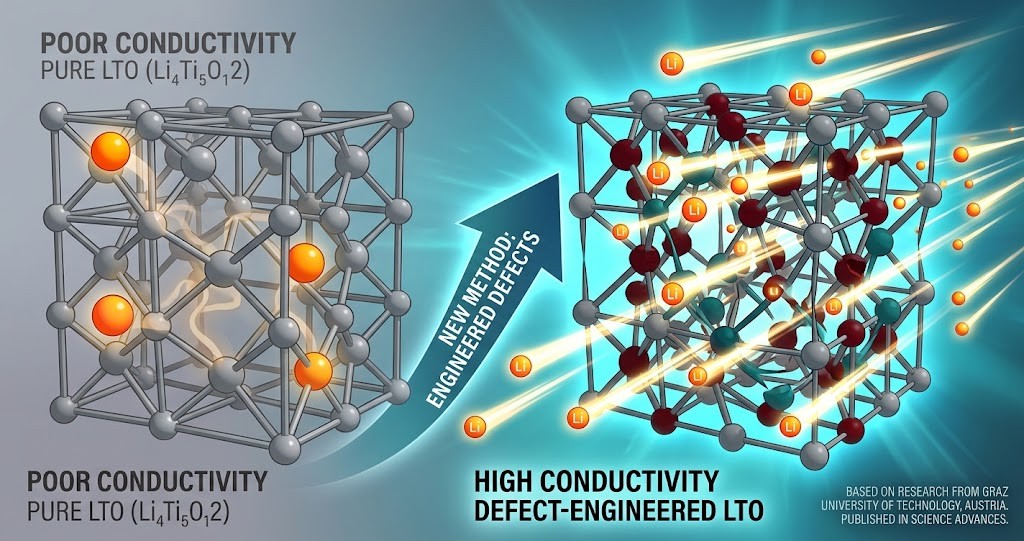
グラーツ工科大学(材料化学技術研究所)のマーティン・ウィルケニング教授らの研究チームは、純粋な状態ではリチウムイオン伝導性が低いチタン酸リチウム(Li4Ti5O12 / LTO)に対し、結晶構造内に意図的に欠陥を形成することでイオン伝導性を大幅に向上させる新手法を開発し、学術誌「Science Advances」に発表しました。
- 低温加熱処理による酸素空孔(陰イオン空孔)の生成 低酸素雰囲気下にてLTOを摂氏300度で穏やかに加熱処理することで、結晶格子から酸素原子を意図的に引き抜き、「酸素空孔」と呼ばれる穴を生成させます。
- これまで遮断されていたイオン拡散経路の活性化 この陰イオン空孔が生成されることで、LTO特有の結晶構造内に元々存在しながらブロックされていたリチウムイオンの移動経路が解放・活性化され、マクロな高速イオン伝導体へと変化します。
- 分光分析による定量的検証と応用可能性 導電率分光法および核磁気共鳴(NMR)分光法を組み合わせることで、リチウム陽イオンの高速拡散経路を直接的に検証・実証しました。本手法はバッテリー技術のみならず、イオントロニクス、ニューロモルフィック(脳型)計算デバイスなど次世代エレクトロニクスへの応用も期待されています。
【関連情報・技術的背景解説】
1. チタン酸リチウム(LTO)負極の特長と従来の課題 LTOは、一般的なグラファイト(黒鉛)負極やシリコン系負極と比較して以下の優れた特徴を備えています。
- ゼロ・ストレイン(Zero-strain)材料: 充放電時のリチウム挿入・脱離に伴う体積変化がほとんどないため、結晶破壊が起こりにくく、超長寿命(数万サイクルの充放電が可能)を実現します。
- 高い安全性と超急速充電性: リチウム析出(デンドライト形成)電位が高いためショートや発火リスクが極めて低く、低温環境下でも急速充電が可能です。
- 課題(固有の課題): 充放電前の未リチウム化状態(Li4Ti5O12)では本質的に電子伝導性・イオン伝導性が非常に低く、高出力化には導電助剤の多量添加や初回充電時の相変化(Li7Ti5O12への移行)に依存する部分がありました。
2. 欠陥エンジニアリング(Defect Engineering)によるイオン伝導性制御 材料の化学組成を変えずに「結晶の乱れ(不完全性)」を利用して物性を制御する技術です。
- 酸素空孔(Anion Vacancy)の役割: 負電荷を持つ酸素イオンが抜けることで局所的な電荷不平衡が生じ、隣接するチタン(Ti)の価数変化(Ti4+からTi3+への還元)を誘起すると同時に、リチウムイオンが移動する際のエネルギー障壁(活性化エネルギー)を大幅に低下させます。
- 低温プロセス(摂氏300度)の製造優位性: 結晶全体の構造破壊を伴う高温処理ではなく、摂氏300度という比較的低い熱処理温度で精密制御できる点は、将来的な材料合成や量産プロセスにおけるエネルギーコスト低減に有利に働きます。
3. 全固体電池や固相電解質への波及効果 本研究で示された「局所的な陰イオン欠陥制御による高速イオン伝導化」のアプローチは、LTO負極単体にとどまらず、酸化物系固相電解質や高出力型急速充電セルなど、固体内での高速イオン輸送を求める多様な次世代電池材料の設計指針として応用可能です。
Simply Heating at 300 Degrees Celsius! TU Graz Dramatically Improves Ionic Conductivity in LTO Batteries
A research team led by Professor Martin Wilkening at the Institute for Chemistry and Technology of Materials at Graz University of Technology (TU Graz) has developed a novel method to significantly boost the ionic conductivity of lithium titanate (Li4Ti5O12 / LTO)—a material with inherently low lithium-ion conductivity in its pure state—by intentionally introducing defects into its crystal structure. The study was published in the journal Science Advances.
- Generation of Oxygen Vacancies (Anion Vacancies) via Low-Temperature Heat Treatment: By gently heating LTO at 300 degrees Celsius in a low-oxygen atmosphere, oxygen atoms are deliberately extracted from the crystal lattice, creating “oxygen vacancies.”
- Activation of Previously Blocked Ion Diffusion Paths: The creation of these anion vacancies unblocks and activates lithium-ion transport pathways inherent to the LTO crystal structure, transforming it into a macroscopic fast-ion conductor.
- Quantitative Verification via Spectroscopy and Potential Applications: Combining impedance spectroscopy and nuclear magnetic resonance (NMR) spectroscopy, the team directly verified and demonstrated these fast lithium-cation diffusion paths. Beyond battery technology, this method holds promise for next-generation electronics, including iontronics and neuromorphic computing devices.
[Related Information & Technical Background]
- Features and Conventional Challenges of Lithium Titanate (LTO) Anodes Compared to standard graphite or silicon-based anodes, LTO possesses distinct advantages:
- Zero-Strain Material: Experiencing almost zero volume change during lithium insertion and extraction, LTO resists crystal degradation and enables an ultra-long cycle life (tens of thousands of charge-discharge cycles).
- High Safety and Ultra-Fast Charging: Due to its high lithium deposition (dendrite formation) potential, the risk of short circuits and thermal runaway is extremely low, allowing rapid charging even at low temperatures.
- Inherent Challenges: In its un-lithiated state (Li4Ti5O12) prior to charging, its electronic and ionic conductivities are intrinsically very low. Achieving high power output previously depended on adding large amounts of conductive additives or relying on the phase transition to Li7Ti5O12 during the initial charge.
- Controlling Ionic Conductivity via Defect Engineering Defect engineering modifies material properties by exploiting “crystal disorder” without altering chemical composition:
- Role of Anion Vacancies: Removing negatively charged oxygen ions causes local charge imbalance, inducing a valence reduction in adjacent titanium (from Ti4+ to Ti3+) while substantially lowering the energy barrier (activation energy) for lithium-ion migration.
- Manufacturing Advantage of Low-Temperature Processing (300 Degrees Celsius): Precise control at a relatively low thermal processing temperature of 300 degrees Celsius—rather than high-temperature treatments that destroy the overall crystal framework—is highly advantageous for reducing energy costs in future material synthesis and commercial manufacturing.
- Implications for Solid-State Batteries and Solid Electrolytes The approach demonstrated in this study—achieving fast ionic conduction through targeted anion defect control—extends beyond standalone LTO anodes. It serves as a valuable design guideline for diverse next-generation battery materials requiring rapid solid-state ion transport, such as oxide-based solid electrolytes and high-power fast-charging cells.


コメント