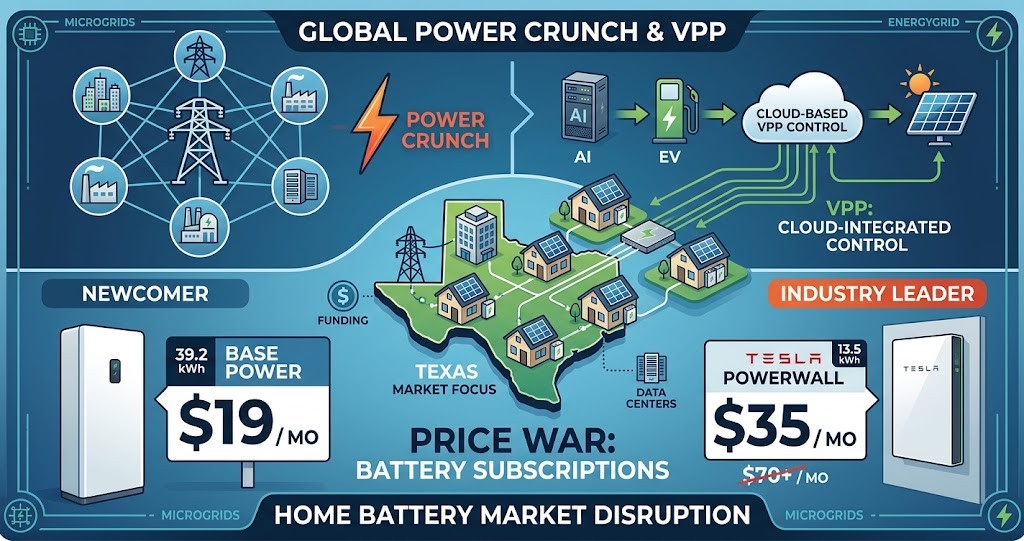
AIデータセンターの台頭や社会の電化に伴い、世界的な電力需給のひっ迫が深刻化しています。そうした中、従来は「初期費用1万ドル以上の高嶺の花」であった家庭用蓄電池市場で急速な価格破壊が起きています。
業界王者であるテスラ(Tesla)に挑むのは、設立1年足らずで20億ドル超の資金を調達した新興企業Base Power。同社は39.2kWhという大容量バッテリーを月額19ドルで提供し、これに対抗するテスラもPowerwallのリース料金を月額35ドルへと大幅値下げしました。
この急激な低価格化を可能にしているのが、分散された蓄電池をクラウドで統合制御するVPP(仮想発電所)技術です。本記事では、急速に拡大するVPP市場の仕組みと、テキサス州を中心に繰り広げられる最新の市場競争・構造的背景を整理して解説します。
1. 記事の要約・主要ポイント
- 市場の急変と格安リースの登場
- テスラが独走していた市場へBase Powerなどの新興勢力が参入。
- 従来の「導入費用1万ドル超」に対し、テスラ(27kWh)が月額35ドル、Base Power(39.2kWh)が月額19ドルという破格のサブスクリプションモデルを展開。
- 低価格を支えるVPP(仮想発電所)モデル
- 各家庭の蓄電池群をソフトウェアで制御し、1つの巨大発電所のように機能させる。
- 電気が安い時間帯に充電し、ピーク時の高値時に系統へ売電。その収益を原資に安価なリース料を実現。
- 建設スピードという圧倒的強み
- 従来型のピーク時火力発電所は建設に2〜4年を要するのに対し、VPPは許認可や送電網の接続待ちを回避できるため数ヶ月〜1年以内で構築可能。
2. 蓄電池とVPPの基本構造
VPPは、家庭用蓄電池や太陽光パネル、場合によっては給湯器などの分散型エネルギー資源(DER)をネットワークで集約・最適制御する仕組みです。
グランドビュー・リサーチによると、VPPの市場規模は現在の74億ドルから2033年には300億ドル規模へ成長すると予測されています。
| 項目 | 従来のピーク時発電所 | 仮想発電所(VPP) |
| 建設期間 | 2〜4年 | 数ヶ月〜12ヶ月 |
| 主なコスト | 土地取得、大型設備、専用送電線 | ソフトウェア制御、家庭用設備導入補助 |
| 環境負荷 | 火力(ガス等)依存が多い | 再生可能エネルギーの余剰電力を活用 |
| 系統への影響 | 局所的な送電線混雑を招きやすい | 需要地(家庭)の近くで地産地消・調整可能 |
3. 理解を深めるための関連補足情報
① なぜテキサス州(ERCOT)が主戦場なのか?
- 独立した電力網とボラティリティ: テキサス州の電力網(ERCOT)は全米の他地域と接続されていない独立系統であり、猛暑や寒波による需給ひっ迫が頻繁に発生します。
- 価格差益(アービトラージ)の最大化: 卸電力価格の上限が高く設定されているため、ピーク時にVPPから放電して得られる収益性が全米で最も高い地域となっています。
② テスラとBase Powerの戦略の違い
| 項目 | テスラ(Tesla) | Base Power |
| 従来の強み | 太陽光とのセット販売、自家消費ブランド | 蓄電池特化、即時VPP接続モデル |
| VPP方針転換 | 自家消費メインから、競合参入によりVPP活用へシフト | 最初から「系統安定化インフラ」として配備 |
| 容量・月額 | 27kWh / 月額35ドル〜 | 39.2kWh / 月額19ドル〜 |
③ AIデータセンター需要と「系統接続待ち(Queue)」問題
- 米国では再エネや大型蓄電所の建設が進む一方、送電網に接続するための審査・工事待ち(Interconnection Queue)が数年単位で停滞しています。
- ハイパースケーラー(Amazon, Microsoft, Google等)は電力の「量」だけでなく「接続速度」を最重要視しており、送電網の工事を回避して数ヶ月で立ち上げられる分散型VPPへの期待が高まっています。
④ 今後の技術的・運用上の課題
- バッテリーのサイクル寿命: VPP運用での頻繁な充放電に対応するため、劣化を最小化する制御アルゴリズムや長寿命な化学組成(LFP等)の選定が不可欠です。
- サイバーセキュリティ: 多数の家庭用機器を分散接続して一括制御するため、制御システムへのサイバー攻撃対策がエネルギー安全保障上の重点課題となっています。
How Virtual Power Plants Are Transforming the Residential Battery Market: Entering a Price War Under $35/Month
Global electricity supply-demand strain is intensifying due to the rise of AI data centers and widespread electrification. Amid these conditions, a rapid price disruption is taking place in the residential battery market, which was once an expensive luxury requiring upfront costs exceeding $10,000.
Challenging market leader Tesla is Base Power, a startup that raised over $2 billion in less than a year. The company offers a large 39.2 kWh battery for just $19 per month. In response, Tesla significantly slashed its Powerwall lease rate down to $35 per month.
Enabling this aggressive price drop is Virtual Power Plant (VPP) technology, which aggregates and controls distributed batteries via the cloud. This article explains the mechanics of the rapidly growing VPP market, along with the competitive landscape and structural background centered in Texas.
1. Article Summary & Key Points
- Market Shift and Ultra-Low-Cost Leases: New entrants like Base Power are disrupting a market once dominated by Tesla. Compared to traditional upfront costs exceeding $10,000, Tesla now offers a 27 kWh system for $35/month, while Base Power offers a 39.2 kWh system for $19/month under highly affordable subscription models.
- VPP Business Model Driving Low Prices: Software aggregates residential batteries to function like a single massive power plant. The system charges during off-peak hours when electricity is cheap and sells power back to the grid during peak high-price hours, generating revenue that funds low lease rates for consumers.
- Overwhelming Advantage in Deployment Speed: While traditional peak power plants take 2 to 4 years to build, VPPs can be deployed within months to a year by bypassing land acquisition, permitting, and grid connection queues.
2. Basic Structure of Batteries and VPPs A VPP is a system that aggregates and optimizes distributed energy resources (DERs)—such as home batteries, solar panels, and water heaters—over a network. According to Grand View Research, the VPP market size is projected to grow from its current $7.4 billion to over $30 billion by 2033.
| Category | Traditional Peaker Plants | Virtual Power Plants (VPP) |
|---|---|---|
| Build Time | 2–4 years | A few months–12 months |
| Primary Costs | Land acquisition, heavy equipment, dedicated power lines | Software control, residential equipment subsidies |
| Environmental Impact | Highly dependent on fossil fuels (gas, etc.) | Utilizes surplus renewable energy |
| Grid Impact | Prone to causing localized power line congestion | Allows local consumption and balancing near load centers |
3. Supplementary Context
① Why Texas (ERCOT) Is the Main Battlefield
- Independent Grid & Volatility: The Texas power grid (ERCOT) operates independently from the rest of the US, making it prone to frequent supply crunches during heatwaves and winter storms.
- Maximizing Price Arbitrage: High wholesale electricity price caps make Texas the most profitable market in the US for generating revenue by discharging VPP power during peak hours.
② Strategic Differences Between Tesla and Base Power
| Category | Tesla | Base Power |
|---|---|---|
| Core Strength | Solar pairing, brand identity focused on self-consumption | Battery-dedicated, instant VPP-connection model |
| VPP Strategy Shift | Shifted from self-consumption focus to VPP utilization due to new competition | Deployed from day one as grid-stabilizing infrastructure |
| Capacity & Monthly Fee | 27 kWh / $35+ per month | 39.2 kWh / $19+ per month |
③ AI Data Center Demand & Interconnection Queues
- While renewable energy and utility-scale battery projects are expanding across the US, grid interconnection queues face multi-year delays.
- Hyperscalers (Amazon, Microsoft, Google, etc.) prioritize interconnection speed alongside total capacity, fueling high expectations for distributed VPPs that can be deployed in months without requiring grid infrastructure overhauls.
④ Technical and Operational Challenges Ahead
- Battery Cycle Life: Frequent charging and discharging under VPP operations accelerate degradation, making cycle-life optimization algorithms and long-life chemistries (such as LFP) essential.
- Cybersecurity: Centralized control over vast networks of distributed home devices makes securing control systems against cyberattacks a critical priority for energy security.
コメント