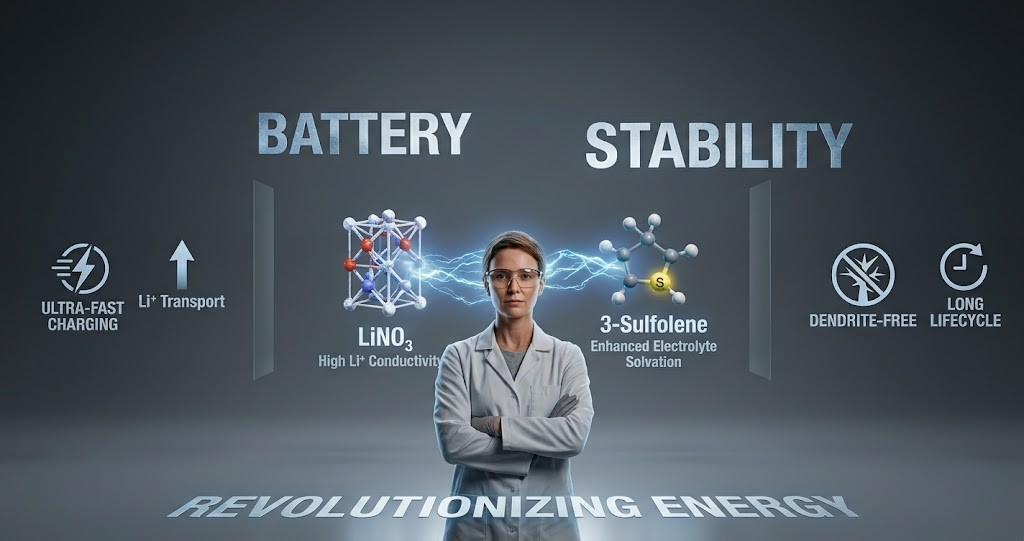
本論文(Wu et al., Nature Communications, 2026)は、リチウム金属負極の高スルーレート(急速充放電)化および長寿命化を実現するため、有機炭酸エステル(カーボネート)系電解液に3-スルホレン(3-sulfolene, 3SF)と硝酸リチウム(LiNO3)のデュアル添加剤を導入する新手法を提案した研究です。
1. 研究の背景と課題(関連情報の補足)
- リチウム金属負極のポテンシャルと課題: リチウム金属は理論容量(3,860 mAh/g)が大きく、標準電位(-3.04 V vs. SHE)が非常に低いため、エネルギー密度 500 Wh/kg 級の次世代電池(LMB)の本命材料とされています。しかし、高電流密度下では界面でのLi+ 輸送速度の遅さに起因してリチウムデンドライトの成長、孤立した「Dead Li」の蓄積、電解液の不可逆な消費が発生し、短寿命やショートの原因となります。
- 従来のカーボネート電解液の限界: 汎用的な炭酸エステル系電解液(EC/DMCなど)では、リチウム表面に有機物主体の固形電解質界面(SEI)皮膜が形成されます。有機系SEIはLi+ 伝導性が低く(不均一なイオン流を引き起こす)、充放電の体積変化に耐えきれずに破砕・再形成を繰り返し、著しい性能劣化を引き起こします。
- LiNO3 の溶解性問題: LiNO3 は無機系(Li3N や Li2O など)の優れた皮膜を形成する添加剤として知られますが、汎用カーボネート電解液への溶解度が極めて低い(室温で 0.01 mg/mL 未満)という致命的な課題がありました。
2. 本研究の核心アプローチ(最適電解液組成とデュアル添加剤戦略)
本論文では、極性を持つ硫黄化合物(SCC)が Li+ および NO3– と強力に配位することに着目し、LiNO3 の溶解度向上に寄与する分子構造をスクリーニングしました。
最適電解液の具体組成
| 区分 | 化合物・溶媒 | 配合量 / 濃度 | 主な役割 |
| 主電解質 | 六フッ化リン酸リチウム(LiPF6) | 1.0 M | 基本的なリチウムイオン伝導の確保 |
| 主溶媒 | エチレンカーボネート(EC) / ジメチルカーボネート(DMC) | 1 : 1(体積比, v/v) | 汎用炭酸エステル系ベース溶媒 |
| 添加剤① | 3-スルホレン(3SF) | 5 wt% | LiNO3 可溶化剤、脱溶媒和エネルギー低減 |
| 添加剤② | 硝酸リチウム(LiNO3 ) | 2 wt%(約 0.29 M) | 高伝導性無機SEI皮膜(Li3N, Li2O)供給源 |
- 3-スルホレン(3SF)の選定と溶解度の克服: 各種スルホン・スルホキシド系化合物の中で、C=C二重結合を持つ3SF(5 wt%)が最適な LiNO3 可溶化剤(Solubilizer)として同定され、従来 0.01 mg/mL 未満だった LiNO3 の溶解度を 2 wt%(約 0.29 M 相当)まで引き上げることに成功しました。
- 溶媒和構造の改質: 3SFと NO3– がリチウムイオン(Li+ )の第1溶媒和構造に進入することで、炭酸エステル分子と Li+ との相互作用(配位)が弱まります。これにより脱溶媒和エネルギー(Ea2)が 64.93 kJ/mol から 39.50 kJ/mol へと著しく低下し、迅速なイオン伝導が可能になります。
- 無機リッチSEIの形成: 3SFとLiNO3 がリチウム負極上で優先的に還元分解され、Li3N/ Li2S / Li2Oなどの高Li+ 伝導性・機械的強度に優れた無機成分に富む均一かつ緻密なSEIが自生的に構築されます。
3. 主な評価結果と電池特性
論文内で示された各種電池セルでの性能データは以下の通りです。
ハーフセルおよび対称セル評価
- Li//Cu ハーフセル: Aurbach法によるクーロン効率(CE)は 98.6%(2.0 mA/cm2, 2.0 mAh/cm2)に達し、核生成過電圧は 42.0 mV まで低下(ベースライン電解液は 260.7 mV)。
- Li//Li 対称セル:
- 3.0 mA/cm2 / 3.0 mAh/cm2 条件にて 400時間 以上の安定した析出/溶解サイクルを達成。
- 5.0 mA/cm2 / 1.0 mAh/cm2 の高電流密度下でも 270時間 の安定駆動を実現。
- Li+転移数(t+): ベースラインの 0.25 から 0.63 へと大幅に向上。
フルセル(実用評価)
- Li//LiFePO4 (LFP) セル:
- 80C という超高スルーレートにおいて、6000サイクル後に 81.7% の容量維持率を記録。
- 高目付(10.5 mg/cm2 )のLFP正極と薄型Li箔(30μm)を組み合わせた厳しい条件(5C)でも、200サイクルで 81.5% の容量を維持。
- Li//NCM811 セル(高電圧・ハイニッケル系):
- 10C 充放電において、500サイクル後に 81.3% の容量維持率を達成。
- 正極上にも薄く強固なCEI(正極界面皮膜:厚さ約 2.9 nm)が形成され、遷移金属の溶出や高電圧下(4.6 V)での酸化分解が抑制される。
- ポーチセル(実用セル実証):
- エネルギー密度 500 Wh/kg 以上(セル全重量ベース)の 7.8 Ah 級ポーチセル2本において、それぞれ143サイクル(維持率 92.1%)、149サイクル(維持率 91.8%)のサイクル安定性を確認。
4. 結論と波及効果
本研究は、炭酸エステル系電解液(1.0 M LiPF6 in EC/DMC)における LiNO3 の難溶性という長年の技術課題を、3SF(5 wt%)という比較的シンプルかつ安価な有機硫黄化合物の共存(デュアル添加剤)によって解決し、2 wt% の高濃度溶解を可能にしました。
形成された Li3N/Li2S/Li2O リッチな無機皮膜は、高速な Li+ 輸送と高電流密度下でのデンドライト抑制を同時に可能とし、超急速充放電(80C)から高エネルギー密度ポーチセル(500 Wh/kg)に至るまで広範な実用可能性を示しています。今後、次世代の急速充電対応リチウム金属電池や全固体・液系ハイブリッド電池の電解液分子設計において重要な指針となる技術です。
出典:https://www.nature.com/articles/s41467-026-76653-7
Electrolyte Design for Lithium Metal Batteries Balancing Ultra-Fast Charge/Discharge and Extended Cycle Life
This paper (Wu et al., Nature Communications, 2026) proposes a novel strategy introducing dual additives—3-sulfolene (3SF) and lithium nitrate ($\text{LiNO}_3$)—into organic carbonate-based electrolytes to achieve high C-rates (ultra-fast charge/discharge) and long operational lifespans for lithium metal anodes.
1. Background and Challenges
- Potential and Challenges of Lithium Metal Anodes: Lithium metal is considered the ultimate anode material for next-generation lithium metal batteries (LMBs) targeting energy densities of 500 Wh/kg due to its high theoretical capacity (3,860 mAh/g) and extremely low standard electrode potential (-3.04 V vs. SHE). However, at high current densities, sluggish $\text{Li}^+$ transport kinetics at the interface trigger lithium dendrite growth, accumulation of isolated “dead Li,” and irreversible electrolyte consumption, leading to severe capacity fade and short-circuiting.
- Limitations of Conventional Carbonate Electrolytes: Standard carbonate electrolytes (such as EC/DMC) form an organic-rich solid electrolyte interphase (SEI) on the lithium surface. Organic SEIs exhibit low $\text{Li}^+$ conductivity (causing non-uniform ionic flux) and fail to accommodate volume changes during cycling, repeatedly fracturing and reforming, which causes rapid performance degradation.
- Solubility Issue of $\text{LiNO}_3$: $\text{LiNO}_3$ is a well-known additive that forms high-quality inorganic SEIs (such as $\text{Li}_3\text{N}$ and $\text{Li}_2\text{O}$), but it suffers from extremely low solubility in standard carbonate electrolytes (< 0.01 mg/mL at room temperature), presenting a critical bottleneck for practical applications.
2. Core Approach (Optimal Electrolyte Composition & Dual-Additive Strategy)
This study focused on polar sulfur-containing compounds (SCCs) capable of strongly coordinating with $\text{Li}^+$ and $\text{NO}_3^-$, screening molecular structures that enhance the solubility of $\text{LiNO}_3$.
Optimal Electrolyte Composition
| Category | Compound / Solvent | Ratio / Concentration | Primary Role |
| Primary Salt | Lithium hexafluorophosphate ($\text{LiPF}_6$) | 1.0 M | Ensuring basic lithium-ion conduction |
| Primary Solvent | Ethylene carbonate (EC) / Dimethyl carbonate (DMC) | 1 : 1 (v/v) | Standard carbonate base solvent |
| Additive 1 | 3-Sulfolene (3SF) | 5 wt% | $\text{LiNO}_3$ solubilizer, reducing desolvation energy |
| Additive 2 | Lithium nitrate ($\text{LiNO}_3$) | 2 wt% (~0.29 M) | Source of highly conductive inorganic SEI ($\text{Li}_3\text{N}$, $\text{Li}_2\text{O}$) |
- Selection of 3-Sulfolene (3SF) and Overcoming Solubility Limits: Among various sulfone and sulfoxide compounds, 3SF containing a C=C double bond (5 wt%) was identified as the optimal $\text{LiNO}_3$ solubilizer, successfully increasing $\text{LiNO}_3$ solubility from < 0.01 mg/mL to 2 wt% (~0.29 M equivalent).
- Solvation Structure Modification: The entry of 3SF and $\text{NO}_3^-$ into the primary solvation sheath of $\text{Li}^+$ weakens the interaction (coordination) between carbonate molecules and $\text{Li}^+$. Consequently, the desolvation activation energy ($E_{a2}$) decreases significantly from 64.93 kJ/mol to 39.50 kJ/mol, enabling rapid ionic transport.
- Formation of Inorganic-Rich SEI: Preferential reductive decomposition of 3SF and $\text{LiNO}_3$ on the lithium anode spontaneously constructs a uniform and dense SEI rich in inorganic species ($\text{Li}_3\text{N} / \text{Li}_2\text{S} / \text{Li}_2\text{O}$) with high $\text{Li}^+$ conductivity and mechanical robustness.
3. Key Evaluation Results and Battery Performance
Performance data across various cell configurations presented in the paper are as follows:
Half-Cell and Symmetric Cell Evaluations
- $\text{Li}\parallel\text{Cu}$ Half-Cells: Achieved a Coulombic efficiency (CE) of 98.6% via the Aurbach method (at 2.0 mA/cm$^2$, 2.0 mAh/cm$^2$), with the nucleation overpotential dropping to 42.0 mV (compared to 260.7 mV for the baseline electrolyte).
- $\text{Li}\parallel\text{Li}$ Symmetric Cells:
- Demonstrated stable stripping/plating cycling for over 400 hours at 3.0 mA/cm$^2$ / 3.0 mAh/cm$^2$.
- Achieved 270 hours of stable operation even under a high current density of 5.0 mA/cm$^2$ / 1.0 mAh/cm$^2$.
- $\text{Li}^+$ Transference Number ($t_+$): Significantly improved from 0.25 (baseline) to 0.63.
Full-Cell Evaluations (Practical Application)
- $\text{Li}\parallel\text{LiFePO}_4$ (LFP) Cells:
- Recorded an 81.7% capacity retention after 6,000 cycles at an ultra-high rate of 80C.
- Retained 81.5% capacity after 200 cycles under demanding conditions (5C rate) using high-loading LFP cathodes (10.5 mg/cm$^2$) and thin Li foil (30 $\mu\text{m}$).
- $\text{Li}\parallel\text{NCM811}$ Cells (High-Voltage, High-Nickel):
- Reached 81.3% capacity retention after 500 cycles at 10C charge/discharge.
- A thin, robust cathode electrolyte interphase (CEI; ~2.9 nm thick) formed on the cathode, suppressing transition metal dissolution and oxidative decomposition at high voltage (4.6 V).
- Pouch Cells (Practical Cell Demonstration):
- Confirmed stable cycling over 143 cycles (92.1% retention) and 149 cycles (91.8% retention) in two 7.8 Ah-class pouch cells with energy densities exceeding 500 Wh/kg (cell total weight basis).
4. Conclusion and Broader Impact
This work resolves the longstanding technical challenge of low $\text{LiNO}_3$ solubility in carbonate electrolytes (1.0 M $\text{LiPF}_6$ in EC/DMC) by co-introducing a simple, cost-effective organic sulfur compound, 3SF (5 wt%), enabling a high-concentration dissolution of 2 wt%.
The resulting $\text{Li}_3\text{N}/\text{Li}_2\text{S}/\text{Li}_2\text{O}$-rich inorganic interphase simultaneously enables rapid $\text{Li}^+$ transport and suppresses dendrites under high current densities, demonstrating broad practical viability ranging from ultra-fast charging (80C) to high-energy-density pouch cells (500 Wh/kg). This technology serves as an important design guideline for next-generation fast-charging lithium metal batteries and hybrid solid/liquid systems.
コメント