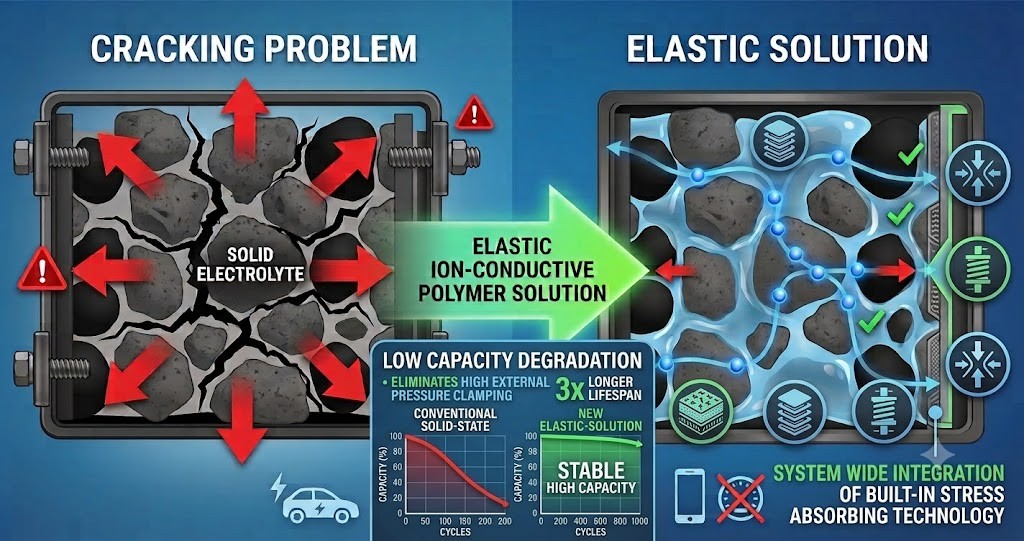
次世代のエネルギー貯蔵デバイスとして本命視されている「全固体電池」。その実用化において最大の障壁の一つが、充放電時に電極が膨張・収縮することで内部に亀裂(クラック)が生じ、性能が急激に劣化する「機械的安定性」の問題でした。
韓国化学研究院(KRICT)、延世大学校、成均館大学校の共同研究チームが発表した新技術は、電池内部に柔軟な「弾性イオン伝導性高分子」を注入することで、この構造的課題を克服するものです。建物の免震装置のように応力を吸収するこのアプローチにより、全固体電池の寿命特性は劇的に向上し、商用化へのブレイクスルーとして大きな注目を集めています。
- 1. 従来技術の課題と開発の背景
- 2. 新開発「弾性イオン伝導性高分子」のメカニズム
- 3. 実証された劇的な性能向上
- 4. 関連情報・商業化へのインパクト(補足)
- 5. 今後の展望
1. 従来技術の課題と開発の背景
全固体電池(硫化物系)への期待
従来の液体電解質を固体に置き換える全固体電池は、液漏れや発火のリスクを根本的に排除できるため「夢の電池」と呼ばれています。特に硫化物系固体電解質は、リチウムイオン伝導度が液体電解質並みに高く、高出力・急速充電に対応できるため、Samsung SDIをはじめとするグローバル企業がこぞって開発を進める最有力候補です。
致命的だった「界面クラック」
硫化物系固体電解質は非常に硬いため、充放電に伴って電極の体積が繰り返し変化すると、電極と電解質の接触界面に微細な亀裂(隙間)が発生します。この隙間が電子やイオンの往来を遮断し、電池寿命を著しく縮めていました。
外部加圧フレームという代償
この剥離を防ぐため、従来の構造では動作時に電池外部から強い圧力(数十MPaクラス)をかけ続ける物理的な結合装置(加圧フレーム)が必要でした。しかし、これは電池パック全体の重量と容積を増やし、製造コストを押し上げる大きな要因となっていました。
2. 新開発「弾性イオン伝導性高分子」のメカニズム
研究チームは、固体電解質粒子間の隙間に液体状態の前駆体を注入し、内部で網目構造に硬化させるインサイチュ(in-situ:電池内部での直接形成)プロセスを考案しました。
- 応力の吸収(免震ゴムの役割)注入された高分子は優れた弾性を持ち、電極の膨張・収縮時に発生する機械的ストレスを柔軟に吸収します。これにより、電極と電解質の密着性が常に保たれ、亀裂の発生を根本的に抑制します。
- イオン伝導経路の補強この高分子自体がリチウムイオン伝導性を持っているため、電解質内部の微細な空隙を埋めつつ、リチウムイオンが移動できる「追加のルート」としても機能します。
3. 実証された劇的な性能向上
実験室での検証により、このアプローチが極めて有効であることが実証されました。
| 評価項目 | 従来の硫化物系電池 | 弾性高分子を適用した電池 |
| リチウム析出・溶解寿命 | 充放電の反復により界面損傷が蓄積 | 2,500時間以上 安定して動作 |
| 200回充放電後の容量維持率 | 22% (著しい劣化) | 75% (従来比3倍以上の寿命) |
| 外部圧力への依存度 | 高い外部圧力を維持する加圧治具が不可欠 | 低い圧力条件下でも安定駆動が可能 |
4. 関連情報・商業化へのインパクト(補足)
EVパック設計の大幅な簡素化
今回の技術がもたらす最大のメリットは、「電池の外部加圧依存度を大幅に下げた点」にあります。 電気自動車(EV)に全固体電池を搭載する場合、強固な加圧フレームが不要になれば、電池パック全体の重量・容積を削減できます。その結果、車両全体の体積エネルギー密度(Wh/L)の向上と構造コストの低減に直結します。
次世代電池の市場動向
世界の全固体電池市場は、今後のEVシフトやエネルギー貯蔵装置(ESS)の普及に伴い、年平均40%を超える極めて高い成長率で拡大すると予測されています。トヨタ自動車や韓国・日本の主要セルメーカーが2020年代後半(2027〜2030年頃)の実用化をターゲットに掲げる中、材料工学アプローチによる課題解決は、各社の量産化ロードマップを加速させる重要な鍵となります。
5. 今後の展望
研究チームの成果は、材料工学分野のトップクラスの国際学術誌『Energy Storage Materials』に掲載されました。今後は、実験室レベルの小型コインセルでの成功にとどまらず、以下のフェーズへと検証を進める計画です。
- 大面積セルへの展開:実際の車載電池に必要となる大面積・多層化パウチセルでの均一な高分子注入プロセスの確立。
- 実駆動環境での信頼性検証:電気自動車特有の激しい温度変化や振動、急速充放電が繰り返される過酷な環境下での長期安定性の確認。
出典:https://finance.biggo.jp/news/b85d4a18-4225-4051-8f2e-538f6b098d30
[All-Solid-State Batteries] Stable Operation Under Low Pressure: Overcoming the “Mechanical Stress” Barrier to Commercialization via Elastic Polymers
All-solid-state batteries are widely considered the ultimate contender for next-generation energy storage devices. However, one of the greatest hurdles to their practical application has been “mechanical stability”—a phenomenon where the repeated expansion and contraction of electrodes during charging and discharging causes internal cracking, leading to rapid performance degradation.
A novel technology announced by a joint research team from the Korea Research Institute of Chemical Technology (KRICT), Yonsei University, and Sungkyunkwan University overcomes this structural challenge by injecting a flexible “elastic ionic-conducting polymer” inside the battery. Functioning much like a seismic isolation system in a building to absorb stress, this approach drastically improves the lifespan characteristics of all-solid-state batteries, drawing immense attention as a major breakthrough toward commercialization.
1. Current Challenges and Background of the Development
High Expectations for All-Solid-State (Sulfur-Based) Batteries
By replacing conventional liquid electrolytes with solid-state alternatives, all-solid-state batteries fundamentally eliminate the risk of leakage and fire, earning them the title of “dream batteries.” In particular, sulfide-based solid electrolytes possess a lithium-ion conductivity comparable to that of liquid electrolytes, making them ideal for high-power output and fast charging. Consequently, global battery giants, including Samsung SDI, are aggressively pursuing this material as their top candidate.
The Fatal Flaw: “Interfacial Cracking”
Because sulfide-based solid electrolytes are incredibly rigid, the repeated volume changes of the electrodes during cycling induce microscopic cracks (gaps) at the contact interface between the electrode and the electrolyte. These gaps obstruct the flow of electrons and ions, severely shortening the battery’s lifespan.
The Penalty of External Clamping Frames
To prevent this delamination, conventional structures required heavy physical clamping devices (pressurized frames) to continuously apply high external pressure (in the tens of MPa range) during operation. However, this significantly added to the overall weight and volume of the battery pack, serving as a primary driver of increased manufacturing costs.
2. Mechanism of the Newly Developed “Elastic Ionic-Conducting Polymer”
The research team devised an in-situ process (direct formation inside the battery) where a liquid-state precursor is injected into the gaps between solid electrolyte particles and then cured into a network structure.
- Stress Absorption (Acts as a Seismic Isolator)The injected polymer possesses excellent elasticity, allowing it to flexibly absorb the mechanical stress generated during electrode expansion and contraction. This maintains constant, tight contact between the electrode and electrolyte, fundamentally suppressing crack formation.
- Reinforcing Ion-Conducting PathwaysSince the polymer itself is lithium-ion conductive, it fills the microscopic voids within the electrolyte while serving as an “additional highway” for lithium ions to travel through.
3. Demonstrated Dramatic Performance Gains
Laboratory validation proved this approach to be exceptionally effective.
| Evaluation Metric | Conventional Sulfide-Based Battery | Battery with Elastic Polymer |
| Lithium Plating/Stripping Lifespan | Interfacial damage accumulates due to repeated cycling. | Stable operation for over 2,500 hours. |
| Capacity Retention (After 200 Cycles) | 22% (Severe degradation) | 75% (Over 3x the lifespan of conventional cells) |
| Dependence on External Pressure | Heavy clamping jigs are indispensable to maintain high external pressure. | Stable operation is achievable even under low-pressure conditions. |
4. Related Insights & Impact on Commercialization
DRUMATIC Simplification of EV Pack Design
The greatest advantage brought by this technology lies in “significantly reducing the battery’s dependence on external pressure.” When integrating all-solid-state batteries into electric vehicles (EVs), eliminating the need for rigid, heavy clamping frames directly reduces the weight and volume of the entire battery pack. This translates straight into an enhanced volumetric energy density ($\text{Wh/L}$) for the vehicle and reduced structural costs.
Next-Generation Battery Market Trends
Driven by the ongoing transition to EVs and the widespread adoption of Energy Storage Systems (ESS), the global all-solid-state battery market is projected to expand at an explosive compound annual growth rate exceeding 40%. With automotive giants like Toyota and leading cell manufacturers in South Korea and Japan targeting commercialization in the late 2020s (around 2027–2030), materials engineering solutions like this are critical keys to accelerating mass-production roadmaps.
5. Future Outlook
The research team’s breakthrough was published in Energy Storage Materials, a top-tier international journal in the field of materials engineering. Moving forward, the team plans to scale their success beyond small, lab-scale coin cells into the following phases:
- Scaling to Large-Area Cells: Establishing a uniform polymer injection process for large-area, multi-layer pouch cells required for actual automotive applications.
- Reliability Verification in Real-World Driving Environments: Confirming long-term stability under harsh, simulated EV conditions, including extreme temperature fluctuations, heavy vibrations, and rapid, continuous fast-charging cycles.

コメント