全固体電池(ASSB: All-Solid-State Battery)は、従来の可燃性有機電解液の代わりに固体の電解質を用いる次世代のリチウムイオン電池です。発火・爆発リスクが大幅に低減する安全性、高エネルギー密度化による走行距離の伸長、急速充電性能の向上といった圧倒的なメリットを持ち、電気自動車(EV)のゲームチェンジャーとして世界中で開発競争が激化しています。
固体電解質には大きく分けて「硫化物系」「酸化物系」「高分子(ポリマー)系」の3つのルートが存在しますが、その中でも「硫化物系」は高いイオン伝導度を持ち、車載向けとして最も有望視されています。一方で、原料となる硫化リチウム(Li2S)などの製造コストが高額であることが実用化の大きな課題とされてきました。
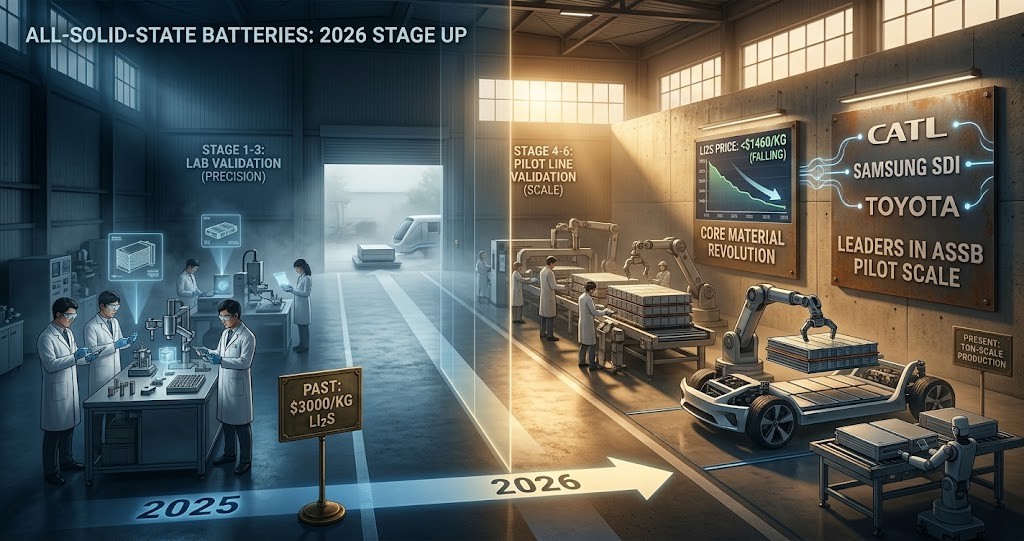
技術の成熟度を示す指標として国際的に使われるTRL(Technology Readiness Level:技術成熟度レベル)では、TRL 1〜3が基礎研究・実験室レベル、TRL 4〜6が実証・パイロットライン検証レベル、TRL 7〜9が実用化・大規模量産レベルと位置付けられています。
以下に、2026年現在における全固体電池産業の最新動向とサプライチェーンの劇的な変化をまとめます。
全固体電池産業の最新動向
1. 実験室段階を突破し「エンジニアリング検証フェーズ」へ
2026年、全固体電池産業は純粋な実験室研究(TRL 1〜3)を突破し、製品の均一性や車載規格への適合を確認するエンジニアリング検証段階(TRL 4〜6)へ正式に突入しました。
- 日韓勢の先行:トヨタ、ホンダ、日産、三星SDI(Samsung SDI)などの日韓メーカーは小規模試作・パイロットラインで先行しています。日産の厚型23層スタック構造の車載全固体電池セルは充放電テストを完了し、従来の液体リチウムイオン電池を上回る容量維持性能を実証しました。
- 中国勢の急追:寧徳時代(CATL)、比亜迪(BYD)、中国第一汽車(FAW)などは試作ラインを加速させており、TRL 4〜5への移行を進めています。
- 量産目標スケジュール:
- 2026年7月:世界初の車載用固体電池の国家標準「電気自動車用全固体電池 第1部:用語と分類」が施行。
- 2027年:寧徳時代および比亜迪が小ロット生産を開始予定。
- 2028年:寧徳時代が大規模量産を開始予定。
2. 電気自動車(EV)から高付加価値領域への応用拡大
全固体電池の初期需要は、EVだけでなく、安全性を重視しコスト感応度の低い高付加価値領域へ広がっています。
- 主な応用分野:ドローン、eVTOL(電動垂直離着陸機)、具身知能ロボット(Embodied AI Robot)、建設機械、マイクロ電子機器。
- 主要プレイヤー:三星SDI、マクセル、Ilika、輝能科技(ProLogium)、Factorialなどのグローバル企業が、これらの分野で象徴的な受注や実用化を進めています。
3. 中核原料「硫化リチウム」の量産と価格急落
硫化物系全固体電池のコスト構造において、固体電解質はセル全体の製造コストの70〜80%を占め、さらにその電解質コストの70〜80%を硫化リチウムが占めています。つまり、硫化リチウム単一で電池セル全体のコストの50〜64%を占める極めて重要な材料です。
- 生産能力と出荷量:
- 世界の硫化リチウム生産能力は2026年上半期時点で600トンを超え、2027年には1000トン級に達する見通しです。
- メーカーの月間出荷量は従来のキログラム(kg)単位からトン(ton)単位へと飛躍的に向上しました。
- 中国の国軒高科(Gotion High-Tech)は、2026年内に1000トン級の生産ラインを稼働させ、2030年には年産5万トンを目指す計画です。
- 価格動向:
- 供給体制の拡大とコスト削減要求に伴い、硫化リチウムの価格は直近半年で50%以上急落し、2026年6月時点で1kgあたり約1460元(約3.5万円)となりました。
- 現在の全固体電池セルの製造コストは1ワット時(Wh)あたり約1.6〜2.2元(約38〜52円)であり、主流の液体リチウム電池(1Whあたり0.39〜0.5元)の3〜5倍程度に留まっています。
まとめと今後の展望
全固体電池は「研究室での技術検証」から「量産に向けたエンジニアリング評価」へとフェーズが大きく変化しました。
硫化リチウムの価格半減は、現在の需要が小規模な試作・開発段階にとどまっている現実を示しつつも、製造コストの大幅な低下を通じて商業化を後押しするポジティブな要素となっています。今後は、日韓勢の先発優位性と、中国勢の堅固なサプライチェーンによる量産化スピードの競合がさらに激化するとともに、車載検証の進展に伴い中核材料への本格的な大口需要が発生することが予想されます。
出典:https://finance.biggo.jp/news/49df35d9-1fa3-4526-ad07-9e56f59fa5b3
All-Solid-State Batteries Break Free From the Lab to Enter Prototype Verification: Japan and Korea Lead While China Catches Up Rapidly, and Lithium Sulfide Prices Plummet by Half
All-Solid-State Batteries (ASSB) are next-generation lithium-ion batteries that use solid electrolytes instead of conventional flammable organic liquid electrolytes. Offering overwhelming advantages such as significantly reduced risks of fire and explosion, extended driving range driven by higher energy density, and improved fast-charging performance, fierce global competition is underway to commercialize them as game-changers for electric vehicles (EVs).
Solid electrolytes are broadly categorized into three types: sulfide-based, oxide-based, and polymer-based. Among these, the sulfide-based route offers high ionic conductivity and is considered the most promising for automotive applications. However, high manufacturing costs for key raw materials like lithium sulfide (Li2S) have posed a major hurdle to commercialization.
Under the Technology Readiness Level (TRL) scale—an internationally recognized metric for measuring technical maturity—TRLs 1 to 3 represent basic research and laboratory validation, TRLs 4 to 6 represent demonstration and pilot-line verification, and TRLs 7 to 9 represent commercial deployment and full-scale mass production.
Below is a summary of the latest trends in the all-solid-state battery industry and the dramatic shifts within its supply chain as of 2026.
Latest Trends in the All-Solid-State Battery Industry
1. Breaking Out of the Lab into the Engineering Verification Phase
In 2026, the all-solid-state battery industry officially moved past pure laboratory research (TRLs 1 to 3) and entered the engineering verification stage (TRLs 4 to 6), focusing on product consistency and automotive standard compliance.
- Japan and Korea Take the Lead: Japanese and South Korean manufacturers, including Toyota, Honda, Nissan, and Samsung SDI, are leading the way with small-scale prototyping and pilot lines. Nissan’s thick 23-layer stacked automotive ASSB cell completed charge/discharge testing, demonstrating superior capacity retention performance compared to traditional liquid lithium-ion batteries.
- China Accelerates Its Catch-Up: Chinese players such as CATL, BYD, and FAW Group are accelerating their prototype lines and advancing toward TRLs 4 to 5.
- Mass Production Roadmap:
- July 2026: The world’s first national standard for automotive solid-state batteries, “All-Solid-State Batteries for Electric Vehicles Part 1: Vocabulary and Classification,” officially took effect.
- 2027: CATL and BYD plan to initiate small-batch production.
- 2028: CATL plans to begin full-scale mass production.
2. Expanding Applications from EVs to High-Value Sectors
Initial demand for all-solid-state batteries is extending beyond EVs into high-value applications where safety is paramount and cost sensitivity is lower.
- Key Application Areas: Drones, eVTOL (electric vertical takeoff and landing) aircraft, Embodied AI Robots, construction equipment, and microelectronics.
- Key Players: Global companies such as Samsung SDI, Maxell, Ilika, ProLogium, and Factorial are securing milestone orders and advancing practical implementations in these fields.
3. Mass Production and Price Collapse of Key Raw Material “Lithium Sulfide”
In the cost structure of sulfide-based all-solid-state batteries, the solid electrolyte accounts for 70% to 80% of total cell manufacturing costs, with lithium sulfide comprising 70% to 80% of that electrolyte cost. This makes lithium sulfide alone a critical material representing 50% to 64% of total battery cell costs.
- Production Capacity and Shipments:
- Global production capacity for lithium sulfide exceeded 600 tons in the first half of 2026 and is projected to reach the 1,000-ton level by 2027.
- Monthly shipments by manufacturers have surged from kilogram-scale to ton-scale.
- China’s Gotion High-Tech plans to bring a 1,000-ton line online within 2026, aiming for an annual capacity of 50,000 tons by 2030.
- Price Trends:
- Driven by expanded supply channels and cost-reduction efforts, lithium sulfide prices plummeted by over 50% in the past six months, reaching approximately 1,460 yuan per kg (around 35,000 yen) as of June 2026.
- Current ASSB cell manufacturing costs stand at roughly 1.6 to 2.2 yuan per Wh (around 38 to 52 yen), which remains 3 to 5 times higher than mainstream liquid lithium-ion batteries (0.39 to 0.5 yuan per Wh).
Conclusion and Future Outlook
All-Solid-State Batteries have undergone a major shift from lab-scale technical verification to engineering evaluation aimed at mass production.
While the 50% drop in lithium sulfide prices reflects the current reality that demand remains centered on small-scale prototyping and R&D, it serves as a strong positive catalyst toward commercialization by significantly lowering manufacturing costs. Moving forward, competition will intensify between the first-mover advantage of Japanese and South Korean firms and the rapid scaling capabilities of China’s robust supply chain, with full-scale demand for key materials expected to surge as automotive validation progresses.

コメント