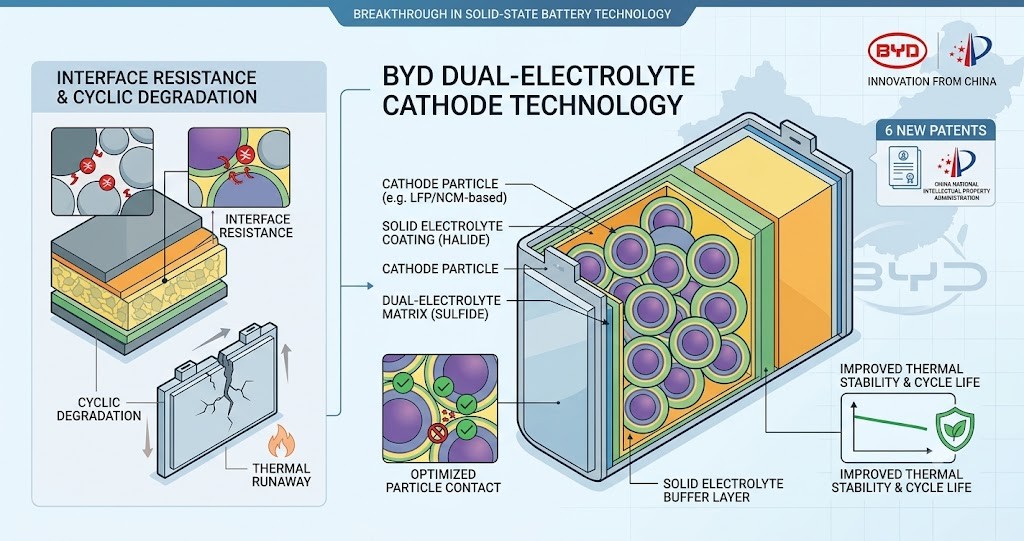
中国のEV大手BYDが、全固体電池(SSB: Solid-State Battery)に関する新たな特許6件を中国国家知識産権局(CNIPA)を通じて公開しました。全固体電池の実用化における最大の障壁は「固体材料同士の界面抵抗(接触不良)」および「充放電サイクルに伴う劣化・熱暴走」です。BYDは今回、ハロゲン化物と硫化物の2種類の固体電解質を組み合わせる「二元電解質(デュアル電解質)カソード方式」をはじめ、緩衝層の設置や粒子接触率の品質管理指標を導入することでこれらの課題解決を図っています。本レポートでは、特許の技術的ポイントと実用化に向けた業界動向について解説します。
1. 特許に見る技術的アプローチ(材料化学・構造設計)
公開された特許は、材料の組み合わせと微細構造の最適化に重点が置かれています。
- 二元電解質の複合化と中間層(CN122494747A) 微粒子ハロゲン化物電解質と微粒子硫化物電解質を正極(カソード)側で併用。両者の間にイオン伝導性と電気化学的安定性を備えた中間層を挟むことで、直接接触による化学反応を抑制し寿命を伸ばします。
- 緩衝層と熱暴走抑制(CN122494554A) 正極活性物質と硫化物電解質の間に第1の固体電解質を緩衝層として配置。正極層の発熱量を1グラム当たり117ジュール以下に抑える設計方針を示し、安全性を担保します。
- 単結晶・多結晶のハイブリッド構造(CN122494567A)
- 内層: 体積変化に強く割れにくい「単結晶カソード材料」と固体電解質を混合。
- 外層: 表面積が大きく高出力(高レート性能)に適した「多結晶カソード材料」と別組成の電解質を配置。
- 単結晶の耐久性と多結晶の出力特性を両立させ、結晶粒界の破損を防ぎます。
- リチウム前処理による抵抗低減(CN122494558A) 金属酸化物および金属硫化物をあらかじめリチウム処理した後に固体電解質と混合。界面抵抗を極限まで低減し、比容量とサイクル特性を向上させます。
2. 量産・品質管理に向けた工夫
- イオン液体湿潤剤の勾配塗布(CN122494552A) 電極の外側領域により多くのイオン液体湿潤剤を配置する「勾配分布」を採用。固体界面のぬれ性を補い、イオン輸送不良を極小化します。
- 接触率指標「Re」の導入(CN122494553A) 正極粒子の周囲60%以上が電解質粒子と密着していることを満たす品質管理指標「Re」を提案。電解質粒子の微細化により接触面積を増やし、高容量と長寿命を保証します。
3. 商業化ロードマップと業界の見方
- 2027年の小規模生産目標 BYDは2027年に二元電解質カソードを採用したSSBセルの小規模(試作)生産を開始し、テスト車両への搭載評価を目指しています。
- 量産化への慎重論 競合であるCATL(寧徳時代)のトップも指摘するように、固体界面の安定化や量産プロセスの構築には高いハードルが存在します。本格的な一般EV向け量産・普及には依然として一定の歳月が必要とされる見通しです。
【関連情報・補足】専門的な背景と技術トレンド
- なぜ「ハロゲン化物×硫化物」の二元電解質なのか?
- 硫化物系: イオン伝導度が最も高く(液体電解液と同等以上)、高出力化に適しますが、耐電圧性がやや低く水分と反応して硫化水素ガスを発生するリスクがあります。
- ハロゲン化物系: 高電圧(4V以上)に対する酸化耐性に優れ、正極との界面で安定しますが、イオン伝導度は硫化物系に劣ります。
- BYDの手法は、高電圧に晒される正極近傍に耐酸化性の高いハロゲン化物を配置し、全体に伝導度の高い硫化物を併用することで、高容量・高出力・高耐圧を同時に満たそうとする合理的なアプローチです。
- 全固体電池の課題「界面抵抗」と湿潤剤(セミソリッド化)のトレンド 充放電時に正極材が膨張・収縮を繰り返すと、固体同士の接点が剥がれて急速に性能が低下します。BYDが特許で示した「少量のイオン液体の添加(湿潤剤)」や「接触率Reの管理」は、完全なドライプロセス(完全固体)の難易度を考慮し、微量の液相を介在させて界面接触を保つ「準固体(半固体)」アプローチを取り入れた、極めて実用的・現実的な量産化アプローチと言えます。
BYD Unveils Six Solid-State Battery Patents: Technological Innovation Driven by Dual-Electrolyte Systems and Interface Control
Major Chinese EV manufacturer BYD has published six new patents related to solid-state batteries (SSBs) through the China National Intellectual Property Administration (CNIPA). The largest barriers to the commercialization of solid-state batteries are interface resistance (poor contact) between solid materials and degradation or thermal runaway associated with charge-discharge cycles. BYD seeks to resolve these issues by adopting a “dual-electrolyte cathode approach” that combines two types of solid electrolytes—halides and sulfides—along with incorporating buffer layers and quality control metrics for particle contact ratios. This report outlines the technical highlights of these patents and industry trends toward commercialization.
- Technical Approaches in Patents (Material Chemistry and Structural Design) The published patents focus on optimizing material combinations and microstructures:
- Dual-Electrolyte Composites and Interlayers (CN122494747A): Combines fine-particle halide electrolytes and fine-particle sulfide electrolytes on the cathode side. Inserting an interlayer with ionic conductivity and electrochemical stability between the two suppresses chemical reactions caused by direct contact, extending cycle life.
- Buffer Layers and Thermal Runaway Suppression (CN122494554A): Places a first solid electrolyte as a buffer layer between the cathode active material and the sulfide electrolyte. It sets a design policy to keep heat release in the cathode active layer at or below 117 joules per gram, ensuring safety.
- Single-Crystal/Polycrystalline Hybrid Structure (CN122494567A):
- Inner Layer: Combines single-crystal cathode materials—resistant to volume changes and cracking—with a solid electrolyte.
- Outer Layer: Places polycrystalline cathode materials—featuring large surface areas suitable for high output (high-rate performance)—with an electrolyte of a different composition.
- Balances the durability of single crystals with the power characteristics of polycrystals, preventing degradation along grain boundaries.
- Resistance Reduction via Lithium Pre-treatment (CN122494558A): Pre-treats metal oxides and metal sulfides with lithium before mixing them with the solid electrolyte. This drastically lowers interface resistance, improving specific capacity and cycle characteristics.
- Innovations for Mass Production and Quality Control
- Gradient Application of Ionic Liquid Wetting Agents (CN122494552A): Employs a “gradient distribution” that places more ionic liquid wetting agent in the outer regions of the electrode. This compensates for poor solid-interface wettability and minimizes ionic transport defects.
- Introduction of the Contact Ratio Metric “Re” (CN122494553A): Proposes a quality control metric “Re,” requiring at least 60% of the perimeter of cathode particles to be in contact with electrolyte particles. Refining electrolyte particle size increases the contact area, ensuring high capacity and long life.
- Commercialization Roadmap and Industry Outlook
- Target for Small-Scale Production in 2027: BYD aims to begin small-scale (pilot) production of SSB cells utilizing dual-electrolyte cathodes in 2027 for evaluation in disguised test vehicles.
- Cautious Outlook on Mass Adoption: As highlighted by top leadership at competitor CATL, stabilizing solid interfaces and establishing mass-production processes pose significant hurdles. Full-scale commercialization and widespread adoption in general consumer EVs are expected to require several more years.
[Related Information & Technical Background] Specialized Background and Technology Trends
- Why Use a “Halide x Sulfide” Dual Electrolyte?
- Sulfide-based: Offers the highest ionic conductivity (equivalent to or higher than liquid electrolytes) and suits high-power output, but has lower oxidation tolerance and risks generating hydrogen sulfide gas upon reacting with moisture.
- Halide-based: Possesses superior oxidation resistance at high voltages (4 V or higher) and remains stable at the cathode interface, though its ionic conductivity is lower than that of sulfides.
- BYD’s method places oxidation-resistant halides near the cathode (where high voltage is applied) while utilizing highly conductive sulfides overall, presenting a rational strategy to simultaneously meet high capacity, high power output, and high voltage resistance.
- Interface Resistance Challenges and the Trend Toward Wetting Agents (Semi-Solid Approach): When cathode materials expand and contract during charge-discharge cycles, solid-to-solid contact points detach, leading to rapid performance degradation. The “addition of small amounts of ionic liquid (wetting agents)” and “contact ratio Re management” outlined in BYD’s patents incorporate a semi-solid/quasi-solid approach—maintaining interface contact via a minute liquid phase—offering an extremely practical and realistic step toward mass production given the extreme difficulty of fully dry processes.


コメント