急速な進化を続けるモバイル・IT機器、そして電気自動車(EV)の未来を握る次世代バッテリー分野において、長年の大きな壁だった「寿命と充電速度」の問題を根本から覆す革新的な発見がありました。
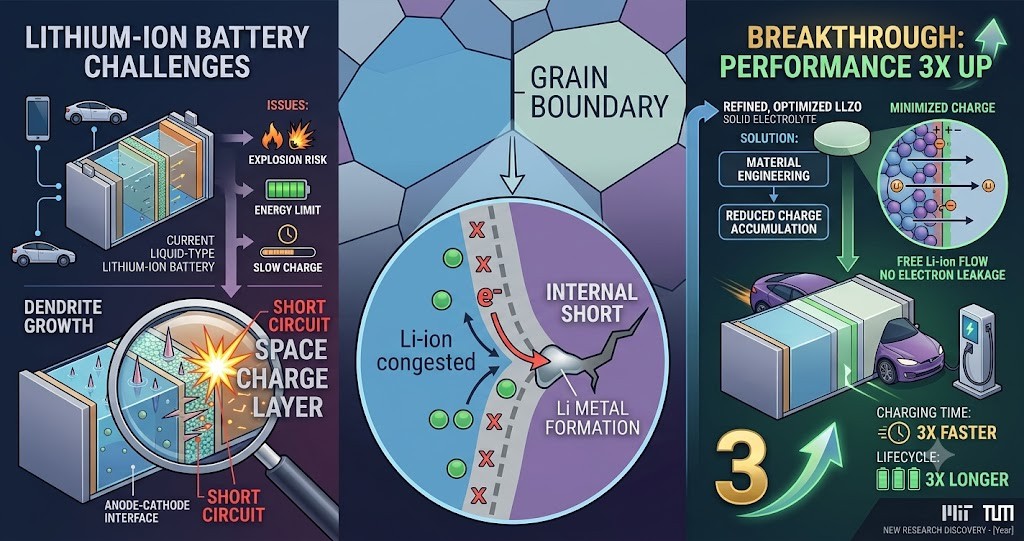
現在の液系リチウムイオン電池はエネルギー密度の限界や発火リスクを抱えており、その解決策として不燃性の「全固体電池」の実現が急務となっています。しかし、開発の最大の障害となってきたのが、電池内部で金属が成長してショートを引き起こす「デンドライト」現象でした。
マサチューセッツ工科大学(MIT)とミュンヘン工科大学(TUM)の共同研究チームが、この破壊的現象の「真犯人」を特定し、性能指標を従来の3倍以上に引き上げることに成功した画期的な研究成果について詳しくまとめました。
1. 核心的な発見:デンドライトの真犯人は「粒界(りゅうかい)」
これまで多くの研究者や企業は、デンドライトの発生源を「電極と固体電解質が接する外側の界面(接触面)」にあると考え、その隙間を埋める緩衝材などの開発に巨額の投資を行ってきました。しかし、MITのチームは固体電解質の「内部」に潜む欠陥に目を向けました。
- 研究対象の材料: 高い化学的安定性と安全性を誇るガーネット型の酸化物系固体電解質「LLZO(Li7La3Zr2O12)」を分析しました。
- 微小な結晶の継ぎ目: LLZOはマクロには滑らかなセラミックの板に見えますが、微視的には約1ミクロン(0.001ミリメートル)サイズの小さな結晶(粒)が敷き詰められたモザイク状の構造をしています。この結晶同士の境界線を「粒界」と呼びます。
- 潜んでいた電気的不均衡: 原子配列が乱れた粒界のコア部分には局所的な電荷が蓄積しており、その周囲に「空間電荷層」と呼ばれる見えない局所的な電場を作り出していることが判明しました。
2. ショートを引き起こす破壊的メカニズム
粒界に形成された空間電荷層(電場)は、固体電解質本来の「リチウムイオンだけを通し、電子は完全に遮断する」という役割を致命的に阻害していました。
- 電子の滞留とイオンの渋滞: この電場は、リチウムイオンの移動に対して強い抵抗を生み出して流れを渋滞させる一方で、本来なら通行止めにするべき「電子」を粒界周辺に漏洩・滞留させてしまいます。
- 内部での金属化反応: 渋滞を抜けてきたリチウムイオンと、粒界に滞留した電子が出会うことで、固体電解質の内部深くで電気化学的な還元反応(Li+ + e- -> Li)が起き、金属リチウムの微小な種が生まれます。
- 内側からの破壊: この金属の種が成長して物理的な楔(くさび)となり、強固なセラミックを内側から引き裂くように破壊しながら電極間を繋ぐデンドライトとなり、最終的に電池を短絡(ショート)させて命を奪っていました。
3. 「電荷のチューニング」による性能3倍の飛躍
研究チームは、電気化学インピーダンス分光法(EIS)や機械学習モデルなどの高度な手法を組み合わせることで、長年ブラックボックスだった1ミクロンスケールの電気的な偏りを可視化・特定しました。
原因が分かったことで、チームはLLZOの材料処理プロセスに以下のエンジニアリングを応用しました。
- 負電荷の最小化: セラミックを焼き固める「焼結プロセス」の温度や化学的処理条件を緻密にコントロールし、粒界に蓄積する負電荷を意図的に最小化しました。
- 見えない壁の消滅: これにより空間電荷層が劇的に縮小し、リチウムイオンの渋滞が解消されると同時に、電子が滞留する領域そのものが排除されました。
- 圧倒的な成果: 改良されたLLZO電解質は、ショートを起こさずに流せる最大電流値である「臨界電流密度」が、従来のベースライン比で300%以上(3倍以上)へと向上しました。これは、EVの充電時間を大幅に短縮し、寿命(ライフサイクル)を3倍に延ばせることを意味します。
4. 追加情報:世界的な開発競争と量産の壁
今回の発見は固体電池の「ミクロな設計図」を提供するものですが、研究室の成果を一般の市場に届けるには、まだ超えなければならない自動車業界共通のハードルが存在します。
- 「酸化物系」 vs 「硫化物系」: 固体電池の材料は、トヨタ自動車や韓国SK Onなどが主導する「硫化物系」と、今回のLLZOに代表される「酸化物系」に二分されます。硫化物系は柔らかく加工しやすいものの水と反応して有毒ガス(硫化水素)を出すリスクがあり、酸化物系は安全ですが硬く内部抵抗が大きいのが弱点でした。今回のMITの発見は、安全な「酸化物系」の弱点を克服し、実用性を大きく押し上げるものです。
- 製造プロセスの大変革という課題: 米QuantumScapeやFactorial Energyなどの有力スタートアップは、主に物理的な圧力や界面の密着性を高めるアプローチでデンドライトを防ごうとしてきました。今回の発見を量産に適用するには、材料の内部電荷まで制御するために「焼結プロセスそのもの」を見直す必要があり、既存の生産ラインや製造工程の大幅な変更を迫られる可能性があります。年間数百数万台分のEV向けに、低コストかつ無欠陥でこの精密な制御を行う量産技術の確立が次の戦場となります。
5. まとめ
固体電池の実用化というフロンティアは、「欠陥のない完璧な素材」を探し求める段階から、素材が必然的に抱えてしまう「微小な欠陥(粒界)の電気的性質を手なずけてコントロールする」という、より解像度の高いエンジニアリングのフェーズへと進化しました。
目に見えない結晶の隙間で起きる電子の悪さを完璧に抑え込めるようになったとき、私たちは真の意味で急速充電が可能になり、寿命の長い、発火の心配がない次世代モビリティの恩恵を享受できるようになるでしょう。
出典:https://xenospectrum.com/solid-state-battery-dendrite-grain-boundary-mit/#google_vignette
It Was “Grain Boundaries,” Not the Interface: The True Mechanism of Solid-State Battery Dendrite Formation and Challenges for Mass Production
An innovative discovery has emerged in the next-generation battery sector—the key to the future of rapidly evolving mobile/IT devices and electric vehicles (EVs)—fundamentally overturning long-standing barriers surrounding battery lifespan and charging speed.
Current liquid lithium-ion batteries face physical limits in energy density and carry inherent fire risks. To solve these issues, realizing non-flammable solid-state batteries has become an urgent priority. However, the greatest obstacle to their development has been “dendrites,” a phenomenon where metallic structures grow inside the battery and cause short circuits.
A joint research team from the Massachusetts Institute of Technology (MIT) and the Technical University of Munich (TUM) has successfully identified the true culprit behind this destructive phenomenon, achieving a breakthrough that raises performance metrics to more than three times conventional levels. Below is a detailed summary of their findings.
1. The Core Discovery: The True Culprit is “Grain Boundaries”
Previously, many researchers and companies believed dendrites originated at the external “interface”—the contact surface where the electrode and the solid electrolyte meet. Consequently, they invested heavily in developing buffer layers to fill those physical gaps. However, the MIT team turned their attention to the internal defects hiding deep within the solid electrolyte itself.
- Target Material: The study analyzed Lithium Lanthanum Zirconate (Li7La3Zr2O12, commonly known as LLZO), a garnet-type oxide solid electrolyte praised for its high chemical stability and safety.
- Microscopic Microcrystalline Joints: On a macro level, LLZO looks like a smooth ceramic plate. Microscopically, however, it reveals a mosaic-like structure packed with tiny single crystals (grains) measuring about 1 micron (0.001 millimeters) in size. The borders where these crystals meet are called “grain boundaries.”
- Hidden Electrical Imbalance: The team discovered that localized electrical charges accumulate at the core of these grain boundaries, where the atomic arrangement is disrupted. This creates an invisible, localized electric field around them known as a “Space Charge Layer.”
2. The Destructive Mechanism Causing Short Circuits
The space charge layer (electric field) formed at the grain boundaries fatally disrupts the solid electrolyte’s core duty: allowing only lithium ions to pass through while completely blocking electrons.
- Electron Pooling and Ion Traffic Jams: This electric field creates strong resistance against the movement of lithium ions, causing a massive bottleneck. At the same time, it allows electrons—which are supposed to be completely blocked—to leak and pool around the grain boundaries.
- Internal Metallization Reaction: When the delayed lithium ions moving through the bottleneck meet the pooled electrons at the grain boundary, an electrochemical reduction reaction (Li+ + e- -> Li) takes place deep within the solid electrolyte. This reaction births tiny seeds of lithium metal.
- Destruction from the Inside Out: As these metallic seeds grow, they act as physical wedges, literally tearing the tough ceramic apart from the inside. This growth forms the dendrites that bridge the electrodes, ultimately causing a short circuit and killing the battery cell.
3. A 300% Performance Leap via “Charge Tuning”
By combining advanced methodologies such as Electrochemical Impedance Spectroscopy (EIS) and machine learning models, the research team managed to visualize and isolate these 1-micron-scale electrical imbalances, which had long remained a complete black box.
With the root cause identified, the team applied a new engineering approach to the LLZO material treatment process:
- Minimizing Negative Charge: By meticulously controlling the temperature and chemical treatment conditions during the sintering process (the stage where the ceramic is baked and hardened), they intentionally minimized the negative charge accumulating at the grain boundaries.
- Vanishing of the Invisible Wall: This optimization dramatically shrank the space charge layer. As a result, the lithium ion bottleneck dissolved, and the zones where electrons previously pooled were completely eliminated.
- Overwhelming Performance Results: The modified LLZO electrolyte demonstrated a spectacular increase of over 300% (more than three times) in its “critical current density”—the maximum amount of current a battery can safely handle without short-circuiting. This achievement directly translates to heavily slashed EV charging times and a tripled battery life cycle.
4. Additional Information: Global Competition and the Mass Production Wall
While this discovery provides a precise microscopic blueprint for solid-state batteries, delivering laboratory achievements to the commercial market requires overcoming massive hurdles shared across the automotive industry.
- Oxide-Based vs. Sulfide-Based Systems: Solid-state battery materials are largely split into two categories: “sulfide-based” systems, championed by Toyota and South Korea’s SK On, and “oxide-based” systems, represented by LLZO in this study. Sulfide systems are soft and easy to process but risk generating toxic hydrogen sulfide gas if exposed to moisture. Oxide systems are exceptionally safe but are hard, brittle, and prone to high internal resistance. This MIT discovery directly tackles the core weakness of the safer oxide-based approach, significantly boosting its practical viability.
- The Challenge of Manufacturing Overhaul: Leading startups like QuantumScape and Factorial Energy have primarily focused on physical pressure and improving interface adhesion to keep dendrites at bay. Applying this new discovery to mass production means manufacturers must look past the interface and adjust the internal electrical charges of the material itself. This requires re-engineering the sintering process itself, which may force a massive overhaul of existing production lines and factory steps. The next battleground will be establishing mass-production technology capable of performing this precise electrical control at a low cost and completely defect-free for millions of EVs annually.
5. Conclusion
The frontier of solid-state battery development has successfully evolved. It has shifted from a phase of searching for a mythical, flaw-free material to a much higher resolution engineering phase: taming and controlling the electrical properties of the microscopic flaws (grain boundaries) that materials naturally possess.
Now that we can perfectly suppress the rogue electrons misbehaving within the tiny invisible gaps of crystal grains, the door is wide open for a new era. Humanity is poised to finally enjoy the true benefits of next-generation mobility: batteries that charge incredibly fast, last three times longer, and completely eliminate the fear of catching fire.
コメント