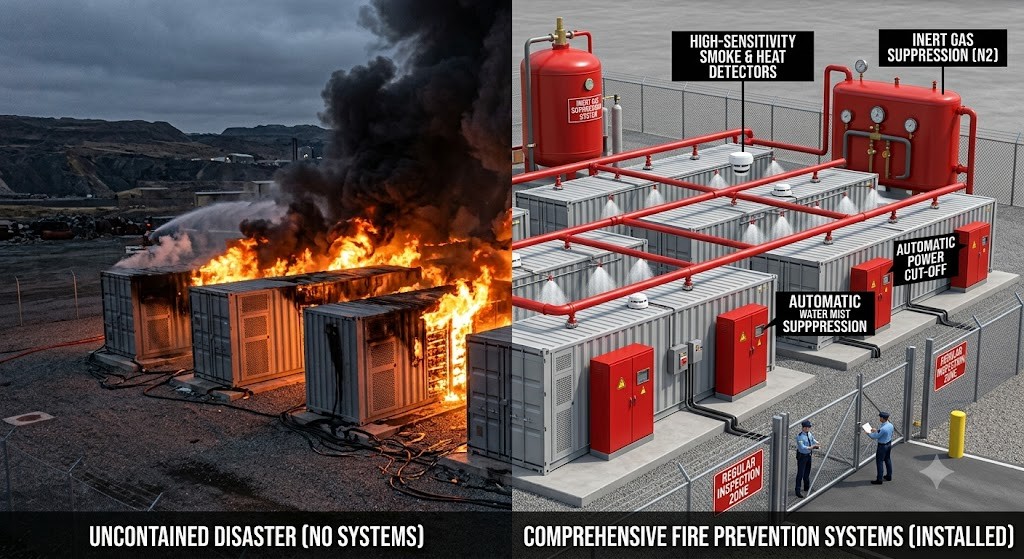
太陽光や風力などの再生可能エネルギーの普及に伴い、大規模なバッテリーエネルギー貯蔵システム(BESS:Battery Energy Storage System)の導入が世界中で加速しています。これに伴い、BESSコンテナにおける「火災安全性」と「熱暴走の抑制」は、業界全体における最も重要な課題の一つとなっています。
単体での故障率は低くとも、システム全体の容量が数ギガワット(GW)規模に拡大すると、事故の絶対数や社会的影響は無視できません。本まとめでは、BESSの主要な利害関係者の懸念、安全基準の最新動向(NFPA 855の改正など)、および高度な試験手法(大規模火災試験)の重要性について関連情報を交えて解説します。
- 1. 利害関係者とそれぞれの懸念事項
- 2. BESS火災安全に関する主要な業界規格と役割
- 3. NFPA 855-2026 改正による「大規模火災試験(LSFT)」の強化
- 4. 試験結果の適用限界と「サイト固有モデリング」の重要性
- 結論:BESS安全対策の新たな方向性
- 1. Stakeholders and Their Primary Concerns
- 2. Key Industry Standards and Their Roles in BESS Fire Safety
- 3. Strengthening “Large-Scale Fire Testing (LSFT)” under NFPA 855-2026
- 4. Limitations of Test Results and the Importance of Site-Specific Modeling
- Conclusion: A New Direction in BESS Safety Strategy
1. 利害関係者とそれぞれの懸念事項
BESSプロジェクトの推進には多角的なリスク管理が必要であり、立場ごとに明確な懸念事項が存在します。
- 事業者・開発者(Developers): 地域住民の反対を防ぐため、人員の安全、システムの稼働率(可用性)、企業の評判を維持することを最優先とします。
- 融資機関・貸し手(Lenders): 万が一の事故における損失の深刻度や、想定される「最大可能損失額」を明確に把握・管理したいと考えます。
- 管轄当局(AHJ:Authority Having Jurisdiction): 消防や自治体などの許認可機関であり、承認の根拠となる客観的かつ厳格な試験証拠を要求します。
- 地域社会(Local Communities): たった一つの火災事故が周囲に拡大せず、単一の事象で確実に収束するという確証を求めています。
これらすべてのステークホルダーに共通するゴールは、「事故を未然に防ぎ、予防が失敗した場合でも被害を最小限に抑えること」です。
2. BESS火災安全に関する主要な業界規格と役割
BESSの安全性を担保するため、主に北米を中心に以下の国際的な安全規格・基準が用いられています。これらは補完関係にあり、個別の役割を持っています。
- NFPA 855: 定置型エネルギー貯蔵システムの設置・設置場所に関する総合的な基準。自治体等に採用されることで法的な拘束力を持ちます。
- UL 9540: BESS一式(システム全体)の製品安全性および認証を規定する規格。
- UL 9540A: システム内部での「熱暴走挙動」「可燃性ガスの発生」「火災の伝播」を評価するための試験方法。それ自体がシステム全体の適合を示す認証ではなく、評価に必要なデータを提供する位置づけです。
【関連情報:火災発生の原因に関するデータ】
BESSの事故原因は、内部のセル(蓄電池本体)の欠陥だけではありません。米国のEPRI(電力中央研究所)のデータベース分析によると、原因が特定された事故のうち、セルやモジュールに起因するものは11パーセントにとどまります。残りの約9割は、制御装置(46パーセント)や、配線・HVAC(空調設備)・冷却装置・統合不具合などのシステム周辺機器(43パーセント)に起因しています。このため、セル単体だけでなくコンテナ全体での安全評価が極めて重要になります。
3. NFPA 855-2026 改正による「大規模火災試験(LSFT)」の強化
最新の規制動向であるNFPA 855-2026(セクション 9.2)では、安全基準が「事故の予防」から「事故発生時の被害抑制(レジリエンス)」へと大きく踏み込みました。
- 従来の試験(例:UL 9540Aの初期アプローチ): セルやモジュール単位で熱暴走が抑えられれば、上位(コンテナ全体や設置レベル)の試験を省略できる場合がありました。
- 新規格(NFPA 855-2026)の要件: セルやモジュール試験で可燃性ガスが発生した場合、「意図的な着火」を伴う大規模火災試験(LSFT:Large-Scale Fire Testing)が必須となりました。
これにより、コンテナ内部で深刻な火災が発生した状態を意図的に作り出し、提案された離隔距離(設置間隔)において「隣接する別のBESSユニットへ火災が延焼しないこと」を実証・評価することが求められます。
4. 試験結果の適用限界と「サイト固有モデリング」の重要性
大規模火災試験(LSFT)を通過したからといって、あらゆる環境で安全が保証されるわけではありません。試験結果を実際の設置現場に適用するには以下の制限と工夫が必要です。
- 構成の変更による影響: 試験は特定の構造、通気経路、離隔距離で実施されます。筐体の配置を近づけたり内部仕様を変更したりした場合は、再試験や技術的な補足解析が必要です。
- 気象条件の制限: 物理試験ではすべての風向・風速(例:10 m/s以上の強風など)を再現できません。
- CFDモデリングとの連携: LSFTで得られた実際の熱流束(熱の影響度)データは、計算流体力学(CFD)を用いたサイト固有のモデル作成に活用されます。これにより、実際の風況や周囲の変圧器・敷地境界線への影響を高度にシミュレーションすることが可能になります。
結論:BESS安全対策の新たな方向性
BESSの火災安全対策は、これまでの「熱暴走をいかに未然に防ぐか」という単一の予防観点から、「万が一大規模な火災が発生した場合でも、被害を1つのコンテナ内に収められるか」という回復力(レジリエンス)と拡大防止の観点へとシフトしています。
内部の抑制技術(セル・モジュールレベル)、コンテナ全体での延焼防止試験(LSFT)、および設置場所に応じた流体・熱シミュレーションを組み合わせることで、融資機関や地域社会に対して確かな安全性の証拠を提供することが可能になります。
Fire Safety Standards for Battery Energy Storage Systems (BESS): A Shift from Prevention to Large-Scale Fire Spread Mitigation
With the widespread adoption of renewable energy sources such as solar and wind power, the global deployment of large-scale Battery Energy Storage Systems (BESS) is accelerating. Consequently, “fire safety” and “thermal runaway mitigation” in BESS containers have become among the most critical challenges facing the entire industry.
Even if the failure rate of an individual component is low, as overall system capacities expand to the gigawatt (GW) scale, the absolute number of incidents and their societal impact cannot be ignored. This summary incorporates relevant context to explain the primary concerns of key BESS stakeholders, the latest trends in safety standards (including revisions to NFPA 855), and the importance of advanced testing methodologies such as Large-Scale Fire Testing (LSFT).
1. Stakeholders and Their Primary Concerns
Promoting BESS projects requires multifaceted risk management, with each stakeholder group holding distinct concerns:
- Developers: Their top priority is maintaining personnel safety, system availability, and corporate reputation to prevent community opposition.
- Lenders: They need to clearly understand and manage the severity of potential losses and the expected maximum foreseeable loss in the event of an incident.
- Authorities Having Jurisdiction (AHJ): As permitting agencies like fire departments and local governments, they demand objective, rigorous testing evidence as a basis for approval.
- Local Communities: They seek assurance that a single fire incident will not spread to surrounding areas and will remain isolated as an isolated event.
The shared goal across all these stakeholders is to prevent accidents whenever possible and to minimize damage if prevention fails.
2. Key Industry Standards and Their Roles in BESS Fire Safety
To ensure BESS safety, the following international safety standards and criteria—primarily established in North America—are widely utilized. These frameworks complement one another and serve distinct functions:
- NFPA 855: A comprehensive standard governing the installation and location of stationary energy storage systems. It gains legal force when adopted by local jurisdictions.
- UL 9540: A product safety standard used to certify complete, fully integrated BESS equipment.
- UL 9540A: A test method designed to evaluate thermal runaway behavior, gas generation, and fire propagation within a system. It is not a certification in itself, but rather provides the necessary data for safety evaluations.
[Related Context: Causes of Fire Incidents]
BESS incidents are not solely caused by internal battery cell defects. According to an analysis of the Electric Power Research Institute (EPRI) BESS Failure Incident Database, among incidents with sufficient public data to classify, only 11 percent were attributed to cells or modules. The remaining approximately 90 percent stemmed from control systems (46 percent) and system balance-of-plant components (43 percent), such as wiring, HVAC or cooling units, and integration failures. This highlights why safety evaluation across the entire container—not just the individual cells—is essential.
3. Strengthening “Large-Scale Fire Testing (LSFT)” under NFPA 855-2026
The latest regulatory update, NFPA 855-2026 (Section 9.2), marks a major shift in safety criteria from simple “accident prevention” to “consequence containment and resilience.”
- Previous Approach (e.g., Early UL 9540A testing paths): Testing could often be concluded at lower levels if thermal runaway was mitigated at the cell or module level without progressing to full unit or installation testing.
- New NFPA 855-2026 Requirements: If flammable gas generation is observed during cell or module testing, a Large-Scale Fire Test (LSFT) involving intentional ignition of vent gases becomes mandatory.
This requirement deliberately creates severe fire conditions inside a container to evaluate and prove that fire will not spread to adjacent BESS units at the proposed separation distances.
4. Limitations of Test Results and the Importance of Site-Specific Modeling
Passing a Large-Scale Fire Test (LSFT) does not guarantee absolute safety under every real-world condition. Applying test results to an actual project site involves the following limitations and strategies:
- Impact of Design Modifications: LSFT results apply to specific configurations, venting designs, and separation distances. Moving enclosures closer together or altering internal specs may require technical justification, additional analysis, or re-testing.
- Weather Condition Limits: Physical testing cannot replicate all potential weather conditions, such as high wind speeds exceeding 10 m/s or varying wind directions.
- Integration with CFD Modeling: Measured heat flux data from LSFT is used to build and validate site-specific Computational Fluid Dynamics (CFD) models. This enables advanced simulation of local wind conditions and potential impacts on nearby transformers or property lines.
Conclusion: A New Direction in BESS Safety Strategy
BESS fire safety is shifting from a single focus on prevention (“Can we stop thermal runaway from starting?”) to a focus on resilience and containment (“If a major fire occurs, can we contain it within a single container?”).
By combining internal mitigation technologies at the cell and module levels, container-level fire propagation testing (LSFT), and site-specific thermal and fluid modeling, project teams can provide robust, credible safety evidence to lenders, regulators, and local communities.
コメント