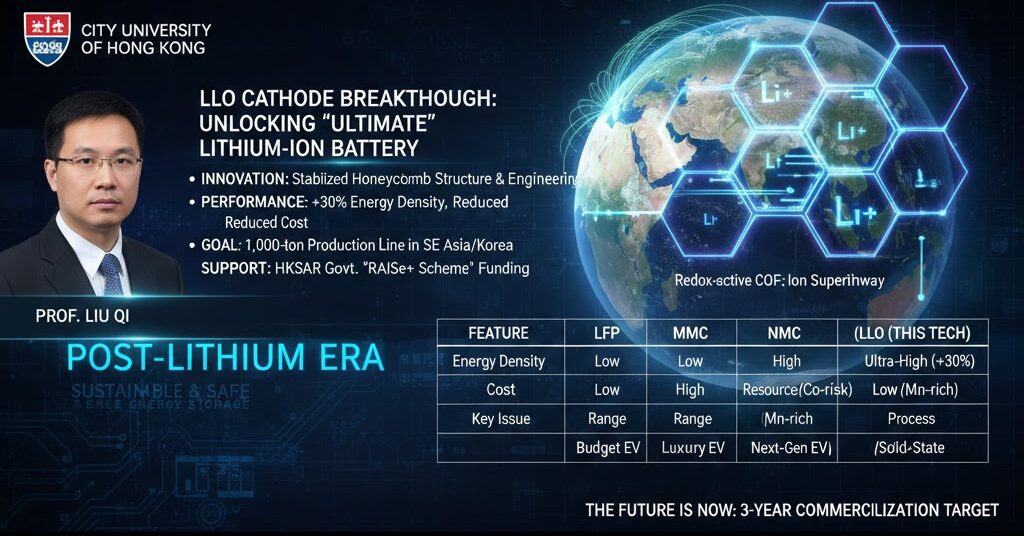
香港城市大学の劉奇(Liu Qi)教授率いるチームは、リチウムイオン電池(LIB)の性能を飛躍的に高める「リチウムリッチ層状酸化物(LLO)」の欠点を克服し、3年以内の実用化を目指しています。
- 核心技術: ハニカム構造の安定化と表面工学により、LLOの弱点だった「電圧低下(電圧減衰)」と「容量低下」を解決。
- 目標: 既存の電池のエネルギー密度を30パーセント以上向上させつつ、コストを削減。
- 規模: 東南アジアまたは韓国に1,000トン級の生産ラインを建設予定。100名の新規雇用を創出。
- 支援: 香港政府の「RAISe+スキーム(大学研究成果の製品化支援)」から資金援助を受ける。
関連情報:LLOが「究極」と呼ばれる理由と課題
ニュースを深く理解するための補足情報です。
1. なぜ「リチウムリッチ(LLO)」が注目されるのか
現在の主流である三元系(NMCなど)電池に対し、LLOはより多くのリチウムを取り込める構造をしています。
- 高いエネルギー密度: 従来の正極材料の理論容量が約200 mAh/g程度であるのに対し、LLOは250から300 mAh/gを超える容量を実現可能です。
- コスト優位性: 高価なコバルトの使用量を抑え、比較的安価なマンガンを主成分にできるため、EVの車両価格引き下げに直結します。
2. 「電圧低下(Voltage Decay)」という壁
これまでLLOが普及しなかった最大の理由は、充放電を繰り返すたびに動作電圧が徐々に下がってしまう現象にありました。
- 構造の不安定さ: リチウムが多く抜けた後に結晶構造が変化し、エネルギーを取り出しにくくなる問題がありましたが、今回のプロジェクトでは「遷移金属イオンの添加」によってこの構造を物理的にロックすることに成功しました。
3. 「全固体電池」への布石
プロジェクトの第2ラインとして挙げられている「固体電池用LLO」は、次世代電池の本命とされる全固体電池との相性を狙ったものです。
- LLOは高い電圧で動作するため、従来の液体電解質では分解が起きやすいという課題がありました。これを固体電解質と組み合わせることで、安全性と超高エネルギー密度を両立する「最強の電池」が実現する可能性があります。
まとめ:次世代電池材料の比較
今回のLLO技術が、既存の主要材料とどう異なるのかを整理しました。
| 特徴 | LFP(リン酸鉄リチウム) | NMC(三元系) | LLO(今回の開発材料) |
| エネルギー密度 | 低い(安全重視) | 高い | 極めて高い(NMC比+30%超) |
| コスト | 安価 | 高価(コバルト等) | 安価(マンガン活用) |
| 主な課題 | 航続距離が短い | 資源リスク・安全性 | 商業化への製造プロセス確立 |
| 主な用途 | 普及型EV・蓄電池 | 高級EV・スマホ | 次世代高性能EV・全固体電池 |
今後の展望:
香港はこれまで金融やサービスのイメージが強かったですが、このプロジェクトを通じて「次世代エネルギー技術の供給源」としての地位を確立しようとしています。研究室の成果(Nature Energy掲載)をわずか3年で1,000トン規模の量産に乗せられるかどうかが、世界のEV市場の勢力図に影響を与えることになりそうです。
Overcoming “Voltage Decay” in Lithium-ion Batteries: City University of Hong Kong Moves Toward Commercialization of Lithium-rich Cathode Materials
A research team led by Professor Liu Qi at the City University of Hong Kong (CityUHK) has overcome the longstanding defects of Lithium-rich Layered Oxides (LLO), a material capable of dramatically boosting lithium-ion battery (LIB) performance. The team aims for commercial application within three years.
- Core Technology: Solved “voltage decay” and “capacity fading”—long-time weaknesses of LLO—through honeycomb structure stabilization and advanced surface engineering.
- Objective: Increase the energy density of existing batteries by over 30 percent while simultaneously reducing costs.
- Scale: Plans to construct a 1,000-ton production line in Southeast Asia or South Korea, creating approximately 100 new jobs.
- Support: Receives funding from the Hong Kong SAR Government’s “RAISe+ Scheme,” which supports the commercialization of university research.
Contextual Information: Why LLO is Hailed as the “Ultimate” Material
To better understand this news, here are some key background details regarding the potential and challenges of LLO.
1. Why is “Lithium-rich (LLO)” Gaining Attention?
Compared to the current mainstream NCM (Nickel-Cobalt-Manganese) batteries, LLO features a structure that can incorporate significantly more lithium.
- High Energy Density: While traditional cathode materials have a theoretical capacity of about 200 mAh/g, LLO can achieve capacities exceeding 250 to 300 mAh/g.
- Cost Advantage: LLO reduces the use of expensive cobalt by using relatively inexpensive manganese as a primary component, which directly contributes to lowering the price of EVs.
2. The Barrier of “Voltage Decay”
The primary reason LLO has not been commercialized until now is a phenomenon where the operating voltage gradually drops after repeated charging and discharging cycles.
- Structural Instability: Once a large amount of lithium is extracted, the crystal structure changes, making it difficult to retrieve energy. This project successfully “locked” this structure physically by adding transition metal ions.
3. Stepping Stone to “All-Solid-State Batteries”
The project’s second focus, “LLO for Solid-State Batteries,” targets compatibility with all-solid-state batteries, considered the next generation of battery technology.
- Since LLO operates at high voltages, traditional liquid electrolytes tend to decompose easily. Combining LLO with solid electrolytes could create the “strongest battery,” balancing safety with ultra-high energy density.
Summary: Comparison of Next-Generation Battery Materials
The following table summarizes how this LLO technology differs from existing mainstream materials.
| Feature | LFP (Lithium Iron Phosphate) | NMC (Ternary) | LLO (Developed Material) |
| Energy Density | Low (Safety-oriented) | High | Extremely High (+30% vs NMC) |
| Cost | Low | High (Cobalt, etc.) | Low (Manganese-based) |
| Main Challenge | Short driving range | Resource risk / Safety | Establishing mass production |
| Main Use | Entry-level EVs / Storage | Premium EVs / Smartphones | Next-gen High-perf EVs / Solid-state |
Future Outlook:
While Hong Kong has traditionally been known as a financial and service hub, this project seeks to establish the city as a major source of next-generation energy technology. Whether this laboratory breakthrough (published in Nature Energy) can be scaled to a 1,000-ton production level within three years will likely influence the global competitive landscape of the EV market.
コメント