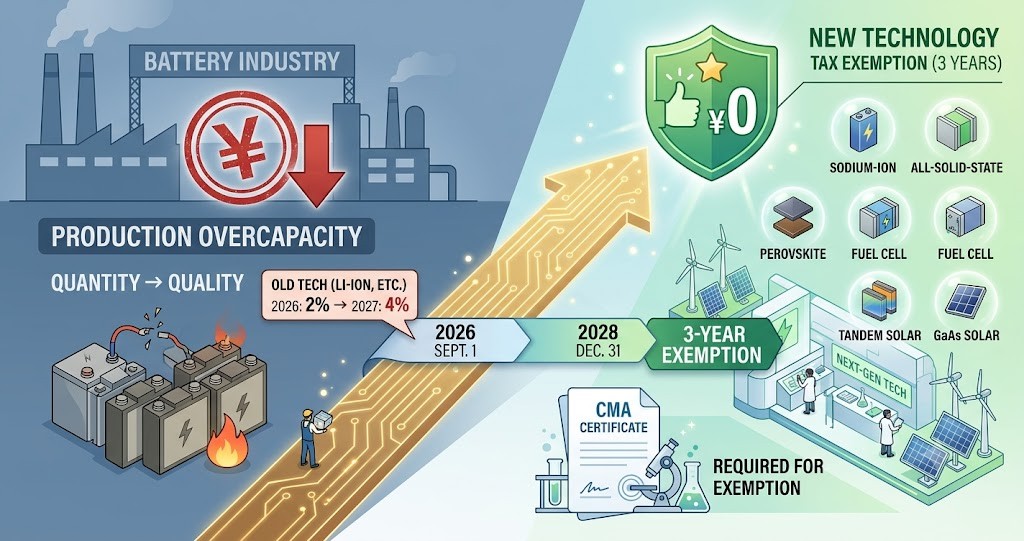
中国財政部などの3部門が発表した電池への消費税課税の再開は、中国の電池産業が「量から質」へと転換する重要な節目となります。この政策は一見すると業界への打撃に思えますが、詳細な分析からは大手企業への影響が限定的であること、そして次世代技術への強力な後押しとなる意図が見えてきます。
本記事の要点に、業界の背景や新技術の現状といった関連情報を付け加えて分かりやすくまとめました。
1. 政策の概要と課税スケジュール
中国で長年続いていた電池への広範な免税措置が終了し、2026年9月から段階的に消費税が課税されます。ただし、産業への急激なショックを避けるため、品目ごとに段階的な税率引き上げが設定されています。
| 対象品目 | 2026年9月1日〜 | 2027年9月1日〜 | 備考 |
| リチウムイオン蓄電池、ニッケル水素蓄電池、無水銀一次電池など | 税率 2% | 税率 4% | 業界の主力製品が対象 |
| 太陽光発電用電池 | 免税 | 税率 2% (2027年4月〜) 税率 4% (2028年4月〜) | 課税スケジュールが緩やか |
【注目】新技術には3年間の免税措置
2026年9月1日から2028年12月31日まで、以下の次世代技術は消費税が免除されます。
- ナトリウムイオン電池、全固体電池、燃料電池
- ペロブスカイト電池、タンデム型電池、ガリウムヒ素電池(太陽光関連)
- ※制度悪用を防ぐため、CMA認定機関の検査報告書取得が必須。
2. 大手企業(寧徳時代など)への影響が限定的な理由
ゴールドマン・サックスやJPモルガンなどの投資銀行は、最大手である寧徳時代(CATL)などのトップ企業への影響は極めて小さいと評価しています。
- 輸出は免税の見通し: 消費税は中国国内での流通が対象となるため、海外売上高比率が30%を超える寧徳時代など、グローバル展開する企業は打撃を抑えられます。
- 圧倒的な利益バッファー: 寧徳時代の2025年の単位当たり純利益は109元/kWhであり、二線級メーカー(8〜41元/kWh)を大きく引き離しています。4%の課税(約24元/kWhのコスト増に相当)を吸収する余力が十分にあります。
- 強い価格交渉力: 高級車種(Bセグメント以上)への採用が多いため、下流の自動車メーカーへコストを転嫁しやすい立場にあります。
業界への影響: 中国国内市場のみに依存し、収益性の低い中小・二線級の電池メーカーはより厳しい淘汰に直面することになり、業界の首位集中がさらに加速する見通しです。
3. 最終製品への影響:EVとエネルギー貯蔵(ESS)の差
課税が100%価格に転嫁された場合でも、製品の性質によって影響度には大きな差が出ます。
- 電気自動車(EV):影響は極めて限定的(1%未満)
- 吉利星願:約494元の影響(車両価格の約0.8%)
- テスラ Model Y:約1025元の影響(車両価格の約0.4%)
- 高級EVほど影響を感じにくく、消費者の購買意欲をそぐレベルではありません。
- エネルギー貯蔵(ESS)プロジェクト:影響は大(IRRが0.3〜1ポイント低下)
- 投資収益率(IRR)に極めて敏感な分野であるため、コスト増はプロジェクトの投資判断に直結します。これにより、国内のESS需要が一時的に抑制される可能性があります。
4. 【関連情報】なぜ今、中国政府は課税に踏み切ったのか?
今回の政策の背景には、中国のEV・電池産業が抱える「過剰生産能力(キャパシティ過剰)」と「過当競争(内巻)」の抑制というマクロ経済的な狙いがあります。
背景1:低価格競争からの脱却
中国の電池業界は、急激な設備投資によって供給過剰に陥り、価格破壊が進んでいました。一律の免税を廃止して成熟技術(リチウムイオンなど)に課税することで、単なる規模拡大による薄利多売のビジネスモデルを抑制し、技術革新へ投資を向かわせる狙いがあります。
背景2:次世代電池の商業化を加速
リチウムイオン電池に4%の消費税が課されることで、これまでコスト面で不利だったナトリウムイオン電池や、次世代の主役とされる全固体電池の相対的な経済性が向上します。3年間の免税措置は、これらの新技術が初期のハイコストを乗り越え、早期に量産化・市場普及するための強力な呼び水となります(例:ナトリウムイオン電池の普及により、集電体に使うアルミ箔などの材料需要も高まる見込みです)。
5. 今後の投資ロジックと注目分野
短期的には財務諸表の「税金及び附加」が増加し利益を圧迫するリスクがありますが、中長期的には優良企業が生き残る健全な市場環境が整います。
- 中流材料の技術革新: AI需要で伸びる高周波・高速対応の超低粗度銅箔(徳福科技、銅冠銅箔など)や、ナトリウムイオン電池化で恩恵を受けるアルミ箔(鼎勝新材など)に注目が集まっています。
- グローバル・リーダー: 海外売上比率が高く、技術主導で動ける寧徳時代や比亜迪(BYD)の優位性は、この税制変更によってむしろ揺るぎないものになるとみられています。
出典:https://finance.biggo.jp/news/59ef463a-7e34-4c59-85d4-7f1a8b30fbcc
[China Battery Tax Policy Change] Lithium-Ion Batteries Taxed up to 4%, Sodium-Ion and All-Solid-State Batteries to be Exempt
The resumption of the consumption tax on batteries announced by three Chinese government departments, including the Ministry of Finance, marks a crucial milestone in the transformation of China’s battery industry from “quantity to quality.” While this policy may at first glance appear to be a blow to the industry, detailed analysis reveals that its impact on major enterprises will be limited, and its clear intent is to provide a powerful boost to next-generation technologies. This report provides a clear, comprehensive summary of the key points of the policy, supplemented with relevant context such as industry background and the current state of new technologies.
1. Policy Overview and Taxation Schedule
China’s long-standing broad tax exemption for batteries is coming to an end, with a consumption tax to be introduced phased-in starting September 2026. However, to avoid a sudden shock to the industry, staggered tax rate increases have been established for each product category.
- Lithium-ion storage batteries, Nickel-metal hydride storage batteries, Mercury-free primary batteries, etc.
- From September 1, 2026: Tax Rate 2%
- From September 1, 2027: Tax Rate 4%
- Remarks: Applies to the industry’s mainstream products.
- Solar cells
- From September 1, 2026: Exempt
- From April 2027: Tax Rate 2%
- From April 2028: Tax Rate 4%
- Remarks: The taxation schedule is relatively gradual.
[Key Focus] 3-Year Tax Exemption for New Technologies From September 1, 2026, to December 31, 2028, the following next-generation technologies will be entirely exempt from the consumption tax:
- Sodium-ion batteries, All-solid-state batteries, and Fuel cells.
- Perovskite solar cells, Tandem solar cells, and Gallium arsenide solar cells.
- Note: To prevent abuse of the system, companies must obtain an inspection report issued by a CMA-certified testing institution before their initial declaration.
2. Reasons for Limited Impact on Major Companies (CATL, etc.)
Investment banks such as Goldman Sachs and JPMorgan assess that the impact on top-tier companies like the market leader CATL will be extremely small, supported by three distinct advantages:
- Exports are Expected to be Exempt: Since the consumption tax targets products distributed within domestic China, companies with global operations—such as CATL, whose overseas sales exceed 30%—can significantly mitigate the impact.
- Substantial Profit Buffer: CATL’s net profit per unit in 2025 stood at 109 RMB/kWh, far outpacing second-tier manufacturers who range between 8 and 41 RMB/kWh. CATL possesses ample financial capacity to absorb the 4% tax, which equates to a cost increase of approximately 24 RMB/kWh.
- Strong Pricing Power: Due to its high adoption rate in premium vehicle models (B-segment and above), CATL is in an advantageous position to pass costs downstream to automakers if necessary.
- Industry-wide Impact: Low-profit, small-to-medium, and second-tier battery manufacturers that rely solely on the Chinese domestic market will face severe consolidation, which is expected to further accelerate market concentration among top leaders.
3. Impact on End Products: EVs vs. Energy Storage Systems (ESS)
Even if the tax burden is 100% passed through to end prices, the level of impact varies drastically depending on the nature of the application:
- Electric Vehicles (EVs): Extremely Limited Impact (Less than 1%)
- Geely Xingyuan: Impact of approx. 494 RMB (approx. 0.8% of the vehicle price).
- Tesla Model Y: Impact of approx. 1025 RMB (approx. 0.4% of the vehicle price).
- Premium EVs will barely feel the change, meaning it is unlikely to dampen consumer buying intent.
- Energy Storage System (ESS) Projects: High Impact (IRR drops by 0.3 to 1 percentage point)
- Because the ESS sector is highly sensitive to the Internal Rate of Return (IRR), any cost increase directly influences investment decisions. This could temporarily suppress domestic Chinese ESS demand.
4. Contextual Analysis: Why Did the Chinese Government Act Now?
The macroeconomic objective behind this policy change is to curb the “overcapacity” and “hyper-competition” (neijuan) currently plaguing China’s EV and battery industries.
- Background 1: Moving Away from Low-Price Competition Driven by aggressive capital expenditure, China’s battery sector suffered from severe oversupply, triggering intense price wars. By abolishing the flat tax exemption and taxing mature technologies like lithium-ion, the government aims to suppress low-margin, high-volume business models focused purely on capacity expansion, redirecting investments toward technological innovation.
- Background 2: Accelerating the Commercialization of Next-Gen Batteries Imposing a 4% consumption tax on lithium-ion batteries improves the relative economic viability of sodium-ion batteries and all-solid-state batteries, which previously faced cost disadvantages. The three-year tax exemption acts as a powerful catalyst for these new technologies to overcome high initial manufacturing costs, accelerating mass production and early market penetration. For example, the adoption of sodium-ion batteries is expected to boost demand for materials like aluminum foil used in current collectors.
5. Future Investment Logic and Key Sectors
In the short term, this tax will appear under “Taxes and Surcharges” on financial statements, directly compressing net profits. In the medium-to-long term, however, it will foster a healthier market environment where resilient, premium companies thrive.
- Innovation in Midstream Materials: Attention is turning toward ultra-low profile copper foil for high-frequency, high-speed applications driven by AI demand (e.g., Defu Technology, Tongguan Copper Foil), as well as aluminum foil, which benefits directly from sodium-ion battery adoption (e.g., Dingsheng New Materials).
- Global Leaders: The competitive edge of companies like CATL and BYD—which boast high overseas sales ratios and lead through technology—is expected to become even more secure as a result of this tax adjustment.

コメント