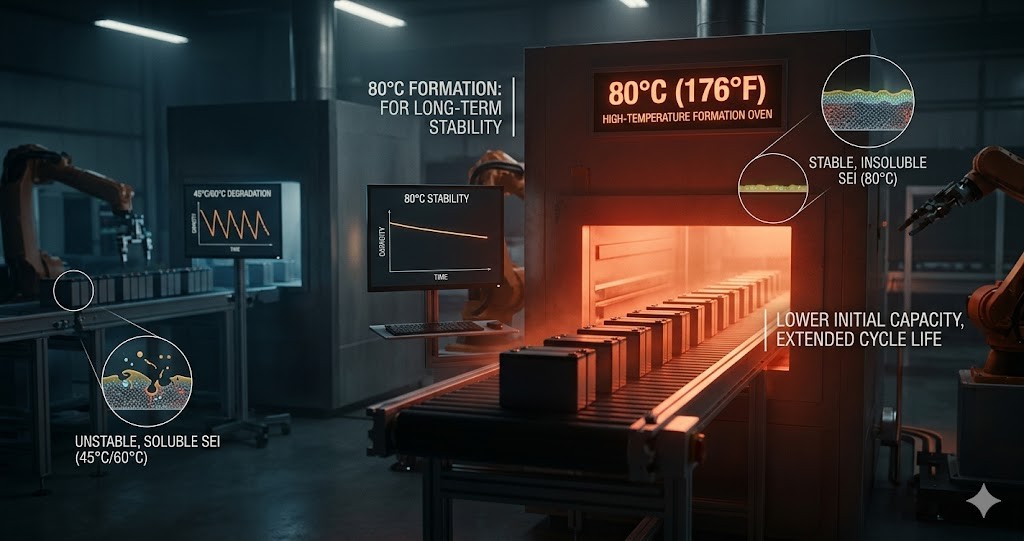
リチウムイオン電池の製造工程における「高温化成サイクル」は、電池の性能と寿命を決定づける極めて重要なステップです。本研究では、45℃、60℃、80℃の3つの異なる温度で化成プロセスを行い、その後の電池特性への影響を詳細に分析しました。
以下に、リチウムイオン電池の高温化成サイクルにおける利点と欠点、およびその背景メカニズムをまとめます。
- 高温化成サイクル(80°C)の主な利点と欠点
- 形成プロセスと保護層(SEI/CEI)のメカニズム
- 劣化モード解析と電解質分析(TEA/GC-MS)
- 結論
- Effects of High-Temperature Formation Cycles (80°C) on SEI Stability and Cycle Life in Lithium-Ion Batteries
高温化成サイクル(80°C)の主な利点と欠点
高温(80℃)での化成は、初期の容量を犠牲にする一方で、長期的な安定性を飛躍的に向上させるというトレードオフの関係にあります。
1. 主な利点(Advantages)
- 長期サイクル寿命の向上: 高温で化成されたセルは、充放電を繰り返した際の容量劣化が非常に緩やかで、寿命が大幅に延びます。
- 抵抗増加の抑制: 劣化が進んでも抵抗(特にパルス抵抗)の増加が低く抑えられ、高い出力を維持しやすくなります。
- 電解質の安定化(エステル交換反応の抑制): 高温化成中に発生する二酸化炭素(CO2)が、電解質溶媒(EMC)の変質(エステル交換反応)を阻害し、バルク電解質の組成を健全に保ちます。
- 安定した保護層(SEI)の形成: 80℃では溶解しにくい強固なSEI(固体電解質界面)が形成され、低温化成で見られるような「SEI成分の溶解に伴う劣化加速」が起こりません。
2. 主な欠点(Disadvantages)
- 初期容量の低下: 化成プロセス中にリチウム蓄積量損失(LLI)と正極活物質の損失(LAM)が大きくなるため、製造直後の電池容量は低温形成時よりも少なくなります。
- 活物質の不動態化: 高温によりセパレータが電極に付着するなどの現象が見られ、一部の活物質が反応に寄与できなくなるリスクがあります。
- 製造コストの課題: 80℃という高温を維持するための設備エネルギーや、部材(セパレータ等)の耐熱性確保が必要となります。
形成プロセスと保護層(SEI/CEI)のメカニズム
電池の初回充放電(化成)時に、電極表面には電解液の分解による保護層が形成されます。
温度によるSEI特性の違い
- 45℃・60℃(低温化成):
- 形成されるSEIの一部に可溶性成分(オリゴマー炭化水素など)が含まれます。
- 高レート(1.5C)での使用中にこれらの成分が電解液に溶け出し、SEIが不安定になります。
- これにより、局所的なリチウム析出(めっき)が起こりやすくなり、容量が急激に低下する「のこぎり歯状」の劣化軌跡を描きます。
- 80℃(高温化成):
- 不溶性の高い、化学的に安定したSEIが形成されます。
- 電解液への溶け出しがないため、高レート使用時も保護機能が維持され、リチウムの損失(LLI)が抑制されます。
劣化モード解析と電解質分析(TEA/GC-MS)
研究では、目に見えない内部変化を捉えるために高度な分析手法が用いられました。
電解質組成の検証
- GC-MS(ガスクロマトグラフィー質量分析): 45℃/60℃で化成した電解液からは、エステル交換反応の産物(DMCやDEC)と、溶解したSEI成分であるOHC(オリゴマー炭化水素)が検出されましたが、80℃ではこれらがほとんど見られませんでした。
- TEA(熱電解質分析): 電解質の融解特性を非破壊で測定する手法です。80℃化成のセルは、充填直後の電解質に近い融解挙動を示し、電解質の劣化が少ないことが証明されました。
劣化の進行パターン
| 化成温度 | 初期容量 | サイクル安定性 | 特徴的な劣化挙動 |
| 45℃ / 60℃ | 高い | 低い | 低レートサイクル時に容量が一時回復する「のこぎり歯状」劣化 |
| 80℃ | 低い | 非常に高い | 安定した容量維持と低い抵抗増加 |
結論
リチウムイオン電池の化成プロセスを80℃という高温で行うことは、「初期の数パーセントの容量を犠牲にして、数倍のサイクル寿命と安定性を手に入れる」ための極めて有効な戦略です。
特に、電解液に添加剤(VCやFECなど)を含まないベースラインの組成において、高温化成が副次的に生成するCO2が、電解質の変質を防ぐ「天然の抑制剤」として機能する点は重要な発見です。今後、急速充電が求められる電気自動車(EV)や長寿命が必要なグリッドストレージにおいて、最適な化成プロトコルの設計指針となるでしょう。
出典:https://pubs.rsc.org/en/content/articlelanding/2026/eb/d5eb00218d
Effects of High-Temperature Formation Cycles (80°C) on SEI Stability and Cycle Life in Lithium-Ion Batteries
The “high-temperature formation cycle” in the lithium-ion battery (LIB) manufacturing process is a critical step that determines battery performance and longevity. In this study, the formation process was conducted at three different temperatures—45°C, 60°C, and 80°C—and the subsequent impact on battery characteristics was analyzed in detail.
The following sections summarize the advantages, disadvantages, and underlying mechanisms of high-temperature formation cycles in LIBs.
Main Advantages and Disadvantages of High-Temperature Formation (80°C)
Formation at a high temperature (80°C) involves a trade-off: it sacrifices initial capacity in exchange for a dramatic improvement in long-term stability.
1. Advantages
- Enhanced Long-Term Cycle Life: Cells formed at high temperatures exhibit very gradual capacity decay during repeated charge-discharge cycles, significantly extending their service life.
- Suppression of Resistance Growth: Even as degradation progresses, the increase in resistance (particularly pulse resistance) remains low, making it easier to maintain high power output.
- Electrolyte Stabilization (Inhibition of Transesterification): Carbon dioxide (CO2) generated during high-temperature formation inhibits the degradation (transesterification) of the electrolyte solvent (EMC), preserving the health of the bulk electrolyte composition.
- Formation of a Stable Protective Layer (SEI): At 80°C, a robust Solid Electrolyte Interphase (SEI) that is resistant to dissolution is formed. This prevents the “accelerated degradation due to SEI component dissolution” typically observed in low-temperature formation.
2. Disadvantages
- Reduction in Initial Capacity: Due to increased Loss of Lithium Inventory (LLI) and Loss of Active Material (LAM) during the formation process, the initial capacity is lower than that of cells formed at lower temperatures.
- Passivation of Active Materials: High temperatures may cause phenomena such as the separator adhering to the electrodes, posing a risk that some active materials can no longer contribute to the electrochemical reaction.
- Manufacturing Cost Challenges: Maintaining a high temperature of 80°C requires additional energy for facilities and necessitates heat-resistant components (e.g., separators).
Mechanism of the Formation Process and Protective Layers (SEI/CEI)
During the initial charge-discharge (formation) of the battery, a protective layer is formed on the electrode surface through the decomposition of the electrolyte.
Differences in SEI Characteristics by Temperature
- 45°C / 60°C (Low-Temperature Formation):
- The resulting SEI contains soluble components such as oligomeric hydrocarbons (OHC).
- During high-rate use (1.5C), these components dissolve into the electrolyte, making the SEI unstable.
- This triggers localized lithium plating, leading to a “sawtooth” degradation trajectory where capacity drops sharply.
- 80°C (High-Temperature Formation):
- A chemically stable SEI with high insolubility is formed.
- Since there is no dissolution into the electrolyte, the protective function is maintained even during high-rate use, suppressing LLI.
Degradation Mode Analysis and Electrolyte Analysis (TEA / GC-MS)
Advanced analytical methods were employed to capture invisible internal changes.
- Verification of Electrolyte Composition (GC-MS): In electrolytes formed at 45°C/60°C, products of transesterification (DMC, DEC) and dissolved SEI components (OHC) were detected. In contrast, these were virtually absent in the 80°C samples.
- Thermal Electrolyte Analysis (TEA): This non-destructive method measures the melting characteristics of the electrolyte. The 80°C formation cells showed melting behavior close to that of freshly filled electrolyte, proving minimal degradation.
Degradation Patterns
| Formation Temperature | Initial Capacity | Cycle Stability | Characteristic Degradation Behavior |
| 45°C / 60°C | High | Low | “Sawtooth” degradation where capacity temporarily recovers during low-rate cycles. |
| 80°C | Low | Very High | Stable capacity retention and low resistance growth. |
Conclusion
Conducting the formation process of lithium-ion batteries at a high temperature of 80°C is an extremely effective strategy to “trade a few percent of initial capacity for a several-fold increase in cycle life and stability.”
Particularly in baseline compositions without additives (such as VC or FEC), the discovery that CO2—generated as a byproduct of high-temperature formation—acts as a “natural inhibitor” against electrolyte degradation is significant. These findings will serve as design guidelines for optimizing formation protocols in Electric Vehicles (EVs) requiring fast charging and grid storage requiring long-term reliability.


コメント