現代のモビリティおよびエネルギー貯蔵の基盤であるリチウムイオン電池は、リチウムやコバルトといった特定金属の「資源偏在性」「サプライチェーンの脆弱性」「価格高騰」という構造的リスクを抱えています。これに対し、地殻中に豊富に存在し、安価(リチウムの約1/10とも言われる)なナトリウム(Na)を用いた電池は、ポスト・リチウムの筆頭候補です。
現在、一部で実用化が始まっている「ナトリウムイオン電池(負極にハードカーボン等を使用)」に対し、「ナトリウム金属電池」は負極に金属ナトリウムを直接使用するため、圧倒的に高いエネルギー密度(理論容量:1,166 mAh/g)を達成できるという大きなメリットがあります。しかし、液体電解質を用いると、充電時にナトリウムが樹枝状に結晶化する「デンドライト」が発生し、短絡(ショート)や発火を招くため、実用化は困難とされてきました。
この安全性を劇的に高めるアプローチとして期待されるのが準固体電解質(QSE)ですが、従来のQSEには「固くするとイオンが通りにくくなり、充電速度や寿命が低下する」という深刻なトレードオフ(ジレンマ)がありました。東南大学が今回発表した「二重インターロック設計」は、この長年の課題を分子レベルの工夫で一挙に解決した画期的なブレイクスルーです。
技術のエッセンスと関連情報
提供された記事の核となる技術データと、それを補完する物理化学的メカニズム・関連情報を整理しました。
1. 課題解決の核心:「二重インターロック設計」のメカニズム
従来、電解質をゲル・固体化するとアニオン(陰イオン)主導の伝導になりやすく、カチオンであるナトリウムイオン(Na+)の動きが阻害されていました。本研究では、カチオン塩であるスズイオン(Sn2+)と、アニオン塩であるジフルオロオキサラトホウ酸(DFOB–)の相反する性質を巧妙に連動させています。
- バルク内(電解質内部)の高速輸送: DFOB–が優先的にNa+と結合の座を奪い合う(キレート・配位の制御)ことで、Na+がポリマー鎖にトラップされるのを防ぎ、自由な移動を可能にしました。
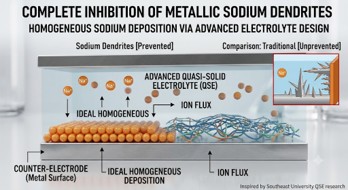
- 負極界面の安定化(対デンドライト): LUMO準位(電子を受け取りやすいエネルギー準位)が低いSn2+が負極(金属Na)側で優先的に還元され、Na-Sn(ナトリウム・スズ)ハイブリッド合金層を形成。これが強固なSEI(固体電解質界面)として機能し、局部的な電界集中を防ぐため、デンドライトの発生が根本的に抑制されます。
- 正極界面の安定化(対高電圧): HOMO準位(電子を放出しやすいエネルギー準位)が高いDFOB–が正極側で優先的に酸化され、わずか 14 nm の極薄かつ緻密なCEI(正極電解質界面)を形成。高電圧下での電解質の分解を防ぎます。
2. 従来技術との性能比較(関連データ補足)
今回のQSEが達成した数値は、従来の液体電解質や一般的なポリマー電解質の限界を大きく凌駕しています。
| 評価指標 | 従来のQSE / 液体電解質 | 本研究の新型QSE | 補足・技術的意味 |
| Na+ 輸率 | 0.4 ~ 0.7 (液体でも低め) | 0.94 | 1.0に近いほどNa+だけが効率よく動き、濃度分極(イオンの偏り)が起きない。 |
| 拡散係数 | 液体電解質の標準値を 1 とした場合 | 液体の6倍 (16.8 AA2 ns-1) | 固体状でありながら、液体よりもはるかに速くイオンが動く。 |
| イオン伝導率 | 固体・準固体では実用下限以下が多い | 1.3 mS/cm | 室温で作動させるための実用ライン (1 mS/cm以上)をクリア。 |
| 機械的強度 | ゲル状で脆弱 | 8.5 kPa(耐突き刺し強度) | デンドライトの物理的な貫通を防ぐ十分なタフさ。 |
3. 電池セル試験における実証結果
正極に高電位・高安定なリン酸バナジウムナトリウム(Na3V2(PO4)3, 略称NVP)を組み合わせたフルセル、および対称セルでの実績は以下の通りです。
- 超急速充電(15C): 約4分での満充電に相当する過酷なレートで、80.1 mAh/gの高容量を維持。
- 長寿命(3C): 実用的な充放電レートにおいて、2000サイクル後も容量維持率90%を達成。
- 長期安定性(対称セル): 電流密度 0.1 mA/cm2 にて、6000時間(約8ヶ月)にわたりデンドライトを発生させずに安定作動(電圧ブレ 0.1 V)。
- 柔軟性の実証: 4 × 5 cmのパウチセルを試作し、スマートフォン駆動および折り曲げ耐性を確認。
今後の展望と商業化への課題
今回の発見は、準固体ナトリウム金属電池を「基礎研究」から「産業適用」のフェーズへ引き上げる重要な一歩ですが、実用化(EVや定置型蓄電池など)に向けてはまだいくつかのハードルが存在します。
- 製造プロセスのスケールアップ(量産化): 「二段階」の重合・反応制御(Sn2+による重合開始とDFOB–による遅延)を、大面積のロール・トゥ・ロール方式や大型パウチセルの製造ラインにおいて、いかに欠陥(ボイドや不均一性)なく再現できるかが焦点となります。
- さらなる高容量正極への展開:今回は安定性の高いNVP(リン酸塩系)が使われましたが、さらなる高エネルギー密度化(リチウムイオン電池超え)を狙うには、より理論容量の大きい層状酸化物系正極や、変換型正極(硫黄など)との組み合わせにおいて、このQSE(特にCEI層)が長期的に耐え得るかの検証が必要です。
- サプライチェーンの構築:ナトリウム自体は安価ですが、添加するSn2+塩やDFOB–アニオンなどの専門化学物質を、低コストかつ高純度で大量調達できる供給網の整備が、最終的なセルコストを左右することになります。
本研究が示した「相反する性質(バルク伝導と界面安定)を二つの塩の相互作用で同時解決する」という二重インターロックの思想は、今後の次世代固体電池開発における新たな標準設計(パラダイム)となる可能性を秘めています。
出典:https://xenospectrum.com/ultrafast-charging-sodium-metal-battery/
New Electrolyte Balancing Fast Conduction and Interfacial Stability: Southeast University’s Approach to Suppressing Dendrites in Sodium Metal Batteries
Lithium-ion batteries, the foundation of modern mobility and energy storage, carry structural risks including “geographic concentration of resources,” “supply chain vulnerability,” and “surging costs” of specific metals such as lithium and cobalt. In contrast, batteries utilizing sodium (Na)—which is abundantly available in the Earth’s crust and inexpensive (often said to be about 1/10 the cost of lithium)—are prime candidates for post-lithium technology.
Compared to “sodium-ion batteries” (which use hard carbon or similar materials for the anode) that are currently seeing initial commercialization, “sodium-metal batteries” offer the major advantage of achieving overwhelmingly high energy density (with a theoretical capacity of 1,166 mAh/g) by directly utilizing metallic sodium for the anode. However, when liquid electrolytes are used, sodium crystallizes into needle-like structures called “dendrites” during charging. This causes short circuits and thermal runaway, which has long made commercialization difficult.
Quasi-solid-state electrolytes (QSEs) are expected to be an approach that dramatically enhances safety. However, conventional QSEs suffer from a severe trade-off (dilemma): making the electrolyte solid impedes ion movement, thereby reducing charging speed and cycle life. The “double-interlock design” recently announced by Southeast University is a breakthrough that resolves this long-standing challenge all at once through molecular-level engineering.
Technical Essences and Related Information
Below is a compilation of the core technical data from the reported article, supplemented by the underlying physicochemical mechanisms and contextual information.
1. The Core of the Solution: Mechanism of the “Double-Interlock Design”
Conventionally, gelling or solidifying an electrolyte tends to result in anion-dominated conduction, which impedes the movement of sodium ions (Na+), the cations. This study ingeniously interlocks the conflicting properties of a cation salt, tin ions (Sn2+), and an anion salt, difluoro(oxalato)borate (DFOB-).
- Fast Transport in the Bulk (Inside the Electrolyte): DFOB- preferentially competes with Na+ for binding sites (controlling chelation and coordination). This prevents Na+ from being trapped by polymer chains, allowing it to move freely.
- Anode Interface Stabilization (Against Dendrites): Sn2+, which possesses a low LUMO level (an energy level that easily accepts electrons), is preferentially reduced at the anode (metallic Na) side to form a Na-Sn (sodium-tin) hybrid alloy layer. This functions as a robust SEI (solid electrolyte interface) and homogenizes the local electric field, fundamentally suppressing dendrite formation.
- Cathode Interface Stabilization (Against High Voltage): DFOB-, which possesses a high HOMO level (an energy level that easily donates electrons), is preferentially oxidized at the cathode side, forming an ultra-thin (~14 nm) yet dense CEI (cathode electrolyte interface). This prevents the decomposition of the electrolyte under high voltage.
2. Performance Comparison with Conventional Technologies
The values achieved by this new QSE significantly surpass the limits of conventional liquid electrolytes and typical polymer electrolytes.
| Evaluation Metrics | Conventional QSE / Liquid Electrolyte | The New QSE of This Study | Supplementary / Technical Significance |
| Na+ Transference Number | 0.4 – 0.7 (Low even in liquids) | 0.94 | The closer to 1.0, the more efficiently only Na+ moves, preventing concentration polarization (ion accumulation). |
| Diffusion Coefficient | 1 (Assuming liquid electrolyte standard value as 1) | 6 times that of liquids (16.8 Ų ns⁻¹) | Despite being in a solid state, ions move far faster than in a liquid. |
| Ionic Conductivity | Often below the practical limit in solids/quasi-solids | 1.3 mS/cm | Clears the practical threshold for room-temperature operation (1 mS/cm or higher). |
| Mechanical Strength | Fragile due to gel state | 8.5 kPa (Penetration resistance) | Sufficiently tough to physically block dendrite penetration. |
3. Verification Results in Battery Cell Tests
The performance achieved in full cells combining a highly stable, high-potential sodium vanadium phosphate (Na3V2(PO4)3, abbreviated as NVP) cathode, as well as in symmetric cells, is as follows:
- Ultra-Fast Charging (15C): Maintained a high capacity of 80.1 mAh/g under the harsh condition equivalent to a full charge in about 4 minutes.
- Long Cycle Life (3C): Achieved a capacity retention rate of 90% even after 2,000 cycles at a practical charge-discharge rate.
- Long-Term Stability (Symmetric Cells): Operated stably for 6,000 hours (~8 months) without generating dendrites at a current density of 0.1 mA/cm², keeping cell polarization (voltage fluctuations) at an extremely low level of ~0.1 V.
- Demonstration of Flexibility: Fabricated a prototype 4 × 5 cm pouch cell, verifying its ability to power a smartphone and its resistance to repetitive bending.
Future Outlook and Challenges for Commercialization
While this discovery is a significant step toward lifting quasi-solid-state sodium-metal batteries from “fundamental research” to the “industrial application” phase, several hurdles remain for commercialization (such as for EVs and stationary energy storage systems).
- Scaling Up the Manufacturing Process (Mass Production): The focus will be on how to replicate the “two-step” polymerization and reaction control (initiation by Sn2+ and retardation by DFOB-) without defects (voids or non-uniformity) in large-area roll-to-roll processes or large-scale pouch cell manufacturing lines.
- Application to Higher-Capacity Cathodes: Although the highly stable NVP (phosphate-based) cathode was used this time, achieving even higher energy densities (surpassing lithium-ion batteries) requires verifying whether this QSE (especially the CEI layer) can withstand long-term operation when paired with layered oxide cathodes or conversion-type cathodes (such as sulfur) that offer larger theoretical capacities.
- Supply Chain Establishment: While sodium itself is inexpensive, the final cell cost will depend on establishing a supply chain that can source specialized chemicals, such as the added Sn2+ salts and DFOB- anions, at low cost, high purity, and high volume.
The philosophy of a “double-interlock design”—simultaneously resolving conflicting properties (bulk conduction and interfacial stability) through the interaction of two salts demonstrated in this study—has the potential to become a new standard design paradigm for the future development of next-generation solid-state batteries.


コメント